Showing posts sorted by relevance for query diamondback. Sort by date Show all posts

Wednesday, August 28, 2013

Species Specific: Diamondback Terrapin


    "The diamondback terrapin is a species of turtle native to the brackish coastal
    swamps of the eastern and southern United States.
     It belongs to the monotypic genus, Malaclemys." 

     http://en.wikipedia.org/wiki/Diamondback_terrapin


On a small hill overlooking a salt marsh in Madison CT, there is a species specific example of a stone representation of a Malaclemys Terrapin, also known as the Diamondback Terrapin.
Below, the turtle seemingly basks on the top of a stone row. 
 
Ornate Group Basking
from: http://www.diamondbackterrapin.com/index/index.php/picture/turtle-setup/


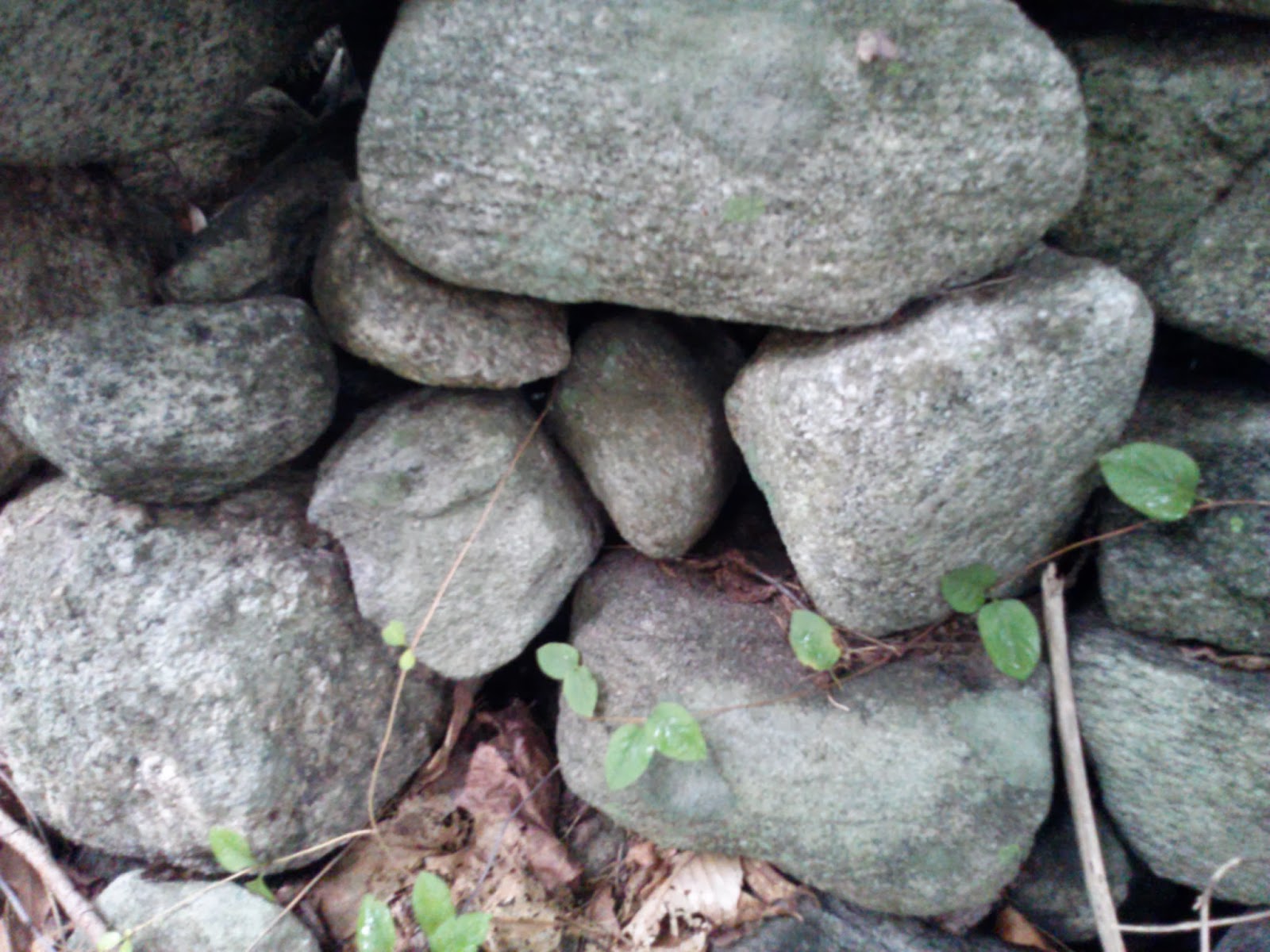
Notice the nuchal notch in the carapace or upper shell, the large head below it...
The forelegs might possibly be a single split humanly enhanced stone. Note the black minerals in the stones that resemble the markings of the terrapin.
(This Diamondback Terrapin appears in this post:


The artistic incorporation of this species specific petroform into a stone row strongly suggests a Native American origin of this "stone concentration."
Other examples of artistic testudinate incorporation: 


Monday, January 13, 2014

Pretending It's the First Day of the New Year...

I thought I might just do one of those "Highlights of 2013:

      My Find of the Year was yet another testudinate "species specific" stone representation/petroform, of a Diamondback Terrapin incorporated into a very beautifully stacked stone row (a very long linear segment of an Indigenous Stone Pile?) at the top of a small hill above a salt marsh in Madison CT, just where you might indeed actually find Malaclemys terrapin.  
http://wakinguponturtleisland.blogspot.com/2013/08/species-specific-diamondback-terrapin.html}
     
You could just call it a Terrapin, since according to Wikipedia: The name "terrapin" is derived from the (Virginia) Algonquian word torope...The name originally was used by early European settlers in North America to describe these brackish-water turtles that inhabited neither freshwater habitats nor the sea." Both Mr. Merriam and Mr. Webster agree that it is an "alteration of earlier torope, from Virginia Algonquian*to·rəpe·w. They also believe the word's First Known Use was in 1613 - but not in Madison since you had to wait for War of 1635 to open up the area to European acquisition.
       The good part it that the Diamondback is in Hammonasset State Park. The bad part is a trail that's planned to stretch to East Haven, on the edge of the former Indian Path Along the Shoreline that is being constructed by robbing the ancient stonework that connected to and perhaps bordered the Path. 
I tell that story here:

 http://wakinguponturtleisland.blogspot.com/2013/08/shoreline-greenway-trail-madison-ct.html

       As well as here, finding perhaps a baby Diamondback Terrapin - or at least another "single stone" rock art turtle, a cobble placed on a "Stones on Boulder" sort of Stone Concentration or Stacked Stone Feature or *(edited on 7/23/2022)* a Káhtôquwuk or Stone Prayer, “invested with prayers for the balance of the universe,” something that is heaped high, ceremonially, religiously, by placing one stone above another stone:


http://wakinguponturtleisland.blogspot.com/2013/08/sgt-part-2.html

And I even continue to drone on: http://wakinguponturtleisland.blogspot.com/2013/08/shoreline-greenway-trail-part-3.html including a photo of this that I always meant to call to to the attention of Mr. badbadpotato - a variation of a table or shelf sort of thing, perhaps:
And my friend DC hooked me up with some Google Images on a post called:
Thanks DC!
There's the new construction looking so bright above, the far more ancient stones hiding under a cover of green, waiting for the LiDAR to show what's left of the fuel breaks of the Indigenous Sacred Landscape Before 1635, when the People cared for the land with prayer and sacred fires in Ceremonies that are long forgotten - but probably very similar to others that are known in other places - just like other stonework in other places... 
I continue on here, seeing either some (eroded with time) human enhancement or just another example of myself exhibiting and recording some delusional pareidolia:
Just when you think you can't take any more, I begin to correct myself as visit the spot for the third time, which  "involved taking the "Bob Cat Trail," the trail left by that little machine that I was pretty certain was borrowing stones from somewhere..."
The Aerial Photo of 1934:
In the comments Someone asked: Could this be an ancient fish trap?
I meant to reply: "I can answer that very quickly: I don't know."

I don't know when I'll get to the next segment of the trail to look more closely - whether I'll have the chance to take some photos of what still exists or just witness it's silent departure.
If you get there first, take some photos before more disappears.

The other highlight was the inclusion of a photo of mine in a book on the Connecticut's Indigenous Peoples by Dr. Lucianne Lavin, who actually labelled it as "turtle-shaped."

     
The above makes me feel some degree of validation - and I don't want to forget a little more, another highlight, the number of sites I've documented that Curtis Hoffman includes on this map of "stone constructions in the eastern seaboard:"

Monday, May 19, 2014

(If It Looks Like a) Duck or Turtle

 If it looks like a duck, and quacks like a duck, we have at least to consider the possibility that we have a small aquatic bird of the family Anatidae on our hands. - Douglas Noel Adams
If the stone or group of stones looks like turtle, and especially a species specific turtle, on what Indigenous People called Turtle Island, we have to at least consider the possibility that we have a Turtle Effigy of most likely Indigenous origin on our hands. - Me 

    I was going to be all sciencey this morning, start writing about patterns of Indigenous Stonework without using the expression “looks like.” It seems that my use of that expression has triggered a few less than flattering comments and criticisms in the past few weeks. I guess it is the most unscientific way to say something.
(The doctor said, “It looks like skin cancer.” So I asked him if he could state that more scientifically.)
      I use photographs to document Observations that I also describe in words. I make these observations with my senses, in particular my sense of sight – or my ophthalmoception, if you want to be truly scientific and confuse your spell-check program. 


"What a Turtle looks like," is okay to say if you are eight years old, but not 58:
(But then again, my six year old grandson is in the minority of people of any age who understands what the word "testudinate" means when I describe an observation of something that resembles a turtle shell.)

If I look at my friend’s photo of an unusual stone and I find it reminds me of a species specific turtle, I’m going to blurt out: “It looks like a stinkpot turtle!” And steal an image of one somewhere and do this so that you can see that I said what I said because that's what it looks like:

(Someone asks, "Is that red star Mars or the Dog Star?"
 I look at the star and say, "Looks like Mars."
"How do you know?" the first person asks.
 "Well, because it looks like Mars," I say.)

      If I climb up a hill side where almost every single stone seems to have been humanly enhanced or purposely placed and realize an outcrop has been enhanced to look like a very similar sort of species specific turtle, I’m probably going to say, “It looks like another Stinkpot!”
(or another kind of turtle with a long, wide neck and a low domed upper shell)
(and two eyes)

I'll do the same for the diamondback terrapin; if I find these stones placed on this row of stones above a salt marsh where diamondback terrapins live, of course I'm going to say, "It looks like a Malaclemys or diamondback terrapin."


Thursday, November 12, 2020

Why a Turtle (Again)??


 The Significance of a Stone Turtle

Or a Turtle Made of Stones

Depends on:

Which Turtle in Which Place?


Frank Speck tells us what he found out about turtles 100 years ago or so,

More recently Ed Lenik tells us this and that about turtles

  – and admits he only has some “Educated Guesses.”

We colleagues all know by now he’s not the only one to say,

“Only the person who created it knows for sure.”


Could be a symbol of the Earth, the first animal, the first clan,

  Could be a symbol of Longevity, Patience, Perseverance or

     Fertility (a womb), Turtle Island (a Homeland), a Hunting Ground

And as Guardian Spirits of Paths and Trails or of Specific Places

When found as a carving on an outcrop – or the shape of an outcrop

Or the shape of a boulder

 Or as heaped up stones resembling the shape of a Turtle,

 Unmistakable head and shell as well as many other details

That may suggest what species the Stone Turtle might be…


My first Turtle was a Box Turtle, the Grandfather Turtle

              – or is it Grandmother Turtle??  

At the edge of a Late Woodland or Contact Era Village  

   Where the Mast Forest began (where the “stone walls” disappear),

Perhaps the place to pray, the place to start the ground fire under the big trees,

 By the Creation Turtle seems a good place to begin

A Ceremony for Balance and World Renewal for that specific place,

Crowned by a Cathedral ceiling of oak and chestnut, hickory and walnut…

My second Turtle was uncovered by chickens scratching,

At what seemed to be Farm Junk Piles

Surprised while gathering kindling

By a low domed snapping turtle perhaps

And 20 years or so later I was surprised to see

Another in the retaining wall where I’ve lived for 40 years


Where my wife and I stood in the yard to take our wedding vows,


Just below that second turtle, surrounded by other smaller turtles,

Perhaps graves, perhaps memorials, perhaps signifying Turtle Clan

(Like that Turtle down in Judges Woods in another Memorial)

I just don’t really know…


 Above: Judges Woods. Below: A Diamondback Terrapin Effigy above the Hammonasset Salt Marsh, "Hunting Grounds," like Ed Lenik says, not for a Turtle Clan, but for the Diamondback Terrapin, if you are looking for the simplest answer as to "Why this particular Turtle in this particular place…"


 As a modern day observer of Stone Turtles

Or Turtles Made of Stone

The main significance is that the Stone Turtle speaks, saying

“Indigenous hands were on these stones,

Placing them just so in order to resemble Turtles…”


Tuesday, February 11, 2014

Wave or a Crawl?

(More Hints at Identifying Indigenous Stonework)


      I guess it’s more of a crawl than a wave maybe – or is every long segment of rows of stones a Great Serpent, connecting the underworld to the upperworld, “suggestive of flowing water or the zig-zag of lightning,” like the Tewa say? {http://wakinguponturtleisland.blogspot.com/2014/02/great-serpents-and-sometimes-serpentine.html}

Look more carefully and closer to see if any of those stones artistically placed as if to more closely resemble animal heads important to the local Indigenous People?

       You might begin to wonder, "Has this one been sculpted, pecked and polished to maybe resemble a bear or some other animal face?"

This crawl or wave is near a certain Diamondback Terrapin Petroform:

       And halfway between the two maybe another, perhaps made by someone with a lesser degree of artistic ability, but still recognizable as a Turtle, incorporated into this row of stones:
Another on another row of stones on the little hill:
I wish I had a better name for this repeated pattern - or any clue at all what to call this one:
(All are my photos, Madison CT 2013)