Tuesday, April 01, 2008

Tree of Peace and Treaty Trees

In a previous post, I mentioned something about these big oak trees:

I know you’ve heard of “Bury the Hatchet,” but did you know the rest of the expression is: “And Plant the Tree of Peace?”

I googled “The Tree of Peace” and got this:
“In an ancient time, the Haudenosaunee were ruled by warfare and anarchy, and people lived in fear and hunger, preyed upon by powerful warriors and tyrants. One day, a white stone carried a man, born of a virgin, across Onondaga Lake to announce The Good News of Peace had come, and killing and violence would end. "Peace," he said, "is the desire of the Holder of the Heavens. Peace comes when people adopt the Creator's Mind, which is Reason." For years The Peacemaker traveled teaching the Path of Peace—that "all people love one another and live together in peace."
One by one he convinced each person, village and nation to accept his teaching. Hiawatha, an Onondaga, was his spokesman. At last, all the people gathered Onondaga Lake for the first Grand Council of the United Nations. There, Peacemaker transmitted The Great Law of Peace—instructions to form a society and government based on liberty, dignity and harmony. The White Pine—with five needles clasped as one—became symbol of Five Nations united as one Confederacy.
Peacemaker uprooted a White Pine, exposing a deep cavern with a river at its bottom. He told warriors to cast weapons into this hole and the river carried the tools of war deep in the Earth.

Replanting the White Pine, The Peacemaker said, "To bury the hatchet signifies the end of war, killing and violence."


"The Tree of Peace," Peacemaker explained, "has four white roots extending to Earth's four corners. Anyone who desires peace can follow the roots to their source and find shelter under The Great Tree."


I didn’t get the many results I expected, googling the phrase, until I thought about “Treaty Tree,” and tried those as keywords - and got a ton of stuff, since I remembered it as being a wide spread thing across the country.

There exist many “Treaty Trees” all over the place that were ref’s I could use, the mo’ refs, the mo’ better. And then of course the age of the big Nonnewaug Trees could be Treaty Trees that fit the time of the two “land purchases” of the area - that were really treaties to share the land here rather than actually sell it – Indian way, the Earth owns you, not the other way around. It may be why there’s two trees, since there was an original and a confirmatory “deed” to the 4th or Nonnewaug Purchase.


It’s interesting to note Nonnewaug's signature and how it changes from the one on this previous “deed.” Could there be some alcohol involved here that accounts for the change in the signature?


How about this one for the “confirmatory purchase” that covered “all previous purchases”??


Well, that’s something to think about, isn’t it?
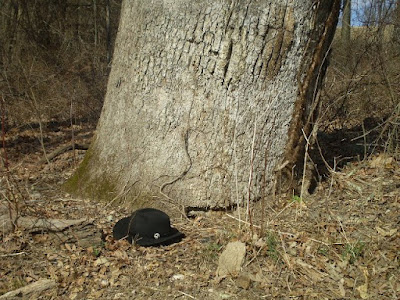
Stones (and a hat) at the base of the Trees:


Wednesday, March 26, 2008

Chestnut Rails by the Other Side of 61

Continuing up the hill, I followed a linear row...

...but it turned into a zigzag.


Then I looked at some mounds, the ones in my last post...
Then I noticed, back toward the power lines, some chestnut rails, on stones, but without the "thrown up against a zigzag- rail fence" stones that are supposed to form the zigzag stone walls...

Clearly someone wasn't following directions...

By the Highway, by the Power Lines


I never noticed this one before, by the highway where the power lines cross it...


Farther uphill, along the southside of the power lines...


(Nothing like a turtle emerging from the ground, eh?)


Tuesday, March 25, 2008

End Stones


Something I see a lot is a large "End Stone," along many stone rows, very often where a linear dryland row gets close to water.


This is an end stone at the "easiest to get to party site," the row taken apart to build a fire circle into which people feel obligated to throw beer cans and smash bottles, chop down living trees - or carve words into them- strew garbage, toilet paper and otherwise vandalise a well known Sacred Site - on Town property.


North of the party site, along the stone row, people routinly drive ATVs over this ancient row....


This row connects the Falls to two large oak trees, more about these to come in a future post. I seem to remember measuring the larger oak tree as being 12ft in diameter at chest hieght about 15 years ago...


There's another popular party and trash site where another linear rows ends with another large End Stone...


There's a four foot long carapace stone right along side of the end stone, but again people rob the stones to build fire pits into which the bottles and cans are thrown...


So my Monday walk brought me farther upstream to a place I hadn't been back to in a long time, where I'd forgotten yet another End Stone. This one meets up with a zigzag row that borders the brook's east branch...


The linear row has a slight curve to the end stone, just after being linked to the zigzag row which is to the left in the photo...


I have a series of blurry photos because I forgot my reading glasses and can't see the screen on the camera...


But the big surprise was the beak motif on one of the "point stones" on the zigzag row.


Friday, March 21, 2008

East Hampton continued

Well, I did recieve some photos from East Hampton CT, sent to me from Paul and Diana Marsh.
The whole concept is very new to them, but they've had a sort of a "crash course" in the ideas of the Cultural Landscape from my suggestions to look at the Rock Piles photos and the specific links Peter keeps on the web page.

As a "stone structure seeker," I do see some things I would investigate further and have asked them for some more specific photos of certain things - including what appeared to be pedestled boulders of a testudinate nature that I first saw in local TV news footage, captured in blurriness below. Their photos follow with some "editorial comments/questions" by me...


Wednesday, March 19, 2008

INDIGENOUS POLITICS: FROM NATIVE NEW ENGLAND AND BEYOND

Something I found interesting, podcasts of a radio show from Middletown CT that I got to from the main page of the site:
http://indigenouspolitics.mypodcast.com/

Wednesday, Jan 30, 2008
10-02-07 Oral Histories at Schaghticoke: Trudie Lamb Richmond
(12 downloads)
Download this episode (55 min)
Trudie Lamb Richmond delivers a talk titled, "Oral Histories at Schaghticoke: Shared Stories- Shared Histories-One People." Richmond is an esteemed elder of the Schaghticoke Tribal Nation, and is a renowned a storyteller who has performed at hundreds of festivals. From 1974-1986, she was Assistant Director of American Indians for Development in Meriden, CT, while serving on the Connecticut Indian Affairs Council. In 1987, Connecticut Governor William O'Neill appointed her to a task force on Native American issues. From 1988-1996, she was the Assistant Director for Public Programs, and then the Director of Education, at the Institute for American Indian Studies in Washington, CT. In 2003, she became the Mashantucket Pequot Museum's Director of Public Programs. Original air-date: 10-02-07


http://indigenouspolitics.mypodcast.com/2008/01/100207_Oral_Histories_at_Schaghticoke_Trudie_Lamb_Richmond-76847.html

Sunday, Jan 27, 2008
4-30-07 Native New England Under Seige
(4 downloads)
Download this episode (50 min)
Host J. Kehaulani Kauanui, Ph.D. (Kanaka Maoli) offersan overview of current political issues facing tribal nations in NewEngland and the role of the states in opposing their quest for sovereignrecognition. Original air date: 4-30-07
http://indigenouspolitics.mypodcast.com/2008/01/43007_Native_New_England_Under_Seige-75669.html

Tuesday, March 18, 2008

CT Indian Affairs Commission

Fwd: CT Indian Affairs Commission/HB 5141
Alyssa Mt. Pleasant was kind enough to take time from her busy life to put together a web site that contains information about the proposed commission. You may access it at http://commissiononamericanindianaffairs.pbwiki.com/

The bill language, copies of testimony and a link to Kehaulani's radio program about the bill are contained on the site.

Please take a moment to check out the site, read what's posted, listen to the radio interviews and then, contact your state reps & senators asking if they will co-sponsor the bill. Alyssa even included a link to Project Vote Smart, where you can enter your nine-digit zip code in order to find out who represents you in the CT General Assembly. (THIS IS JUST TOO EASY!!!)

The Environment Committee is expected to vote on the bill today. We were able to get flyers seeking a YES vote into their mailboxes yesterday thanks to Rep. Sharkey.

Also, forward the link above or this entire email to your friends and family. Ask them to support the bill by contacting their elected officials, too.

http://ctnativeamericanaffairs.mypodcast.com/2008/03/Connecticut_American_Indian_Affairs-90513.html

Download this episode (52 min)
Host J. Kehaulani Kauanui examines legislation currently before theConnecticut state Committee on Environment: HR 5141, an ActConcerning a Commission on Native American Indian Affairs.The state of Connecticut already has state commissions such asthe Permanent Commission on the Status of Women, the Latino andPuerto Rican Affairs Commission, and the African-American AffairsCommission. Dozens of states across the United States have NativeAmerican Affairs Commissions, and New England is no exception withthe Maine Indian Tribal-State Commission, the Vermont Commissionon Native American Affairs, and the Massachusetts Commission onIndian Affairs. Given that Connecticut is rapidly earning areputation for its anti-Indian hostility, many people suggest thata Commission could help turn the tide of fear, racism, and ignoranceregarding the state-recognized Native Nations and other NativeAmerican residents, including the increasingly diverse populationof Native Americans from tribes across the country moving herefor employment and educational opportunities. This episode willfeature a range of perspectives on the politics of this proposal ininterviews with L. Mixashawn Rozie (Mahicanu), Mikki Anganstata(Eastern Cherokee), Sherman Paul (Maliseet), Ruth Garby Torres(Schaghticoke Tribal Nation), Trudie Lamb Richmond (Schaghticoke Tribal Nation, and Cedric Woods (Lumbee).

My Country 'Tis of Thy People You're Dying

Buffy Sainte-Marie on Rainbow Quest with Pete Seeger

LYRICS:
Now that your big eyes have finally opened
Now that you're wondering how must they feel
Meaning them that you've chased across America's movie screens
Now that you're wondering how can it be real
That the ones you've called colorful, noble and proud
In your school propaganda
They starve in their splendor
You've asked for my comment I simply will render

My country 'tis of thy people you're dying

Now that the longhouses breed superstition
You force us to send our toddlers away
To your schools where they're taught to despise their traditions
You forbid them their languages, then further say
That American history really began
When Columbus set sail out of Europe, then stress
That the nation of leeches that conquered this land
Are the biggest and bravest and boldest and best
And yet where in your history books is the tale
Of the genocide basic to this country's birth
Of the preachers who lied, how the Bill of Rights failed
How a nation of patriots returned to their earth
And where will it tell of the Liberty Bell
As it rang with a thud
Over Kinzua mud
And of brave Uncle Sam in Alaska this year

My country 'tis of thy people you're dying

Hear how the bargain was made for the West
With her shivering children in zero degrees
Blankets for your land, so the treaties attest
Oh well, blankets for land is a bargain indeed
And the blankets were those Uncle Sam had collected
From smallpox-diseased dying soldiers that day
And the tribes were wiped out and the history books censored
A hundred years of your statesmen have felt it's better this way
And yet a few of the conquered have somehow survived
Their blood runs the redder though genes have paled
From the Gran Canyon's caverns to craven sad hills
The wounded, the losers, the robbed sing their tale
From Los Angeles County to upstate New York
The white nation fattens while others grow lean
Oh the tricked and evicted they know what I mean
My country 'tis of thy people you're dying
The past it just crumbled, the future just threatens
Our life blood shut up in your chemical tanks
And now here you come, bill of sale in your hands
And surprise in your eyes that we're lacking in thanks
For the blessings of civilization you've brought us
The lessons you've taught us, the ruin you've wrought us
Oh see what our trust in America's brought us

My country 'tis of thy people you're dying

Wednesday, March 12, 2008

1491: New Revelations of the Americas Before Columbus


From Wikipedia, the free encyclopedia


1491: New Revelations of the Americas Before Columbus
Author: Charles C. Mann
Publisher: Knopf Publication date: 2005


"1491: New Revelations of the Americas Before Columbus is a 2005 non-fiction book by American author Charles C. Mann about the pre-Columbian Americas. The book argues that there is evidence accumulated over the last several decades suggesting that human populations in the Western Hemisphere - that is, the indigenous peoples of the Americas - were larger in number, had arrived earlier, were more sophisticated culturally, and controlled and shaped the natural landscape to a greater extent than had been previously thought.


An indicative map of the prominent political entities extant in the Western Hemisphere c. 1491 C.E., as presented in 1491.


Book summary:
"The past 140 years have seen scientific revolutions in many fields, including demography, climatology, epidemiology, economics, botany, genetics, image analysis, palynology, molecular biology, and soil science. As new evidence has accumulated, long-standing views about the pre-Columbian world have been challenged and reexamined. Although there is no consensus, and Mann acknowledges controversies, Mann asserts that the general trend among scientists is to acknowledge that
(a) the population levels were probably higher than traditionally believed among scientists and closer to the number estimated by "high counters"; (b) humans probably arrived in the Americas earlier than thought over the course of multiple waves of migration to the New World (not solely by the Bering land bridge over a relatively short period of time);

(c) The level of cultural advancement and settlement range was higher and broader than previously imagined; and
The New World was largely not a wilderness but an environment controlled by humans (mostly with fire).

These three main foci (origins/population, culture, environment) form the basis for three parts of the book.


Introduction:
Mann was inspired to write this book because he was taught in high school that "Indians came across the Bering Strait about 13,000 years ago, that they had so little impact on their environment that even after millennia of habitation the continents remain mostly wilderness." He examines what he terms "Holmberg's mistake", named for the anthropologist Allan R. Holmberg, who lived among the Siriono in the 1940s and came to the conclusion that they were the most "culturally backward peoples" in the world. Mann writes that Holmberg's theory was in fact a mistake, because smallpox and influenza devastated Siriono villages during the 1920s, and the Siriono were the "persecuted survivors of a recently shattered culture."

Part One: Numbers From Nowhere


Mann first tackles New England in the 1600s, and the idea that European technologies were superior to Indian technologies. Guns were a prime example, as they were seen by Indians as nothing more than "noisemakers," and they were difficult to aim. Famous colonist John Smith even noted that "the awful truth...it could not shoot as far as an arrow could fly." Indian technology was actually more impressive, such as the moccasin, which was far more comfortable and sturdy than the boots Europeans wore, and were actually preferred by most of them during that era because its padding offered a much more silent approach to warfare. Canoes are also a prime example that disproves the myth of superior technology of the Europeans. The canoes made by Indians were faster and more maneuverable than any small European boats...


...Mann concludes that Indians were a "keystone species," one that "affects the survival and abundance of many other species." By the time the Europeans arrived and settled in the Americas, the "boss" (Indians) had been almost completely eliminated. Disease ran rampant and killed off the Indians, disrupting their control of the environment. When Indians died, animal populations, such as that of the buffalo grew immensely. "Because they (Europeans) did not burn the land with the same skill and frequency as its previous occupants, the forests grew thicker." The world discovered by Christopher Columbus was “largely an inadvertent European creation.”
Mann concludes with the idea that we must look to the past to right the future. "Native Americans ran the continent as they saw fit. Modern nations must do the same. If they want to return as much of the landscape as possible to its state in 1491, they will have to create the world’s largest gardens."


Monday, March 10, 2008

It's Time to "Wake Up"

I went back to my second post (http://wakinguponturtleisland.blogspot.com/2006/06/little-history-native-peoples_07.html) of “Waking Up on Turtle Island” to “copy and paste” this quote in order to repost it once again.

“Native people’s histories and stories have been told by others – rather dispassionately at times and not always with accuracy. Something is missing when we cannot and do not know our true past. Something is terribly wrong when our past is not accurately recounted,” Trudie Lamb Richmond writes in Enduring Traditions; the Native Peoples of New England, edited by Laurie Weinstein.

And also to repost this from my very first post, explaining why this blog is called “Waking Up on Turtle Island:”
“It's been many years since I woke up to the fact that I live in a special place on Turtle Island.Not that I was actually asleep for a long period of time, but rather I gradually became aware that remnants of ancient stonework was all around me, dismissed as Colonial construction, but really (were actually) part(s of or, more accurately “remnants of,” that remain still to today) of a managed cultural landscape that may be hundreds or thousands of years old.”

To go back to sometime in the 1990s when I first met Trudie, I should add that she mentioned a book she had heard of called “Manitou,” that also suggested that there existed remnants of, as the full title of the book says, “The Sacred Landscape of New England’s Native Civilization.”
I ordered the book since I couldn’t find it in any libraries nearby and got it just in time to take with me on a family camping trip to Burlingame State Park in Rhode Island. It was a life changing experience to read that book in that place – and then to walk trails in the greater Charlestown area, following stone rows of all sorts. In particular I remember following one, inside the park itself, that was a spiral – a motif I’d seen before as petroglyphs and designs on Indian baskets.

The very first page I read in James Mavor and Byron Dix’s “Manitou” also led me to seek out a group they sent acknowledgements to, The New England Antiquities Research Association, or NEARA (http://www.neara.org/ ), which is how I first met Peter Waksman (http://rockpiles.blogspot.com/), who in turn introduced me to Norman Muller at a NEARA conference in Danbury CT.

I was very lucky to say the least to make all these associations.

I was also very relieved to find that other people were seeing the same things as I.

The sad part is that 17 years later for me (and much, much longer for others), the scientific community, for the most part, remains hostile to the idea that there still remains, on “Turtle Island,” an incredible amount of stonework that represents perhaps thousands and thousands of years of remnants of a Sacred Cultural Landscape, some of it hidden but also in plain sight along the scars of the present Cultural Landscape of the last five hundred years.

And I’ll add, “While more and more of it, through ignorance and prejudice, disappears every day.”

While there are some enlightened and courageous individuals doing ground breaking work to combat the bigotry of the scientific community, like Doctors Curtiss Hoffman and Lucianne Lavin for example, I think that the time has come for that community to “Wake Up On Turtle Island,” so to speak.

After all, the empirical evidence is literally “written in stone.”

Friday, March 07, 2008

East Hampton TV News "Capture" Attempt


I did try to capture some of the news video I saved - by using my camera.
It didn't work so well, but the last one (from the Channel 8 video about the East Hampton Developement in my last post) shows boulders that would certainly attract the attention of anyone who frequents RockPiles (and all it's related links)...