Thursday, March 05, 2020

Tûnuppasuonk Káhtôquwukanash


also
Tûnuppasuonk Kodtonquag(kash)
                         - turtle effigies in stone (Nipmeuw).


    Káhtôquwuk (Narragansett), allegorically, a 'stone prayer.'

Tûnuppasuonk Kodtonquag(kash) - turtle effigies in stone (Nipmeuw):


Turtle in Mohegan Pequot
      Turtle:  toyupáhs  NA
 NA – toyupáhs plural toyupáhsak
                                            toyupáhs NA turtle
         toyupáhsuk: on the turtle 
  Awáyáhsak yok. Noy’hc, toyupáhs, skôks, wôpsuq, tá muks: “These are animals. Deer, turtle, skunk, eagle, and wolf.”

Wednesday, March 04, 2020

Shoreline Qusukqaniyutôk and Single Horn Snake Effigies


(Not so clear with LiDar:)


Qusukqaniyutôk: (‘stone row, enclosure’ Harris and Robinson, 2015:140, ‘fence that crosses back’ viz. qussuk, ‘stone,’ Nipmuc or quski, quskaca, ‘returning, crosses over,’ qaqi, ‘runs,’ pumiyotôk, ‘fence, wall,’ Mohegan, Mohegan Nation 2004:145, 95, 129) wall (outdoor), fence, NI – pumiyotôk plural pumiyotôkansh.)


Friday, February 28, 2020

An Emerging Serpent (RI)


Skuguisu káhtqwk (káhtôquwuk)


    "The explanation of Moore and Weiss' Figure 3 (2016:51), which shows a ring of carefully stacked cobbles outlining part of a boulder and trailing behind it, forming an emerging serpent form, reports a claim by Ives that it "allows for a large quantity of stones to be stored within a small footprint."  Objectively assessed, the form claimed by Ives to be an efficiency device is not at all efficient; it holds very few stones for its area on actual count. Ives' cited conjecture fails upon real-life testing and practical farm economics, and fails to explain the "stone corral" shown, being built partly on and partly off an immovable boulder, and being empty of actual "stored stones." No explanation is offered as to why stone "corrals" are usually empty at sites across the Northeast, or why stones on immovable boulders, which do not move on their own, need to be "corralled." 

     Evaluations of máunumúetash*  by parties who do not test their hypotheses against Northeast Algonquian cosmology and rituals are doing, at best, only half an investigation..."

Nohham Rolf Cachat-Shilling
Bulletin of Society for Connecticut Archaeology (2018)


*Máunumúet(ash) - place(s) of ceremonial gathering (ehenda mawewink, Lënapeuw, mawighunk, Mahhekanneuw). Themes of connectedness, reciprocity, prayerfulness and continuity are expressed through máunumúetash.

Monday, February 24, 2020

Ives' Eyes

    Observations of an Indigenous pattern of placing stones in a "stone wall" in such a way as to suggest the row of stones that is possibly a larger stone  Snake Effigy is made up of smaller stone effigies, often smaller snakes, sometimes effigies of other sorts - and perhaps most often and most easily recognizable Turtles Effigies (even in a YouTube video):
A brief glimpse:
A moment of recognition, observing a shell and a head stone:

Suggestion of a Specific Species:

The light catches some other effigies:

Making the effigies come alive by overlaying human eyes:


  “Ives remains skeptical of ceremonial stone landscape theory, noting that it was independently developed by Euro-American antiquarians prior to its endorsement by Native American tribal authorities, and has expressed concern regarding the broader social costs of ceremonial stone landscape preservation campaigns, citing their record of mobilizing white guilt, the psychosocial phenomenon described by race relations scholar Shelby Steele, to gain political support and subvert criticism…”
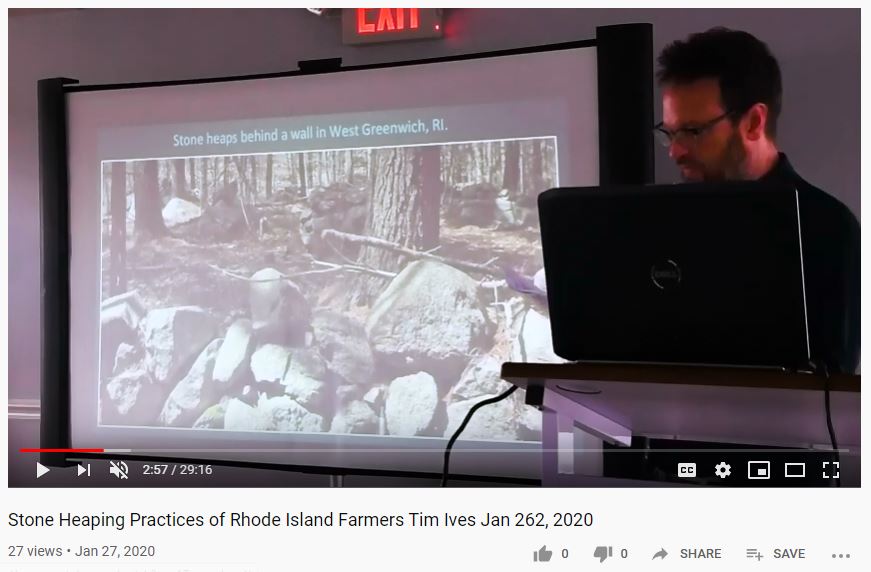
   Some Images from: Ives, Timothy H., "Stone Heaping Practices of Nineteenth-Century Farmers: New Insights from Archival Sources", An invited presentation for the Annual Meeting of the Barrington Preservation Society, January 26, 2020.  https://youtu.be/uGWoMRPRxDI

Search results for that third distinguishing characteristic of a nuchal notch that even a Professional Archaeologist can be trained to identify:
https://wakinguponturtleisland.blogspot.com/search?q=nuchal

Friday, February 21, 2020

Further On Up the Road

At the Preacher's Preserve
(2016)
   Above: A segment of stonework, an assumed "stone fence" or an "Estate Wall" associated with the first Puritan Minister in the former "North Woodbury Purchase," in the Nonnewaug Cluster, CT Cluster #3 in Stone Prayers by Curtiss Hoffman (2018). It's "further on up the road" from an interesting gateway that has one of the finest examples of a row of stones that may be a Snake Effigy:
Overlaying a snake's eye isn't necessary to emphasize the observation:
Adding eyes and horns makes it come alive, so to speak:

Collection of other similar observations of the repeated pattern here:

Back to that photo from 2016, I observed that this gently undulating row of stones could be said to have been stacked in courses that could be said to resemble smaller stone snakes -rather than stones randomly stacked during field clearing or removal from the road I was walking along or a "formal wall" made using batter boards or strings typical of English stone fence constructions that are more brick or block-like:
What I did not notice until just yesterday was that there may be another snake effigy segment  of this row of stones which was in the shadows that day and is just out of the photo:


Collection of Serpent Stacking photos and overlays:

Thursday, February 20, 2020

Anthropomorphic Effigy faces (Maryland)


Sherry R. writes, “I read your blog about the little face found in Lisbon (CT): 

I have a collection of artifacts found from 1900-1930 off a farm in Maryland including little faces. The faces look like individuals and are small and flat… I believe they are clay, but not sure..."

   "All we know is they were found by the owner of a farm. Coastal farmland. Items were glued to this board between 1920-30 by the land owner. They are still attached so I don't know what's on the backs. The display board is ugly so I wanted to detach them. I was considering detaching them until I saw the story about a similar face that was said to be rare. This board was one that the farmer's Grandson did not want because he said he was keeping the best ones. I'll attach some side views of the faces…"


"This is a piece of pottery shard on the board and stone beads:"