Monday, November 21, 2016

Snowy Morning Photos

A "Gateway."


Zoomorphic?:


Anthropomorphic?
Nearby, across the road, a little north, a little east: 


Looking down into the wetland, there's a culvert - for a spring just below this Stone Feature? 


Along another road: 
A single stone turtle (head inclusion in another stone)? Is that a right foreleg?
There are smaller stones on those distant boulders: 
Zooming in, trimming the turtle beak off accidentally: 

Is that a turtle? Is that a right foreleg? 


Another sort of entry way? 
The kind that uses a turtle as a step?


Friday, November 18, 2016

Ocular Scales, Rattlesnake


"The scales look like piled stones," reads one comment. 

An image search brings up this one:
Image stolen from: https://noahsage.com/

And I think "The piled stones look like scales:"
I just happened upon one from Rock Piles in that same search:
But the small post oculars are on the other side, so I have to find a different image for comparison:


Wednesday, November 16, 2016

Askúquand Auntau - The Snake Spirit Speaks

You’ve heard the Serpent Speak, you know.
      Angry, the Great Serpent sounds like thunder...
           Content, the Underwater Panther purrs with the sound of trickling water...
The Great Serpent sounds like every kind of rain.
The Great Serpent sounds like Water.

Thinking about Water - and Water Protectors,
I walked up to the Falls from the floodplain fields below,
All alone, but Surrounded by Great Serpents made of stone,
Suddenly in the middle of a huge
    – and loud -

Gathering of Crows...


Tuesday, November 15, 2016

Monday, November 14, 2016

(Turtle Island) Burial ground (ND)

Burial ground at center of police confrontations is known historical site
CAROLINE GRUESKIN Bismarck Tribune
      “In two confrontations involving pepper spray and tear gas, Dakota Access Pipeline protesters faced police at a creek separating the main Oceti Sakowin protest camp from a nearby hill. They said the hill contained burial sites and police were disturbing them by patrolling on the location.
      At least three people, including two important Sioux women, were once interred on this hill, known as Turtle Island...”


Saturday, November 12, 2016

Offerings to a Stone Snake

Offerings to a Stone Snake Provide the Earliest Evidence of Religion
70,000-year-old African ritual practices linked to mythology of modern Botswanans
By JR Minkel on December 1, 2006
 
“Coulson made the discovery while searching for artifacts from the Middle Stone Age in the only hills present for hundreds of kilometers in any direction. This group of small peaks within the Kalahari Desert is known as the Tsodilo Hills and is famous for having the largest concentration of rock paintings in the world.
The Tsodilo Hills are still a sacred place for the San, who call them the "Mountains of the Gods" and the "Rock that Whispers".
The python is one of the San's most important animals. According to their creation myth, mankind descended from the python and the ancient, arid streambeds around the hills are said to have been created by the python as it circled the hills in its ceaseless search for water.
Sheila Coulson's find shows that people from the area had a specific ritual location associated with the python. The ritual was held in a little cave on the northern side of the Tsodilo Hills. The cave itself is so secluded and access to it is so difficult that it was not even discovered by archaeologists until the 1990s.
When Coulson entered the cave this summer with her three master's students, it struck them that the mysterious rock resembled the head of a huge python. On the six meter long by two meter tall rock, they found three-to-four hundred indentations that could only have been man-made.
"You could see the mouth and eyes of the snake. It looked like a real python. The play of sunlight over the indentations gave them the appearance of snake skin. At night, the firelight gave one the feeling that the snake was actually moving".
They found no evidence that work had recently been done on the rock. In fact, much of the rock's surface was extensively eroded.
When they saw the many indentations in the rock, the archaeologists wondered about more than when the work had been done. They also began thinking about what the cave had been used for and how long people had been going there. With these questions in mind, they decided to dig a test pit directly in front of the python stone.
At the bottom of the pit, they found many stones that had been used to make the indentations. Together with these tools, some of which were more than 70,000 years old, they found a piece of the wall that had fallen off during the work...”
More:

Friday, November 11, 2016

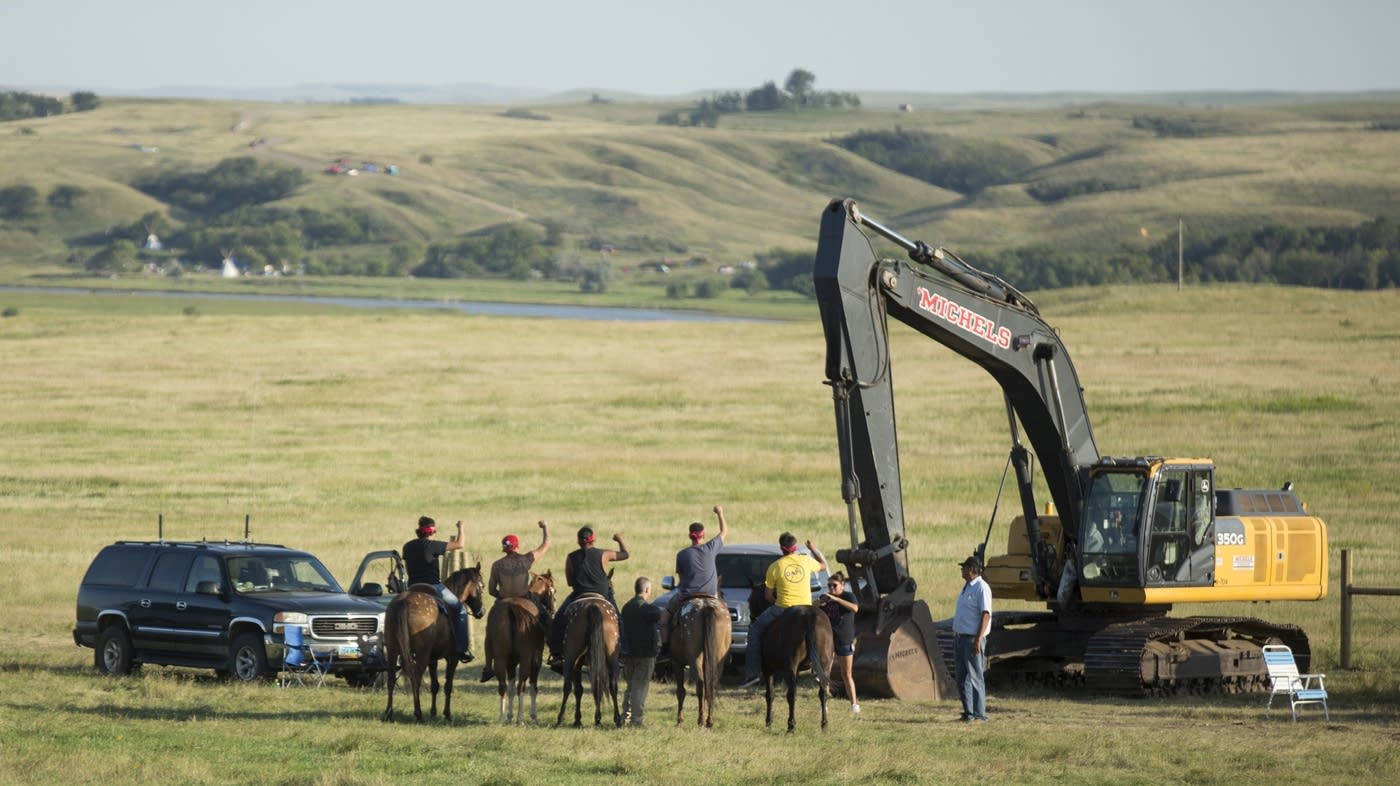
What the Trump Victory Means for Standing Rock

Image source: https://www.mprnews.org/story/2016/09/14/standing-rock-protest-camp-becomes-movement
by Jenni Monet, posted Nov 09, 2016
     The Sioux tribe is facing a pro-oil president-elect with personal investments riding on the completion of the Dakota Access pipeline.
What a Trump victory may spell for the continued battle over the Dakota Access pipeline—and for indigenous rights, in general—is alarming.

    For starters, President-elect Trump would stand to personally profit from the project. His campaign energy adviser, Harold Hamm, would also see gains. Hamm is the CEO of Continental Resources, which has plans to flow its supply of Bakken fracked crude through the pipeline. With Trump’s recent victory, Hamm is also on the short list of becoming U.S. energy secretary.

    As Politico reports, Trump is also seriously considering 74-year-old Forrest Lucas, of oil products company Lucas Oil, as a top contender for interior secretary, along with “Drill, Baby, Drill” Sarah Palin.

This political changeover has come at a critical time in the struggle at Standing Rock.


Trump vs the National Historic Preservation Act
(7 months ago):
     “Several years ago, one of my coworkers had the dubious honor of performing an archaeological survey on some of Trump’s land...One day, while my coworker was leaving the field, a limo pulled up and a window rolled down.  A hand from inside the vehicle waved him over.  There was the Donald himself, wanting to know the progress of the excavation.
    “Find anything?” he asked.
     “Oh!  Yes-” Trump’s question is one you only want to ask an archaeologist if you have time to kill. We love to talk about the stuff we find, and my coworker made the mistake of thinking Trump actually cared because a few minutes later (he stated):
 “Unfind it.”
     No matter how many grumpy landowners and construction managers we deal with, a statement like this always comes as something of a shock, and in my coworker’s telling of the story, it took a moment to process.  “What?”
    “I said, unfind it.”
      That was about the moment where he realized what exactly it was that Trump wanted him to do.  Not gonna lie, going through an attempted strong-arming from the man himself would be a little surreal, and my friend handled it better than I would have: “Oh!  Sir, we will ensure you are in compliance with all relevant laws and statutes.”
     “That’s not what I said-”
      “We’re here to ensure you are in compliance with all relevant laws and statutes, and that’s what we’ll do.”
      At this point, Trump must have told his driver to drive off in a huff, because the window rolled up and the limo pulled away...”
  

Thursday, November 10, 2016

East Bay’s mysterious rock walls (CA)

Paranormal? American Stonehenge? Theories abound...
     “Some go in a straight line, others twist like a demented snake up a steep hillside, others come in a spiral two hundred feet wide and circle into a boulder,” amateur wall historian Russell Swanson wrote in 1997. Over 12 years, he visited more than 40 miles of the stone structures.”

  And I add a horn, a Great Serpent’s eye:
      “The walls seem out of place in California’s wild golden hills, evoking instead memories of tidy New England fields memorialized by poet Robert Frost, or the rich green pastures of Ireland...”


    And I add a horn, a Great Serpent’s eye:
Somewhere in New England, Brian Cohen indeed captures a similar image:
And I add a horn, a Great Serpent’s eye:
“Is it so difficult to think that the native people of California could also pile rocks into a wall?” writes Frank Groffie here: http://www.frankgroffiesmiscellany.info/files/The-East-Bay-rock-walls.pdf


Wednesday, November 09, 2016

Kaistowanea?

You could tell that story here to good effect:

Kaistowanea (Haudenausonee); Ka-is-to-wan-ea, the small two headed brightly colored serpent, “whose skin had beautiful colors with gold and silver stripes down its back.” The Serpent “when caressed…would wave its beautiful heads to express its gratitude.” Ka-is-to-wan-ea grew rapidly, became so large that “it rested on the beam of the lodge.” The Ka-is-to-wan-ea, so beautiful and graceful in its youth, soon grew to be a ravenous monster, and having grown so large that the lodge could contain it no longer, wandered to a cave (or stone sweat lodge?) under the mountain...

Becoming even larger “the monster had circled the hill and lay with its double jaws extended before the gate. Some attempted to pass out, but were driven back…

Condensed from:

https://books.google.com/books?id=wGIEAAAAYAAJ&lpg=PA1&dq=Bare%20hill%20New%20York&pg=PA6#v=onepage&q=Bare%20hill%20New%20York&f=false

https://books.google.com/books?id=l4o0AQAAMAAJ&pg=PR26#v=onepage&q&f=false

    and one line “gold and silver” from: Two-Headed Serpent Prophecy of the Haudenausonee “Kwe Kwe” As Told by Stuart Myiow of the Mohawk Traditional Council of Kahnewake

http://www.indigenouspeople.net/twohead.htm


Tuesday, November 08, 2016

Xunantunich Belize

   A "Maya Snake Dynasty Temple"
    with some (rather rectangular) restoration going on, it looks like.  
     Would there be some Serpent Stacking visible where the stonework is untouched so far?
     My eye is drawn to a couple places:


     “Xunantunich’s name means "Stone Woman" in the Maya language (Mopan and Yucatec combination name), and, like many names given to Maya archaeological sites, is a modern name; the ancient name is currently unknown. The "Stone Woman" refers to the ghost of a woman claimed by several people to inhabit the site, beginning in 1892. She is dressed completely in white, and has fire-red glowing eyes. She generally appears in front of "El Castillo", ascends the stone stairs, and disappears into a stone wall.” ~ https://en.wikipedia.org/wiki/Xunantunich

Wednesday, November 02, 2016

How to Draw Rocks

John Muir Laws
"To observe and to not ask questions is to…sleep.” ― Todd Newberry
     “Rocks are common elements in almost every landscape. On a big scale they are mountains, on a small-scale they are the boulders or stones in a field[1]. Getting comfortable with depicting rocks that show planes and structure will help many of your drawings. Here are the key points for success:

Learn to see planes, even rounded boulders have planes.
Show planes with shading line angle, shadows, and cracks.
Use a simple value scale and see the shapes in each zone.
Look for and include the light and dark wedges (more on this below).
Cracks will change angles as they move from one angle to another.
Ground the rocks with dark shadows...
      Start observing rocks around you. Try your hand at simple studies to carve the planes and give your rocks volume. The best way to learn how to draw rocks is to practice with real rocks you find around you. Also learn a little about geology and the history of the rocks you draw. They will become even more wonderful to you.” ~ http://johnmuirlaws.com/art-and-drawing/how-to-draw-rocks

  My Questions: Where is that particular bunch of stones shown in that first drawing? Did the thought cross your mind that the stones could be said to resemble a Turtle - or species specific, a Desert Tortise? Were these stones humanly placed, perhaps humanly enhanced? Is it near a row of stones, thinking of those East Bay Walls, also known as the Berkeley Mystery Walls, a boulder carapace and cobble stone head perched on an outcrop (pointing north)? 
I've seen a few photos of some other Desert Tortoises:

 John writes: “We live in a world of beauty and wonder. Train your mind to see deeply and with intentional curiosity, and the world will open before you. Keeping a journal of your observations, questions, and reflections will enrich your experiences and develop gratitude, reverence, and the skills of a naturalist. The goal of nature journaling is not to create a portfolio of pretty pictures but to develop a tool to help you see, wonder, and remember your experiences in nature. You can learn to do this. You do not need to be an artist or a naturalist. These are skills you will develop as you go. The time to begin is now.”
https://youtu.be/9X9adiPLl1I?t=30m9s


[1] Or Field Stones and Boulders in Stone Piles or Rows of Stones.