Saturday, March 19, 2022

Káhtôquwuk/ 'Stone Prayer'

“Invested with prayers for the balance of the universe”

   As I understand it, Káhtôquwuk  means, allegorically, a 'Stone Prayer.'

   A káhtôquwuk is a kind of stone pile, a kind of stone heap, something that is heaped high, ceremonially, religiously, prayerfully, by placing one stone above another stone.

    Káhtôquwukansh is the plural of “Stone Prayers.”

   Kahtoquwuk in Narragansett, kodtuquag in Massachusett, Kodtonquag in Nipmuk, and many more variations all mean "stones that have been stacked up."

   Nohham writes, “There are several types of kodtonquagkash (kodtuhquag in Massachusett), including effigies.  Most kodtonquagkash are not more than 2 m (6.56 feet) wide and less than 1.8 m. (5.9 feet) tall.  They are usually made in an organized manner, in several courses of stones, often turret-like in form atop a base boulder.  There are kodtonquagkash types that are built directly on the forest floor, on shallow bedrock or even no rock at all.”


In Mohegan Nipawu means “he stands/ stands up,” in Nipmuc the word is nípaü, as in nípaü kodtonquag – a Stone Prayer made of either tabular or round stones, stacked in upright courses, sometimes on top of boulder bases. The plural is nípaü kodtonquagkash, as I understand it through personal communication with Nohham, who describes these as apparent “standing “cairns” on rocks, Nípaü kodtonquag(kash).  These are invested with Prayers for the Balance of the Universe.”


“kodtonquag”- ceremonial stone grouping (káhtôquwuk, Narragansett), allegorically, a “stone prayer.” https://vc.bridgew.edu/cgi/viewcontent.cgi?article=1189&context=bmas


   "At a site in Shutesbury MA, “94% of intact concentric circle káhtôquwuk are formed from four to six rings, the center most often being a stone of unusual type (jasper with contrasting line, pegmatite, quartz crystal or quartz inclusion, leucic granite, or similar mineral). Center stone is usually quite round or else pyramidal..."

    "88% of intact boulder-based cairn káhtôquwuk consist of 38-50 flattish stones, usually all of the same type in a given feature, where basal stones are somewhat larger than the succeeding courses of stone, which are quite uniform in size. Courses of stone number five to seven in intact specimens of this type…” - Nohham Rolf Cachat-Schilling (2016 Massachusetts Archaeological Society)

   Hasennnípaü refers to  (a single) stone (that) stands up,  as does sunś nipámu  or ‘marker stone’  in Narragansett, as found in Ancient Ceremonial Landscape and King Philip’s War by Harris and Robinson (2015:140), viz. sunś, ‘stone,’ nipawu ‘stand up,’ from the Mohegan Dictionary (Mohegan Nation, 2004:100, 83) which sometimes serve as indicators.


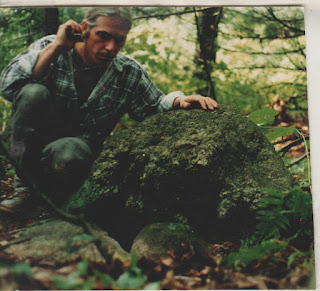
James Cachat photo
"The hassunnipau shown is in Shutesbury at an unnamed sacred place.
 It is almost 6' tall and about 1/5' wide at the widest part near the base." - Nohham

https://www.academia.edu/40876478/Quantitative_Assessment_of_Stone_Relics_in_a_Western_Massachusetts_Town


 https://www.academia.edu/40876479/Assessing_Stone_Relics_in_Western_Massachusetts_Part_II_Patterns_of_Site_Distribution

     And I find Nohham writes that a “Skuguisu káhtqwk refers to a "boulder-based cairn" which is possibly an emerging serpent form…”

One more example, an Obvious Effigy:


Tûnuppasuonk qussukquanesash – “Small Stones Turtle”  

 "Qussuk  (Proto Eastern Algonquian)(singular): a rock/stone
     qusanash  (PEA)(plural): rocks/stones   (PEA) (diminutive plural): small rocks/stones"

Personal Communication: Al Conley (2020)


From Frank G. Speck:


Thursday, March 03, 2022

Our Hidden Landscapes with Dr. Lucianne Lavin

 Via the Lyme CT Land Trust


  About twenty five years ago or so, when I showed Dr. Luci Lavin a "Stone Turtle Effigy" opposite my upper driveway, she assumed that I was "completely bonkers."

Nonnewaug Stone Turtle Effigy (1996)
About five years ago or so, after a talk she had given on "Our Hidden Landscapes," she told me that she felt she owed me an apology for thinking that I was "completely bonkers."

I let her know that it was nice of her to do so but that it wasn't necessary since the existence of Ceremonial Stone Landscape features does not preclude the fact that I may actually be "completely bonkers."


One may view "Our Hidden Landscapes with Dr. Lucianne Lavin" here:


Friday, February 25, 2022

Cheepie, Hobomock

Hobbomok appears in dreams in many forms,

 including a deer, a man, or an eagle, 

but his favorite forms are the eel and the snake. 

Hobbomock: The Sleeping Giant


“Horned Serpent: Only a few Wampanoag representations of horned serpents have survived, but they seem to have been substantially the same as in other Algonquian tribes: giant snake-like water monsters with horns that lurked in lakes and rivers and ate people. In the Wampanoag tribe, horned serpents were associated with Cheepi (Hobbomock), who would sometimes take the form of a horned serpent.”

http://www.native-languages.org/wampanoag-legends.htm


Abbomocho (Hobbomock, Chepi)

The Healing Spirit

The Spirit of Death, night, northeast wind, the dark and the underworld. To the English Hobbomock meant the Devil, Evil Spirit

 Chapter 10: Spirit Names and Religious Vocabulary

by Dr. Frank Waabu O'Brien, Aquidneck Indian Council

http://www.bigorrin.org/waabu10.htm

Hobomock

Also known as: Chepi, Chipi, Cheepie, Cheepee, Cheepi, Cheepii, Chepian (pronounced chee-pee in Wampanoag.)

Tribal affiliation: Wampanoag, Narragansett, Mohegan, Pequot (MA, RI, and CT)

In Wampanoag and Narragansett traditions, Hobomock was the manito (spirit) of death-- a destructive, often evil being usually in opposition to Kautantowit. Hobomock was sometimes also referred to as "Chepi," which means "ghost" in Wampanoag. Hobomock is the subject of many Wampanoag 'bogeyman' stories, warning children away from dangerous or naughty behavior. In other legends, Hobomock plays macabre tricks on adults such as stealing their eyelids so that they can never sleep again or twisting their feet to make them lame. After the introduction of Christianity, Wampanoag and Narragansett people began to identify Hobbomock with the Devil.

http://www.native-languages.org/hobomock.htm


Jipijka'm
Tribal affiliation: Mikmaq
Alternate spellings: Jupijkám, Tcipitckaam, Chipitchkam, Chepitchcalm, Kchi Pitchkayam, Ktchi Pitchkaam, Chepechcalm, Chepichkaam, Chepitchkaam, Che-Pitch-Calm, Chepichealm, Jibichkam, Jipijkma, Chepitkam, Ktchi-Pitchkayam
Pronunciation: chih-pitch-kawm
Also known as: The plural form of their name is Jipijkamak or Jipijkmak, and the female form is Jipijkamiskw or Jipijkamiskwa.
Type: 
Lake monsters, serpents
Related figures in other tribes: 
Kci-Athussos (Maliseet), Tatoskok (Abenaki), Mishiginebig (Anishinabe), Maneto (Fox)

Jipijka'm is a 
great horned serpent, common to the legends of most Algonquian tribes. It is said to lurk in lakes and eat humans. Since it has only one horn according to most Mi'kmaq stories, it is sometimes called the Unicorn Serpent in English. Its horn is usually described as red and yellow and has powerful magical qualities.

http://www.native-languages.org/jipijkam.htm


Hobbomok appears in dreams in many forms, including a deer, a man, or an eagle, but his favorite forms are the eel and the snake. Terrifyingly, Hobbomok also sometimes appears as a European, as John Josselyn recorded in 1674:


"Another time, two Indians and an Indess, came running into our house crying out they should all dye, Cheepie (Hobbomok) was gone over the field gliding in the air with a long rope hanging from one of his legs: we askt them what he was like, they said all wone Englishman, clothed with hat and coat, shooes and stockings."


(William Simmons' Spirit of the New England Tribes, and Kathleen Bragdon's Native People of Southern New England, 1500-1650.)

http://newenglandfolklore.blogspot.com/2010/05/hobbomok-and-shamanic-power.html

Thursday, February 24, 2022

Walls that Mysteriously Begin With a "Snake Head"


Remember: "If you are finding it difficult to identify an obvious "snake head,"
Then try looking through you fingers like Mr. Monk..."


Some find it helpful to bring along a small child:


Friday, February 18, 2022

Wednesday, February 16, 2022

Watch Online: Dr. Lucianne Lavin on Connecticut’s Indigenous Peoples and the Natural World

    "Did you know that New England was not a “wilderness”, as described by the early English settlers, but a built and managed landscape? Dr. Lucianne Lavin, director of research and collections at the Institute for American Indian Studies in Washington, gave a presentation about Connecticut’s Indigenous Peoples and their relationship with the natural world, exploring the long, rich histories that extend back thousands of years before the arrival of settler-colonists. Dr. Lavin explains how  Indigenous Peoples have managed the physical environment to enhance plant and animal populations. Indigenous folklore and sacred stories reflect this stewardship. Click below to enjoy a recording of this talk.


      Dr. Lucianne Lavin, has over 40 years of research and field experience in Northeastern archaeology and anthropology and is a founding member of the state’s Native American Heritage Advisory Council and former editor of the journal of the Archaeological Society of Connecticut for 30 years. Her award-winning book, Connecticut’s Indigenous Peoples: What Archaeology, History and Oral Traditions Teach Us about their Communities and Cultures, was recently published by Yale University Press in 2013. The book won an Award of Merit from the Connecticut League of History Organizations, won  second place in the books category in the 2014 New England Museum Association Publication Award Competition, and  was selected as a Choice Magazine “Outstanding Academic Title for 2013 in the North America Category.”


https://youtu.be/DfPavP-z9OM


Saturday, February 12, 2022

One Turtle Head - and One Turtle Shell

"There are a few ways in which these "turtle head stone and shell combinations"

do resemble turtles, as well as a few ways in which they do not."


"Turtle One"  1996

   It is not just examples of those large snakehead plus snake-like body, often undulating vertically and horizontally or even in a zigzag pattern, "stone walls" that I keep an eye out for. I also look for turtle effigy-like stones, made in combination with another stone, incorporated into the row of stones which is the larger effigy. Sometimes it's a plain stone, but sometimes it can also be turtle head-like stones with apparent eyes upwards, with a carapace stone, and even sometimes feet. Capstones are used as a distinguishing characteristic to identify formal Estate Walls, yet I find sometimes there is a simple "Turtle" head-like stone below some capstones as if it were a simple upper shell of a turtle effigy that will cause me to pause in my former "This is a Euro-American Estate Wall" assessment:


   Walking along that same “stone wall,” I observed a more complicated construction, a pair of turtles, with an apparent protruding nuchal notch in each shell - when a reasonable person might begin to detect a pattern related to Iconography often found in other forms of Indigenous "Art," in a wide variety of media:


  Those two were in the same "Estate Wall," while this one is 80 miles away, by a salt marsh where Diamondback Terrapins were almost hunted to extinction to provide turtle soup to NYC restaurants. There are a few ways that this capstone combination does resemble a certain species of terrapin and a few ways that it does not. The stone shell does resemble the scutes of the terrapin in a way, while the colors and textures of the stone head and feet do seem to much the same.

 And I didn't find that shell in place; I brought it along to create the photo, suggesting it may have been a place for a respectful turtle hunter to make a tobacco sacrifice before venturing into the salt marsh below:


There is a high degree of probability that this snapping turtle incorporated into this circa 1700 retaining wall was intentionally “dressed” to resemble a specific species of turtle by Indigenous stoneworkers using European tools who were living at the Nonnewaug Wigwams, building a "watch house" site for the early Pomperauge Plantation in present day Woodbury CT, the "Edge of the Wilderness" at that time:


Friday, February 11, 2022

One Snake Head

 "Dr. Timothy Ives has written an elegant and scholarly work exposing the academic fraud and political larceny of the "ceremonial stone landscape" movement.”

Bruce Gilley  “Stoned in America”


One Snake Head 

      At the Beginning (Not the End) of a “Stone Wall” is Nothing

 Two Snake Heads at Two Stone Walls may be a Coincidence

While Three Snake Heads at Three Stone Walls is a Conspiracy, as the old archaeologist joke goes,

                      But Four Snake Heads at the Beginning (Not the End) of Four “Stone Walls”

               May be more than:

 “a juggernaut of wishful thinking masquerading as science.”

“a shakedown culture complete with lawyers, fake science, and internal schisms (that) makes Timothy Ives’ book both a microcosm and a warning about the direction of our country.”

“farming relics” and  “pseudoscience that goes into determining that the stone piles are related to Native American rituals.”


https://www.einnews.com/pr_news/552945725/new-english-review-press-announces-the-forthcoming-release-of-stones-of-contention-by-timothy-h-ives

https://www.theamericanconservative.com/articles/stoned-in-america/