Friday, November 05, 2021

A Certain Stone


A Certain Stone,
In a Certain Place,
Placed a Certain Way,
Qusuqaniyutôkanuk, “on the stone wall.”

Perhaps a certain prayer was said here,
Perhaps a certain tobacco mixture,
Burned in a certain shell,
As the smoke rose to the Creator...
Another place,
Another sort of Prayer:
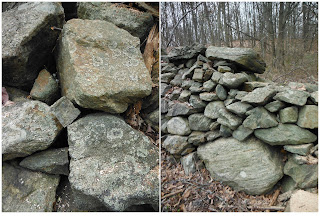
Another and another...

Stones placed in a way,
So as to suggest 
The Living Stone has Eyes,
The Stone sees your intentions...

Untouched, these stones tell a story,
Untouched, these stones continue to pray
Untouched, these stones are Nation Treasures,
Disturbed, some say, these are "just stones,"
Disturbed, some say, a Certain Spirit "comes back at you."


"Interviewee 6 also described the cairns as sacred altars: “When our people went out to seek God…seeking the truth, seeking power, seeking direction, seeking guidance . . . whenever they went there and received an answer or confirmation or received a power . . . they built an altar saying "this is where the Creator spoke to me" and this is now sacred.”

In noting the power of cairns, Interviewee 6 added that [t]he thing about cairns is, if you knock them over or if people destroy them with malicious intent . . . somehow the spirit of the place or of this person who put it there could come back on you…”
With that statement, Interviewee 6 voiced a commonly  held  cultural  belief  that disturbing  a  rock  cairn, either inadvertently or deliberately, can result in serious supernatural consequences..."
With that statement. Interviewee 6 voiced a com-monly held cultural belief that disturbing a rock cairn, either inadvertently or deliberately, can re-sult in serious supernatural consequences. Inter-viewee 3 told the following story about the power of cairns: We were going up to locate a site, it was a vi-sion quest, and a tree had fallen down on top of this rock. The rock was probably 10 inches tall and weighed about 7 or 8 pounds. A tree fell down on the rock and the rock didn't move. It was just sitting on another rock, it didn't budge it. They're definitely powerful, there's definitely some kind of spirit there, I believe.

Sunday, October 31, 2021

Located that Other House


I've been looking for some time to find this house
with the stone retaining wall at the facade:
Someone sent me the address:

Googled a better view:
But I can't do that at my house,
I'm below the hill at street level:
And I'm trying to show you
Snakes in the retaining wall:
I guess I mean Snakes in the Stonework
all around the oldest colonial settler house
in this part of town - Nonnewaug:
And the Turtles as well, of course
 - or is that "in the courses of the stonework??"


Saturday, October 23, 2021

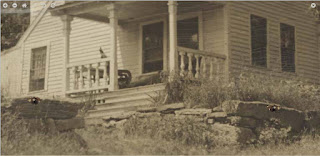
Stone Serpents at the Nonnewaug Watch House

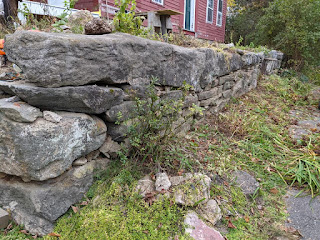
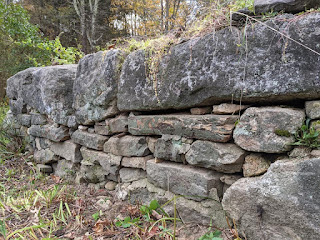
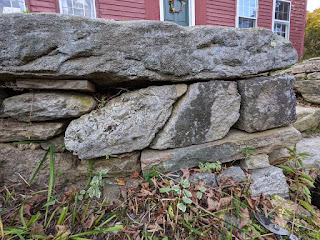
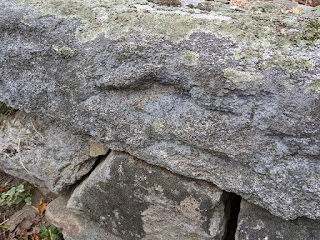
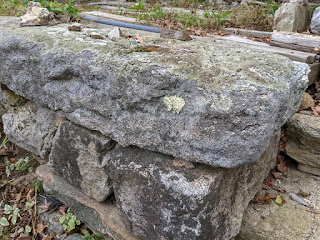
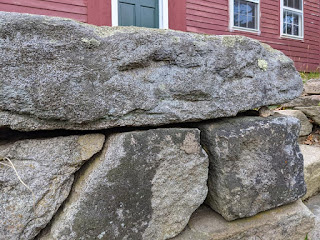
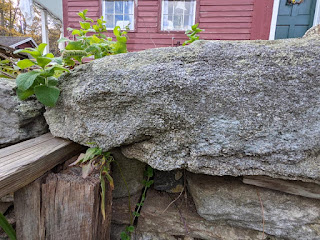
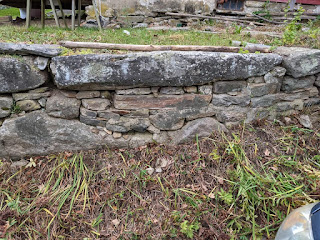
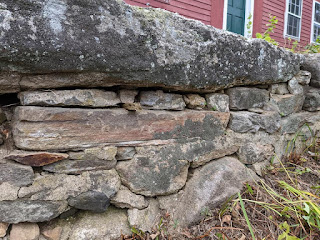
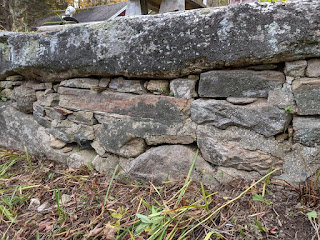
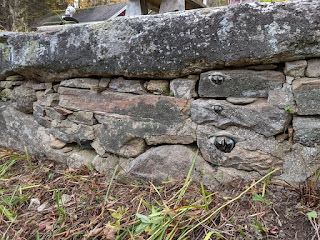
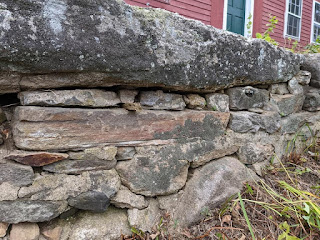
 Cutting down the summer's screen of iris and fern and phlox, at the Nonnewaug Watch House, the stone serpents that make up the retaining wall in the front of the house are more easily seen. 

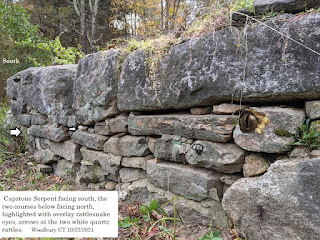
Below the capstone serpent, I notice two have a white quartz stone at the very end,
and it makes me think, "Rattles."


(The eye:)


If the courses of stones are laid down in a manner that resembles a usually larger snake head and body of stones of diminishing size
 - and sometimes a lighter colored stone for a rattle -
then you probably looking at distinguishing characteristics of Indigenous Stonework.

Call it "Serpent Stacking" in your field notes, if you like...


WPA Photo detail (and overlay): 


Monday, October 18, 2021

Culvert-like & Causeway-like (Paugussett Homeland CT)


I'm hoping that a footbridge hasn't impacted this spot above (and below):
I haven't taken this path in quite some time and don't really know.
You might be able to tell that this upstream side floods now and then.
You might call it a vernal pool, but you might also suspect it to be,
as Lisa Brooks writes about in The Common Pot,
a wetland garden, cultivated by Indigenous women,
in this case, the ancestors of the Paugussett...
 
(Screen capture from Kindle)

(A Turtle Effigy at the Wetland Garden)

The upstream side of the "culvert." 
Note the stone that could be used to block the stream
to raise the level of the water in the Garden:
Big Stone Snakes that can see your intentions abound here: 

Another spot, ten miles to the north,
 a similar stone structure on another stream:


Causeway Collection:

Ten miles south of the first "culvert,"
A Larger Causeway and possibly the remains of another "culvert:"
Closer, the possible effigies created by
the Serpent Stacking of courses of stones,
 are distinguishing characteristic of Indigenous Stonework:
Back north again, near the second "culvert" shown,
Is some of the most massive of similar known stonework,
Most likely related to a downstream Cranberry Garden.
A modern culvert to the left, the Indigenous culvert in the center:
The other side, the outlet:


Flooding destroyed the original Indigenous construction,
later "repaired" but not "restored:"