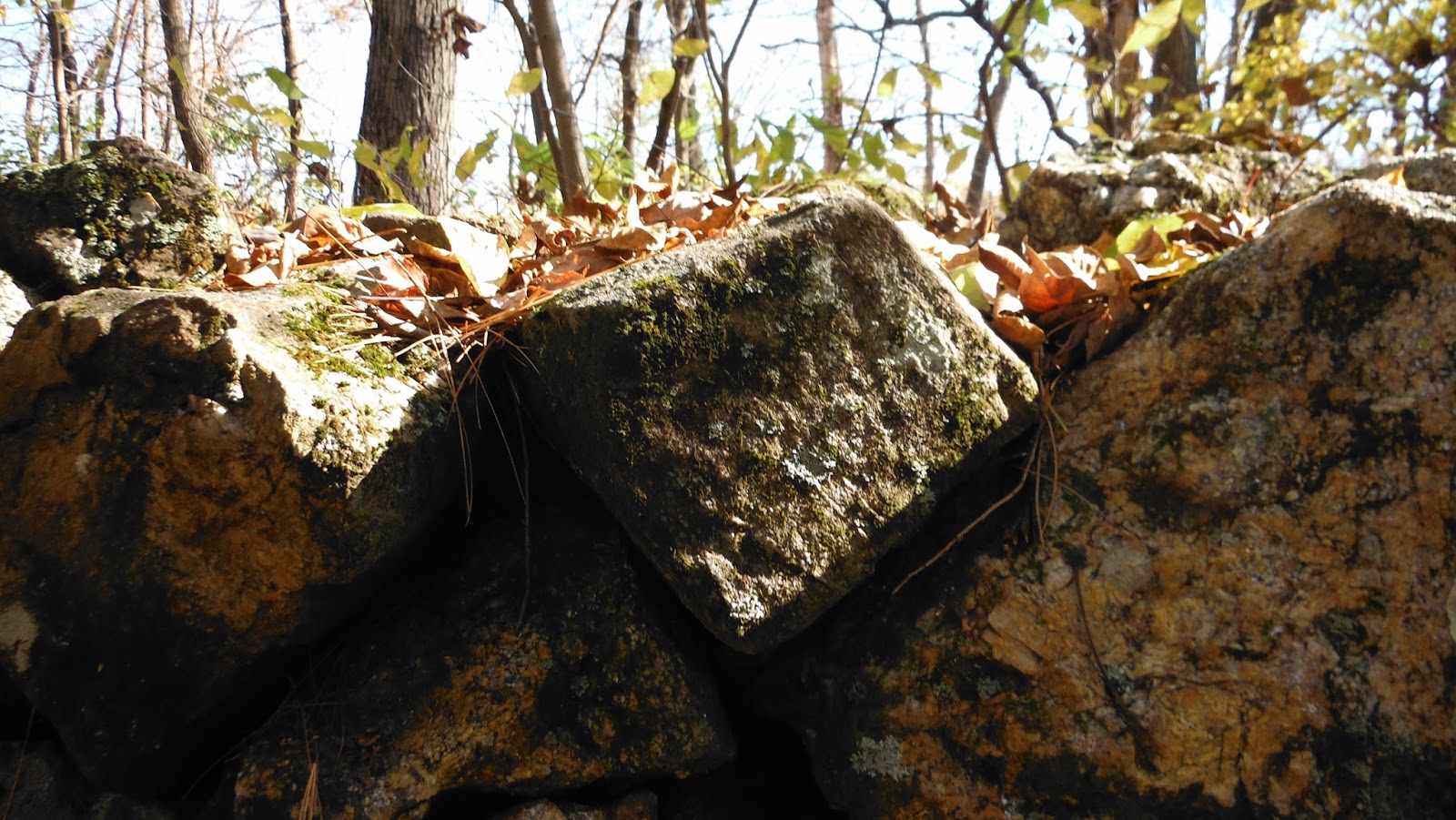
The
craftsman who built this wall perfectly accommodated glacial boulders that lay
in his path.
“I have to say that the most impressive
sight on this part of the day’s trek was completely man-made—one of the most
beautiful stone walls I’ve ever seen. It ran for some distance along part of
the Acorn Trail in the middle of the woods and far away from current homes. And
it was very different from the typical stone walls one often sees in the middle
of forests (and everywhere else) in this part of New England. Those walls are
the byproduct of land clearing and evidence that someone once used—or, this
being New England, attempted to
use—the land in the vicinity for agricultural purposes. While lovely and
long-lasting, most of those walls appear relatively haphazardly built. Not so
this stone wall! This wall was a work of real craftsmanship. It was uniformly
tall and wide—maybe two feet across—and almost perfectly flat on top. Someone
had taken care to fit the stones together tightly as he constructed the wall,
laying the largest stones at the very bottom and using increasingly smaller
stones as he built upward. Especially fascinating to me were the several
glacial boulders that lay in the path of the wall and which the wall builder
had perfectly accommodated. When was this wall built? Who was this craftsman? I
want to know more!”
It’s as if almost everyone
forgets that in the long stretch of time between glaciers and New England, Indigenous
People inhabited the Eastern gate of Turtle Island. Those “stone walls” may
rather illustrate how those cultures viewed, managed, and spiritually connected to a “three tiered” landscape as well. Fire came from the eyes of
Thunderbirds or Thunder Beings in the form of lightning. The sound of thunder
was the voice of the Great Serpent who controlled the rains that put out the
fires. The Thunder Birds lived in the Upper World and associated with high
places. The Great Serpents lived in the Underworld, traveled Underwater.
See: Horned
Serpent: “Only a few Wampanoag representations of horned
serpents have survived, but they seem to have been substantially the same as in
other Algonquian tribes: giant snake-like water monsters with horns that lurked
in lakes and rivers and ate people. In the Wampanoag tribe, horned serpents
were associated with Cheepi (Hobbomock), who would sometimes take the form of a
horned serpent.” http://www.native-languages.org/horned-serpent.htm
I look for cultural clues in “stone walls”
that might suggest an Indigenous origin for what might be better described as a
geoglyph or petroform that recalls the Great Serpent.
A boulder such as this one
should be quite obvious as a clue to a row of stones of Indigenous origin
rather than associated with farming activities on the estate of the first
Puritan minister in 1760:
When I look at the carlisletrekker photo above, I note a flat-topped
triangular boulder very similar to the shape of a rattlesnake head, further suggested
by some human enhancement to resemble two eyes below a large thin long supraocular
scale casting a shadow in the photo above.
I’m also reminded of a similar stone
at the terminus of a zigzag segment of “stone wall” in Woodbury CT:
Another
nearby, a stone row border for the wetlands and an upper terrace (within a mile
or two, I think...):
Along a brook, two different views:
At the forward point of a zigzag (note the wooden rails - what's left of them...):
This one is sort of free-standing: