Showing posts sorted by relevance for query great serpent. Sort by date Show all posts

Thursday, February 19, 2015

Effigies as a source of protection to agricultural fields

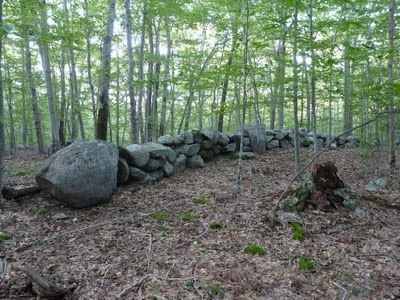
     So the other day I’m gliding along some frozen New England roads, snow mounds along both sides of the road, bigger mounds piled at intersections, - and suddenly it occurs to me that this could almost be a fine way to illustrate or at least imagine the stone rows along all those suspected Indian Trails I believe I am observing, trails bordered with a stone fuel break, complete with a big serpent’s head where the trails meet. Lately I’ve been pondering the possible serpentine, and therefore probable Indigenous, origin of “stone walls.” I’m thinking these days that the rows of stones containing effigies are also larger effigies – especially if I come across a single boulder or group of stones that resembles a snake or serpent head’s.

     I’ve been thinking about a certain place I know where a bunch of possible serpents stretch across a little first terrace hillside above the big floodplain, some land still in active agricultural use, but with a history I suspect to be far older than that, working on drawings with too much information, but very similar to this one I just made:
     So I just happen to be browsing around and find an entry with the keywords “effigy and agricultural field” from just a hundred years ago or so by Stephen Denison Peet in Prehistoric America, Volume 2 (1890)
      “Effigies as a source of protection to agricultural fields have been alluded to. Illustrations of this are numerous. The garden beds and corn-fields at Indian Prairie and Forest Home, near Milwaukee, were protected by intaglio effigies. There are cornfields on the west shore of Lake Koshkonong, near the residence of Mr. Rufus Bingham…

(The author refers to some eagle effigy mounds as surrounding possible fields: “stretched along at right angles on the bluff of the river, itself forming a wall between the river and a swale and guarding the bluff from approach. Within this wall the ground seemed to be broken as if there had been garden beds or corn fields. Possibly the effigies were designed as a fence to protect the corn fields. This was on the farm of Mr. Eaton. There were other mounds about a half mile north of the line, but they had been obliterated and could not be surveyed (93).”)

     “…Here the corn hills are on the low ground between two points which extend out toward the lake. On one point was the remains of an old French trading-point, cellar, stone chimney and other relics. On the other point are conical mounds arranged in such a shape as to give the idea that there was formerly a Mound-builders' village there. In the rear of both is a large group of effigy mounds, a group which extends along the line of the highlands partially surrounding the corn-fields. An old trail passes through this group. It would appear from history that there was a Winnebago village on one side and a Fox village on the other, the effigies being near the Winnebago village, but round mounds near the Fox village.
We speak about this particular locality where there were corn-fields and garden beds because we know that there were various superstitions about the raising of corn. In fact, everything that had life about it was regarded as being a gift from the master of life, and the soil itself was regarded as a source of life. There are many places where garden-beds were protected by animals, sometimes the figures thus protecting them are clan emblems but sometimes they are mounds which have a peculiar shape.

 In one place we found the garden-beds protected by a massive serpent, or rather by a natural ridge which had been modified and mounded so as to resemble a serpent. We do not know as there was any connection between this serpent ridge and the superstition about the weather divinities, and yet it is a remarkable fact that among the Dakotas the serpent is a symbol both of the lightning and of the rain. This great serpent was near Mayville and was a very peculiar object. It may have been a mere coincidence, and yet taken with other things it looks as if it embodied the native myth.”
Now I had just been messing with the idea of a drawing of that hillside first terrace that looks like this when I quickly add in grey some paint program doodlings of the possible serpent petroforms:
Is it just a strange coincidence or might some great serpent ideas be portrayed in stone rather than an earth mound at the edge of agricultural fields??

Peet writes on about the serpent: “The superstition about the serpent is next to be considered. Here we come in contact with a very remarkable coincidence. The serpent effigy is found in Ohio, in Wisconsin and in Dakota, three places where the tribe of Dakotas are supposed to have been located. There is this peculiarity about all of these, they are conformed to the shape of the land on which they are situated, the natural and the artifical shape both giving the idea that the serpent divinity haunted the spot. Whether this is a conception which is peculiar to the Dakotas or not, it is a very remarkable coincidence that these effigies should appear in the places where the Dakotas have lived, and only in those places…
The great serpent in Adams County has an altar in the very center of the body and the shape of the serpent corresponds to the shape of the ridge, the effigy having been placed upon the ridge because of its resemblance to the serpent. We claim priority in the discovery of this fact. The suggestion made several years ago has however been taken up and carried out farther than we had expected. Mr. W. H. Holmes ascertained that the ridge was not only like a serpent in its general shape, but that the rocks at the end of the ridge resembled the head of the serpent in their shape, a projecting ledge having the appearance of the sharp nose, cavities in the rock above having the appearance of eyes and the form and color of the rocks of the cliff below having the appearance of the white neck and bulging mouth or jaw of the serpent, while the tortuous shape of the ridge made it to resemble the folds of a massive serpent which was creeping out from the bluff and thrust its immense front into the very center of the valley, the depressions in the ridge above representing the rise and fall of the folds of the serpent. It is a conception which to any one is impressive and fills the mind with a kind of superstitious dread, but to an Indian was especially impressive. We have only to imagine the fire lighted upon the altar on the top of the ridge, shooting its gleams up to the sky, casting fitful shadows over the valley below, and filling the whole scene with its mysterious glare, to realize how terribly the minds of the superstitious people would be impressed. The fire can be seen for several miles. The erection of an effigy of an immense serpent a thousand or twelve hundred feet long on this spot was in accord with the superstitions of the people. It was not strange that they should recognize the resemblance for they seem to have been given to serpent worship, but the repetition of the practice of erecting serpent effigies in this way is remarkable. We do not know how they received this cult. The original home of serpent worship is supposed to have been in India and yet it is spread from India to Great Britain and appears wherever the Indo-European race has trodden. Its introduction into this country may have been from Europe, via Iceland, Labrador and the northeast coast. The coincidences are so striking that we are inclined to say that it was a borrowed cult, yet there are those who maintain that it was indigenous to America…”
The serpent effigy is found in many places. We here call attention to a recent discovery which we made at Fort Ancient. This fort is forty miles from Cincinnati and is situated on the Little Miami River. The river is a very swift and tortuous stream, subjected to sudden floods. It flows between low banks, but the bluffs rise on either side, making very wild and romantic scenery. The bluffs are as tortuous as the stream. The fort is situated on one of these tortuous ridges or bluffs. The walls of the fort are four and one-half miles in length, but are very crooked, so crooked that while the area within is only about eighty acres, these are about four times as long as would be necessary to surround that amount of land. The walls of the fort are in the shape of massive serpents, the heads of the serpents forming the gateways. The conception was taken from the shape of the bluffs and the land surrounding the fort. Ten years ago we visited the spot and discovered the resemblance of the walls to serpents. This was at the lower fort. Here two serpents are apparently contending with one another. The heads are near together at the gateway, one head turned sideways and the other shooting straight forward. The stricture of the neck is represented by an opening in the walls. From this point the bodies separate, twisting out and leaving a wide space between them for the fort. The bodies rise and fall corresponding to the ground and rolls along the edge of the bluff. Their heads form one gateway and their tails forming another, the whole figure having the shape of a double serpent with tails and heads together, a shape which was very familiar in the East Indies and which there represented astronomical principles, the great serpent which surrounded the earth and the cosmogonic egg being between them. This myth is found in Scandinavia. It may be that it was brought to America from these countries. The discovery which we made, however, was this: While standing on the walls of the lower fort somewhere near the terraces we could look down into the valley of the stream just below, and we discovered that the shape of the valley between the bluffs was almost exactly the shape of the fort itself and the bluffs themselves had the shape of the walls surrounding the fort. At least the two embody the same superstition in reference to the natural and artificial effigies. So far as this is concerned there is no question. The conception was evidently taken from a view of the scenery. The walls and area of the fort were the counterparts of the bluff and the valley between them, while the tortuous course of the swift stream completed the picture. The figure of the serpent was everywhere present. The resemblance was too striking to escape observation. It was not a mere coincidence, but the recognition was easy. This recognition, was undoubtedly the cause of the walls of the fort being in the shape of serpents. It was a recognition which had impressed the builders of the fort. The walls on which we stood overlooked the scene. It was a lookout station. There was a pathway from the fort to the lookout. This pathway had evidently been trodden by the people who dwelt in the fort. They had evidently stood on this spot and recognized the resemblance and had been impressed with it. It was a strange superstition and yet it was very powerful. Whether the superstition was a natural one or the remains of a lingering myth, a fragmentary tale which had come down from their fathers, or not, we do not know. The serpent divinity haunted the scene wherever this strange people went. Two serpents surrounding the hollow orb as we found it here is a common conception. This may be a mere coincidence, still it is worthy of study. The great serpent in Adams County is said by Squier and Davis to have embodied the cosmogonic egg. If this is the case then the same was embodied in the walls of the ancient fort. See Diagram XI.
The same conception about the serpent is given by the effigy which Professor Todd has discovered in Dakota. He calls it "boulder mosaics." 

 The shape of the serpent is made by two lines of boulders which run in parallel lines along the summit of a large ridge, the lines separating at the head to represent its flattened shape, and in the center of the head two other boulders which represent the eyes. He says: "The eyes had a stony stare and the effigy resembled a serpent very plainly.
Peet mentions New England – and “the northwest” as other places where history and religion become identical:
“Locality always leaves its mark on native tradition, and native myths also leave their marks on localities. We should know from the New England myths that the people who held them were residents of the seashore, for the animals which are made to figure in these myths are animals peculiar to the sea. We know that they dwelt in a region where (there) were rocks and romantic scenery, and that they were a people who were influenced by this peculiar scenery. Their traditions are many of them, localized, the rocks often being made to symbolyze their myths. It is singular, however, that the myths which fix upon scenes in nature are those which remind one of the animal divinities which were worshipped. The figure of the moose and the turtle and other animals have been recognized in certain strange and contorted figures in the rocks and mountains, and myths have been connected with them, the myth having evidently been made to account for the resemblances.
This is not peculiar to New England. We learn from Rev. M. Eells, Rev. S.Jackson,D.D., and others, that the tribes of the northwest coast have many of their myths connected with the different objects in nature, such as mountains and valleys, streams and rocks, showing that with them there was a tendency to throw an air of religion over nature. The same thing has been illustrated by Dr. Washington Matthews, in his article on Navajo Myths. Here the animals are all associated with the different localities, the animals and the scenes of nature having been regarded with a peculiar sentiment which makes history and religion identical. We present this, then, as a proof that the emblematic mounds were regarded in a religious light, the scenery and the animal shapes both proving the different elements in the prevalent nature worship.”
And here’s the whole deal if you’d like to look: https://books.google.com/books?id=CEQXAAAAYAAJ&pg=PP1#v=onepage&q&f=false


Sunday, May 23, 2010

Serpent Thoughts (With Out Feathers)


The Horned Serpent vs The Feathered Serpent

After reading the newspaper story about Mike and the Serpent Stone he found in Woodbury (http://rockpiles.blogspot.com/2010/05/woodbury-man-claims-to-have-found.html) and saying, “To read more about the serpent, and to see stone structures that resemble the "foot snake" read the Rock Piles Blog...), I thought I’d post some past links about the Horned Serpent of Turtle Island since I am Waking Up On Turtle Island once again. Open up some new windows with a right click on the links, so you don’t lose this page.

From Wikipedia, the free encyclopedia:

“The Horned Serpent appears in the mythologies of many Native Americans.[1] Details vary among tribes, with many of the stories associating the mystical figure with water, rain, lightning and/or thunder. Horned Serpents were major components of the Southeastern Ceremonial Complex of North American prehistory. [2][3]

The Horned Serpent was venerated, in various forms, by the Cherokee, Choctaw, Chickasaw, and Creek, just to name a few. Some myths say it is invisible, or that it brought rain and made a noise similar to (but not the same as) thunder.[citation needed]

Among the Eastern and Western Cherokee Indians, the horned serpent known as Uktena was venerated. Anthropologist James Mooney, describes it thus:

"Those who know say the Uktena is a great snake, as large around as a tree trunk, with horns on its head, and a bright blazing crest like a diamond on its forehead, and scales glowing like sparks of fire. It has rings or spots of color along its whole length, and can not be wounded except by shooting in the seventh spot from the head, because under this spot are its heart and its life. The blazing diamond is called Ulun'suti -- "Transparent" -- and he who can win it may become the greatest wonder worker of the tribe. But it is worth a man's life to attempt it, for whoever is seen by the Uktena is so dazed by the bright light that he runs toward the snake instead of trying to escape. As if this were not enough, the breath of the Uktena is so pestilential, that no living creature can survive should they inhale the tiniest bit of the foul air expelled by the Uktena. Even to see the Uktena asleep is death, not to the hunter himself, but to his family."

According to Sioux belief, the Unktehila (Ųȟcéǧila) are dangerous reptilian water monsters that lived in old times. They were of various shapes. In the end the Thunderbirds destroyed them, except for small species like snakes and lizards. This belief may have been inspired by finds of dinosaur fossils in Sioux tribal territory. The Thunderbird may have been inspired partly by finds of pterosaur skeletons. [4]

Other known names

• Misi-kinepikw ("great snake") - Cree

• Msi-kinepikwa ("great snake") - Shawnee

• Misi-ginebig ("great snake") - Oji-Cree

• Mishi-ginebig ("great snake") - Ojibwe

• Pita-skog ("great snake") - Abenaki

• Sinti lapitta - Choctaw

• Unktehi or Unktehila - Dakota

External links

• Horned serpent, feathered serpent.

• Lakota creation myth involving Unktehi

• Native American Fossil Legends

• The Uktena And The Ulûñsû'tï

Horned-Serpent-SanRafaelSwell-Utah-100_1933.jpg‎ (800 × 450 pixels, file size: 157 KB, MIME type: image/jpeg)


And then there's Wiki's link to: http://www.sacred-texts.com/nam/cher/motc/motc050.htm, "The Uktena And The Ulûñsû'tï," the latter "...a bright, blazing crest like a diamond upon its forehead..."

The most famous Horned Serpent?

Great Serpent Mound, Ohio
The following passage has been adapted to modern usage from an account given by Tuscaroran Chief Elias Johnson.

“A Great Horned Serpent also next appeared on Lake Ontario who, by means of his poisonous breath, caused disease, and caused the death of many.
http://cosmictusk.com/e-p-grodines-compilation-of-first-peoples-accounts-of-the-yd-impacts

I found and posted these:

http://rockpiles.blogspot.com/2009/10/snake-legend.html (of Naugatuck CT), http://wakinguponturtleisland.blogspot.com/2009/10/foot-snake.html


Stones and Serpents


I really do believe Mike’s stone is a Native American creation, the foot snake a cultural motif. Next time I see him I’ll ask about the stone wall business. Some people insist that certain “stone concentrations” actually recall the Serpent as a “wall,” perhaps better described as a petroform. Some great photos can be found at, like the entry for 9/1/ 2009 at Ceremonial Landscapes:

http://www.ceremonial-landscapes.com/blog/index.php?/archives/P7.html

http://www.ceremonial-landscapes.com/blog/index.php?/archives/P4.html, if you scroll down to “The serpent wall.”

My friend Peter was moved to make a Christmas post at his Rock Piles Blog:

http://rockpiles.blogspot.com/2009/12/merry-christmas.html


On the more serious side: http://rockpiles.blogspot.com/2008/05/uktena-horned-creature-with-diamond.html


And I’m sure if you search his site, you’ll find lots more.

• I’ll leave you with these from a series of posts, probably best read from oldest post to newest: http://wakinguponturtleisland.blogspot.com/2009_09_01_archive.html

Friday, March 30, 2018

Back to a Zigzag (CT 2007)

Qusukqaniyutôkansh (pl): Rows of Stacked Stones, colloquially “stone walls” or “stone fences,” often assumed to be post contact constructions related to property ownership and agriculture.


    I just hadn't realized that "stone walls" as Great Serpents concept - the Qusukqaniyutôkanash or Stone Rows as Snake Effigies - in Indigenous Stonework, back in 2007. Looking for something else, I just happened upon a blog post written just as the land clearing began along this old Indian Trail, its origins going back perhaps to a time when this floodplain was a glacial lake. This morning I did a double take, wondering how had I missed this...

Listening to the Sound of Distant Thunder; Angry Voice of the Great Serpent: https://wakinguponturtleisland.blogspot.com/2007/06/im-listening-to-sound-of-thunder-in.html

   This boulder should have been a clue, down at the northwestern end of this enclosed space, the zigzag remains of that same stone row that bounds that floodplain field by the Nonnewaug Stone Fish Weir on the eastern edge, the old Indian Trail on the western side, another boulder, perhaps humanly enhanced to resemble the head of a timber rattlesnake and the Great Serpent as well - a little fanciful with a rhomboidal shape for the the Snakes left eye:
Zigzag rows of stone aren't rare in the immediate area. A short drive away is this one, similar but not identical, just one more example of zigzag stacked to resemble entwined snakes - timber rattlesnakes with flat-topped triangular heads most often:

Sometimes these snakes are realistic, sometimes not - and they aren't always boulders.
Maybe it's a slightly larger cobble.
Sometimes something about the stone, especially something about the shape of the eye already there rather than pecked into it:


Sometimes the zigzag turns linear, maybe even turns a corner and maybe the Serpent Head is not very triangular or flat on top:

Sometimes there's a sort of  Trompe l'oeil ('trick of the eye') to some of them and the Serpent, just like so many do in Great Serpent Stories, seems to change into something else as you walk around it:
Sometimes that Serpent Head will be at a slight (zigzag?) angle, and perhaps it recalls the Uktena, the Strong Looker, who knows your thoughts and intentions, who offers protection with the gift of tobacco, from the Thunder Beings who shoot fire from their eyes - and from the Great Serpent itself:
No, I just didn't have all these images fitted into my cognitive map back in 2007, just didn't know all those Great Serpent Stories I've been collecting now for sometime.
But I'm trying to learn how to listen better as the Landscape Speaks to me...

Adding this in January 2020:
In Stone Prayers; Native American Stone Constructions of the Eastern Seaboard (2018), Dr. Curtiss Hoffman writes about Qusukqaniyutôk or Stone Rows as Snake Effigies: “Some of the more remarkable rows have what appear to be serpent heads at their ends. These and the sinuous walls have been reclassified to the “effigies” category (page 61)…It is my understanding that the Algonquin term qusukaniyutak, which applies to stone rows and enclosures, also may be used to define serpentine walls. The Algonquin term for snake, skug, does not appear to be applied to these structures (page 92).”

Monday, November 24, 2014

Serpent Gateway

CANTO III.
     "Wake, children of Ge-nun-de-wah! The tradition of the Seneca Indians, in regard to their birth, is, that they broke out of the earth from a large mountain at the head of Canandaigua Lake, and that mountain they still venerate as the place of their birth; thence they derive their name, "Ge-nun-de-wah," or Great Hill, and are called, "The Great Hill People," which is the true definition of the word Seneca. The great hill at the head of Canandaigua Lake from whence they sprung, is called Ge-nun-de-wah, and has for a long time past been the place where the Indians of that nation met in council, to hold great talks, and to offer up prayers to the Great Spirit, on account of its having been their birthplace; and also in consequence of the destruction of a serpent at that placce in ancient time, in a most miraculous manner, which threatened the whole of the Senecas, and barely spared enough to commence replenishing the earth. The Indians say that the Fort on the Big Hill or Ge-nun-de-wah, near the head of Canandaigua Lake, was surrounded by a monstrous serpent, whose head and tail came together at the gate. A long time it lay there, confounding the people with its breath. At length they attempted to make their escape, some with their hominy-blocks, and others with different implements of household furniture; and in marching out of the fort, walked down the throat of the serpent. Two orphan children, who had escaped this general destruction by being left some time before on the outside of the fort, were informed by an oracle, of the means by which they could get rid of their formidable enemy; which was, to take a small bow and a poisoned arrow, made of a kind of willow, and with that shoot the serpent under its scales. This they did. and the arrow proved effectual; for on its penetrating the skin, the serpent became sick, and, extending itself, rolled down the hill, destroying all the timber that was in its way. At every motion a human head was discharged, and rolled down the hill into the lake, where they lie at this day in a petrified state, having the hardness and appearance of stones; and the pagan Indians of the Senecas believe that all the little snakes were made of the blood nf the great serpent after it rolled into the lake. To this day the Indians visit that sacred place to mourn the loss of their friends, and to celebrate some rites that are peculiar to themselves. To the knowledge of white people there has been no timber on the Great Hill since it was first discovered by them, though it lay apparently in a state of nature for a great number of years, without cultivation. Stones in the shape of Indians' heads may be seen lying in the lake in great plenty, which are said to be the same that were deposited there at the death of the serpent." (page 354)
The Poetical Works of William H. C. Hosmer, Volume 1 (Google eBook)
William Howe Cuyler Hosmer
Redfield, 1854 - Indians of North America

Another Possible Serpent Gateway
Washington CT
(Looking East)

Above:1965 aerial photo.
Below: 1965 photo with a little enhancing of the rows of stones and the Gateway.


The Gateway: it is possible that the large stone has been moved from the center of the gap, blocking the view of the head of the possible snake effigy to the left or north of the gateway gap. It is possible that on the other side of the gap, some might interpret the large rounded stone as similar to an egg in the jaws of another possible Great Serpent or perhaps as the Serpent's tail…


Slightly more than half a kilometer, over a third of a mile, you could say the area outlined in yellow above is close to 2,000 feet worth of a stone wall perimeter with some very interesting features, such as capstones that more resemble petroform turtles rather than quarried blocks of stone.

Does it keep something in or does it keep something out?
Could it work as a hunting trap? Was fire used inside to drive animals out ward toward the gap? Was fire used outside of the rectangle to drive animals into the trap?
Was it a resource zone of a certain plant, herb, or tree? A certain animal?
Did it surround a house site?
 Was it defensive in nature?

LiDar image crop:

Saturday, February 08, 2014

Great Serpents and Sometimes Serpentine Rows of Stones

(Hints for Identifying Indigenous Stonework continues...)


     I suppose I should start with the smallest of Stone Serpents that I’ve come across because that would be the easiest thing to do. The photos aren’t great, some cell phone photos from the only visit I took to the spot along a dirt road named for a Native American person who once lived there – just where and when I don’t know.


There’s an interesting spot just past the tail of this snake, a particular sort of placement of stones my friend Alyssa calls a “wave,” or a “crawl” of cobbles over a larger stone:
The Head Stone:
Side view:
“It's not the most "dramatic" of serpent heads, but it's longer than wider, triangular like an actual snake's head - maybe Scuppo, about whom I know nothing else about other than the fact that he was "an Indian" who lived here on this hill somewhere, might have constructed this Serpent and never got around to finishing the head stone, but that's just a fanciful guess...” from: http://wakinguponturtleisland.blogspot.com/2012/06/serpent-surprise.html
A much more interesting Serpent is this one:


“Three Faces Theory: head-on, it's a snake. Looking south - second of the 3 views - it's asleep. Looking north, open jaws, perhaps the Egg in the Mouth deal, as in the Ohio Mound???” 
Link to Bing imagery of this smaller segment Stone Serpent: http://binged.it/1fS1XXy

These two are “short” (or ‘shorter,’ you might say, even at almost 100 feet long) segments of rows of stones and are much like photos I’ve seen (or been sent photos of), such as a group PWAX once posted up all together here:  http://rockpiles.blogspot.com/2009/09/serpent-mounds-of-stone.html
and I'll repeat them here
(Larry Harrop photo)

(Mike Hoye Photo)

(Peter Waksman Photo)

This one, with a possibly pecked and polished headstone, seems to be a very long Snake Petroform:
The white dot in the inset is the boulder head stone of the Snake or Serpent. The body and tail, partially a long zigzag stone row, forms a present day border at the Nonnewaug Falls Preserve.
The ingredients to make a Snake Effigy are pretty simple – a large stone for the head, often quite triangular, with smaller stones to create the body and tail. But what about all those other zigzag rows of stone in that above aerial photo from 1934, you might ask. What’s to say that they aren’t all carefully constructed Serpent Effigies? I’ve pondered that: http://wakinguponturtleisland.blogspot.com/2009/09/snakes-end-stones-and-some-re-thinking.html


Often these rows end up near water and this one is no exception, barely a few hundred feet from that grinning serpent head stone, another triangular head stone on something that could be another snake or serpent-like petroform:


(An experimental try at making two bad photos into one semi-good illustration:)

Elsewhere on Turtle Island, you find references to snakes and serpents and zigzags:
Avanyu (also Awanyu), is a Tewa deity, the guardian of water. Represented as a horned or plumed serpent with curves suggestive of flowing water or the zig-zag of lightning, Avanyu appears on the walls of caves located high above canyon rivers in New Mexico and Arizona. Avanyu may be related to the feathered serpent of Mesoamerica— Quetzalcoatl and related deities. Avanyu is a frequent motif on Native American pottery of the Southwestern United States.
"The Avanyu, as it is pronounced in Tewa, or horned serpent, is not a myth. The pueblo people of Santa Clara Pueblo, New Mexico, believe that the great horned serpent lives in the waters and tributaries of the Rio Grande river. It is a common belief that there a vast underwater tunnel systems that run under the ground and that natural springs are "sipapu," or gateways to these underground places where the serpents live. These are not unlike the great anaconda of South America, often depicted and described as being more than a hundred feet long when fully grown, the difference being that the Avanyu has a single or several horns protruding from the back of its head. Judging from several eyewitness accounts, it is my personal theory that the younger ones have one horn and grow more as they age, with the adult specimens having several. Sometimes the serpent is depicted as being "feathered," although, those that have claimed to see the creature describe it as having smooth or scaly surfaces, no feathers being noted. Many important and trustworthy people among the descendants of the people known as the "anasazi" have seen this legendary creature with their own eyes, my great-grandmother, Margaret Tafoya, being one of them. They are often described as having a horse-like head, and grey skin with red markings running over the front of its face to under its eyes. The common belief is that they are able to release energy in the form of lightning from their mouths, as well as control the water in which it resides…” ~ Ryan Roller-Kha'-Po' Owingeh,  Santa Clara Pueblo, NM - http://en.wikipedia.org/wiki/Awanyu
The Great Serpent (or Horned Serpent) is the most well-known mythological figure from the Southeastern Ceremonial Complex (S.E.C.C.). Its roots go back to Hopewell times, if not earlier. It usually is described as horned and winged, although the wings are more an indicator of its celestial origin than an essential form of the creature. In some versions of Shawnee myths, the serpent is described as a multi-headed monster with one green and one red horn, horns being a manifestation or marker of its power. In other myths, it is described as a one-eyed buffalo with one green and one red horn. The Piasa figure of the Miami was painted on a bluff near present-day Alton, Illinois. It was described as having the body of a panther, four legs, a human head, an impossibly long tail and horns.
Mishibizhiw, the Ojibwa underwater panther, was a combination of rattlesnake, cougar, deer, and hawk. Other native peoples also gave descriptions of the being, sometimes now referred to as the Spirit Otter, with the majority seeming to belong to one of two extremes, and a multitude in between.[11]

Older related posts:
and try a blog search for serpent or snake for much more information and speculation: 

Friday, September 23, 2016

Stone Great Serpent Search


  “Serpent Stones is an interpretation of an ancient game believed to have been played by the Aztecs over 600 years ago.” ~ https://boardgamegeek.com/boardgame/119165/serpent-stones
   “Stone Great Serpent” in the search box brings me to some Google Images.

No surprise at the image, but check the sources using the photo of the Great Serpent Mound. Lots of ancient mysteries types (insisting anyone but Indians made it), a bunch of New Age opportunists, and the obligatory aliens from space people chiming in.
   But here’s the credible people (maybe), saying, “Serpent Mound...is the largest documented surviving example of an ancient effigy mound in the world. While part of the tradition of effigy building among some American Indian cultures in what is now the eastern United States, this site is the greatest masterpiece of that tradition both here and elsewhere in the world. The sinuous, artistically-striking monumental sculpture is more than 1,200 feet long. Its scale and elegance are without peer. It embodies fundamental spiritual and cosmological principles that still resonate with many today, including astronomical alignments that mark the seasons.” http://worldheritageohio.org
“The entire worldwide list of around 1,000 properties can be explored on an interactive map, the main page claims, so I take a look at the USA section. I end up here, reading, “Poverty Point Monumental Earthworks bear exceptional testimony to a vanished cultural tradition, the Poverty Point culture, centered in the Lower Mississippi Valley during the Late Archaic period, 4,000-2,500 years ago. This site, which dates to 3,700-3,100 BP, is an outstanding example of landscape design and monumental earthwork construction by a population of hunter-fisher-gatherers. The mound complex is a singular achievement in earthen construction in North America: it was not surpassed for at least 2,000 years (and only then by people supported by a farming economy). The particular layout of the complex is unique to this site. The natural setting of this inland settlement was an important factor in the site’s establishment and longevity. The location provided easy access to the Mississippi River valley and the hardwood forests along its margins. Although rich in edible resources, the setting lacked stone, a critical raw material for tools and other objects. Thus, an extensive trade network for rocks and minerals from hundreds of kilometres away played a key role in the Poverty Point phenomenon.”
     Now I live somewhere where stone was readily available.
     Peppered into those Google Image results are quite a few of my photos, as well as others who have been kind enough to allow me to use their photos.
Newly added 1/30/2021:


     Just like Matt Bua in Talking Walls, I am suggesting that we pass by the stone remnants of a World Heritage Site, everyday and everywhere, here at the Eastern Gate of Turtle Island, once one of the world’s largest gardens, guarded by Stone Great Serpents in a setting that didn’t lack stone.

      I’m suggesting taking another look at all those "stone walls" again with 12,000 years of Traditional Ecological Knowledge in mind, an Indigenous Homeland tended with Prayers in Stone and Fire, watched over by and protected by Great Serpents, "Big Snakes" in a hundred different dialects...
(Larry Harrop photo)
...while remembering the many Great Serpent stories.
(Also a Larry Harrop photo)