Tuesday, December 19, 2017

Stones on the Landscape

Stones on the New England Landscape
They write about:
Sheep and Cows,
Oxen and plows
      Linear Lines of Refuse
            A few Hundred years old

Those Boulders, they say, are a common feature of Old England dry stone walls.


Stones on the Landscape of Turtle Island
I look at, write about: The Spirit Being
Of a thousand Great Serpent Legends
Protectors of the Sacred Places defined by qusukqaniyutôkanash
                       Rows of stones that enclose places
                                Some a few Thousand years old


Those Boulders, I say, are a common feature of Indigenous Ceremonial Stone Landscapes

There are variations, but to get the point across for this alternative hypothesis,
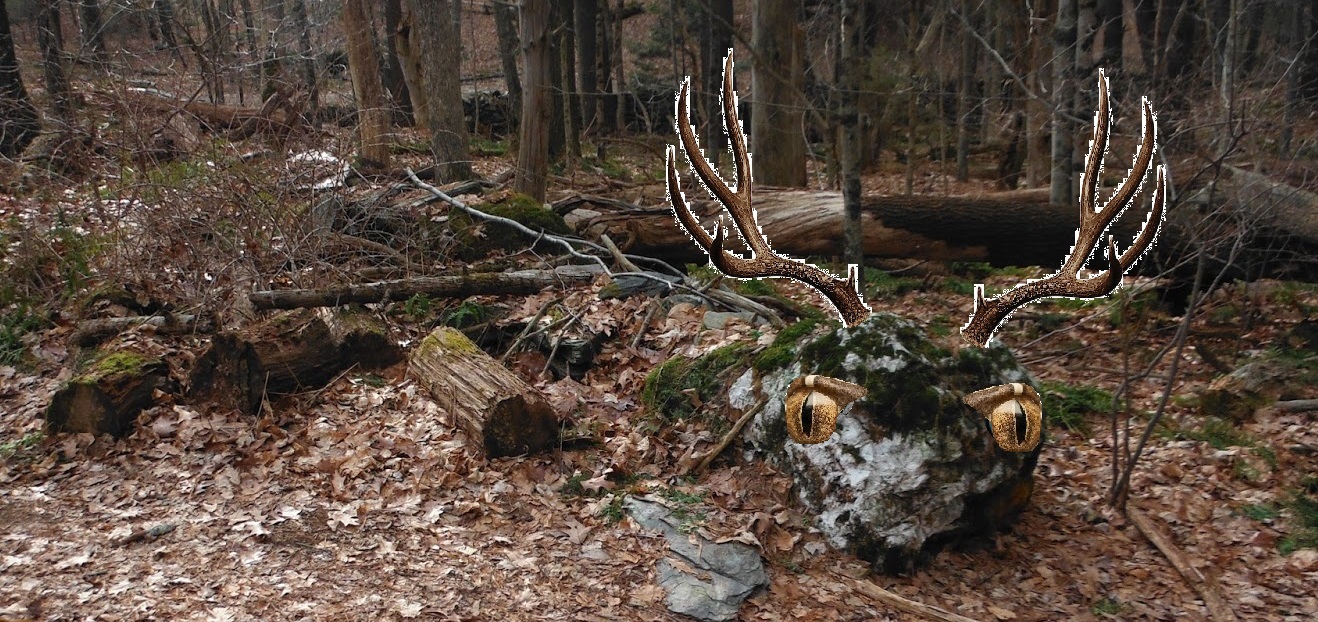
I look for examples of (more or less) flat topped triangular boulders,
Especially those with the suggestions of something much like rattlesnake eyes
Paint eyes in to bring the point to life, again and again and again...

Overlay horns for emphasis again and again and again...


Someone moved the (possible fallen) Ulunsuti, I just noticed:


Painted in Ulunsuti - maybe where it was meant to go:

      Regarding large often triangular flat topped boulders at the beginning of dry stone walls, and especially those that also have a smaller stone placed on top of that that may just correspond to the Ulunsuti/Ulun'suti, a “jewel” found on the forehead of the Great Serpent: these maybe be Great Serpent Petroforms.
     If you think about the Human presence in the Americas as a long shirt, European style stone fences or walls in the Americas are, at best, the top or Sunday button and it has a proper corresponding top or Sunday hole. You can try but you can’t fit Monday through Saturday’s buttons into that single Sunday hole...

Monday, December 18, 2017

That Polka-Dot Dragon Re-write and Re-post

I know neither How nor Why the images on an old post about some stones up the road from me were compromised, so here's a little re-post that I tickled the old post into giving up:

Polka Dot Dragon or Beaver?
 Originally from SATURDAY, JULY 16, 2011
This used to be a "boulder field," rocky unplowed land, that was full of stones on boulders which I never had the chance to look at closely. Then the bulldozer arrived and it now it's been landscaped so that it now looks like this:


Somebody saw this one particular stone as a dragon or something like that and painted it mostly green and, perhaps inspired by John Lee Hooker, many polka-dots: 
     I on the other hand see a beaver, perhaps on a boulder that represents a turtle, as in the local Creation Story I've heard...   
(Flip the photo, add some eyes and lift an image:)

Thursday, December 14, 2017

Part of the Great Mystery


A friend (of Abenaki ancestry) once wrote to me: "There is no need to question the land, the place where one finds oneself. The answers are all freely available - Creation is always speaking and being. Rather, always question oneself. Am I listening? Can I see? Am I present? Who else is here? Am I fulfilling my responsibilities as a part of the Great Mystery or have I (again) separated myself?”


"To both see and observe: Therein lies the secret." ~ Sherlock Stones

Three White Quartz Triangular Boulders at Gaps in Stone Walls
(or)
Three  White Headed Serpents at Three Different Gateways, First up above the stream that flows into the Cranberry Garden, the other two at the first terrace...

Friend:

Wednesday, December 13, 2017

A Yurok Forest History (1994)


Chapter 2: Culture and Landscape

    "The cultural framework of Yurok life is deeply intertwined with sustainable management of the environment. Before European contact the Yurok forest was managed to meet spiritual as well as material needs. The relationship was a dynamic one: the Yurok used various tools to maintain and develop their forest, and at the same time they let the environment guide them in determining where to live and in other aspects of life. Much of this information is embodied in Yurok spiritual tradition. Although they have lost control over much of the management and use of their indigenous territory, Yurok culture and lifeways remain connected to the forest.

     Waterman’s Yurok Geography (1920) extensively documents the spiritual and economic meaning of many sites and landscapes along the river. A variety of reports to the Forest Service have documented aspects of Yurok ethnography and resource use. This chapter draws on these reports, published accounts, and interviews to highlight aspects of the relationship between the forest and the tribe...
Figure 2-2. Sweathouse and cemetery on tribal lands

... Waterman commented in 1909 that many boulders in the river were known by their proper name to every Yurok, and sites were often named with names meaning “downstream-from-a-particular-rock” or “upstreamfrom-a-particular rock.” Yurok Forest History 1994 pg. 44


Of special relevance to forest management is the use of trails. 

     Waterman states:
      Trails are “like people,” that is, they are sentient, and must be treated with urbanity. If you step out of a trail and in again, and fail to preserve decorum, the trail becomes resentful. Along each important trail there are “resting-places.” Few of these show on my maps, because I did not travel the trails myself, but hundreds of such places are to be found. People when traveling kept on in a business-like way until they came to these resting places. There they took off their packs and had a good breathing spell. If they did differently they were likely to have bad luck....Here and there in the Yurok country are large trees into which parties of travelers shot arrows, as an offering for good luck on the trail (1920).
     Some of the major trails are indicated on Waterman’s maps (1920). Yurok Forest History 1994 pg. 45
... A major preoccupation of forest management...was reflected by passage of the Act of September 20, 1922 (42 Stat. 857) which mandated that the Secretary of the Interior protect timber on public lands, National Parks, National Forests, Indian Reservations, or other lands under the jurisdiction of the Department from the depredations of fire, insects, and beetles. Suppressing fire in the region was not an easy task due to inaccessibility, limited funds, and the belief by many, especially the Yurok, that fire was a good thing (Roberts, 1983)..." Page 33

Waterman: http://rockpiles.blogspot.com/2013/04/yurok-geography-by-t-t-waterman.html

Tuesday, December 12, 2017

Great Oak Horned Serpent

"Redrawn" with Rattlesnake Eye, Deer Antlers and an Ulun'suti 
- added to the original:
Without the Ulun'suti:
A dark eye or is there a missing stone eye??
Is the big white stone (at the seventh scale/marking) the heart??
Stone scales, markings, body undulating in height...


Monday, December 11, 2017

Snow on a Stone Serpent by the Stream


    So I'm leaving the school, the venue for the Ceremonial Stone Landscape, back in October, about to walk to the parking lot when I suddenly remember that I meant to: "Ask Doug Harris if he thinks it's disrespectful to overlay eyes and horns onto photos."
    So I do, prefacing the question with the thought that these additions make the Stone Feature come alive and that I'm doing so, sort of "hitting people over the head with them to get my message across."
     I add that if he finds it's disrespectful, unhelpful, that I won't do so anymore - I won't add the eyes and horns and post them up here anymore, take down all the old overlays...
 
Above: Great Serpent Overlays
Below: the original photos that still include the Ulun'suti,  


Ulunsuti/Ulun'suti


James Mooney "Where The Uktena Stays:"

Sunday, December 03, 2017

Monument Mountain and a Mohican Sacred Place

Mohicans Past & Present: a Study of Cultural Survival 
Lucianne Lavin, Ph.D. 
February, 2011 
"Abstract: Study of artifacts collected from Stockbridge Mohicans living in Wisconsin between 1929 and 1937 and associated documents show that although they had been Christianized, victimized and precariously depopulated through European diseases, poverty and warfare over the past 300 years, the Mohicans remained a tribal community throughout the historical period. They achieved this through adherence to core cultural and spiritual traditions and strong leadership that focused tribal members on several key survival strategies, which allowed the Mohican people to remain together physically and politically. Their story is one of courage and persistence in the face of seemingly unbeatable odds."
(Excerpts pertaining to Ceremonial Stone Landscape:)


Excerpt from:

Friday, December 01, 2017

Wâunonaqussuk

wâunon- ‘honor’ + qussuk ‘stone’ = wâunonaqussuk – ‘honoring stone’
"...a long, low boulder with many small, round stones on top." 

(Wawanaquas- sik, ‘place of many honoring stones,’- Nochpeem Mahikkaneuw/Wappinger, Ruttenber 1992b:373). https://vc.bridgew.edu/cgi/viewcontent.cgi?article=1202&context=bmas

Wawanaquasick, stone-heaps on the north line, "here the Indians have laid several heaps of stones together by an ancient custom among them;" (Page 19)
Wawanaquasick
   “JOSEPH VAN GELDER – That he is Forty Eight Years of Age  He understood the Indian language  that he knows a place called Wawanaquasick  it lies between Claverack and Sheffield one Breakfast Travel from the River to wawanaquasick.  it lies about 9 or 10 Miles East from the River – has seen it often has traveled.  It lies upon the East part of a Hill  has heard of it high thiry Year ago from old Indians who told him it was wawanaquasick and Said it was an old Place they had there, a great many years ago – Old Nannahaken and old Skannout old Panneyote who were Ancient Indians told him so.  Old Skannout was quite grey with Years – Nanahacken about 70 Years then, and old Skannout appeared older then Ampawekine called Sankenakeke who was the Sachem of the Mohickens also told him of it.  He was then better than Sixty Years of Age, they were all of the Mowhickens Tribe  the Indians told him it was an offering Place of their old fore fathers and a boundary between the tribes Mohickens and the River Indians  the Eastern Tribes was called Mohigens and lived at Stockbridge he is sure – the Indians told him Wawanaquasick was a boundary between the Mohicken and the River Indians  they used to join together when they went to war...”
Wawanaquasick ~ Location in Town of Livingston, Columbia Co., N.Y.