Friday, October 06, 2006

3 Items by Gary Snyder

For All:
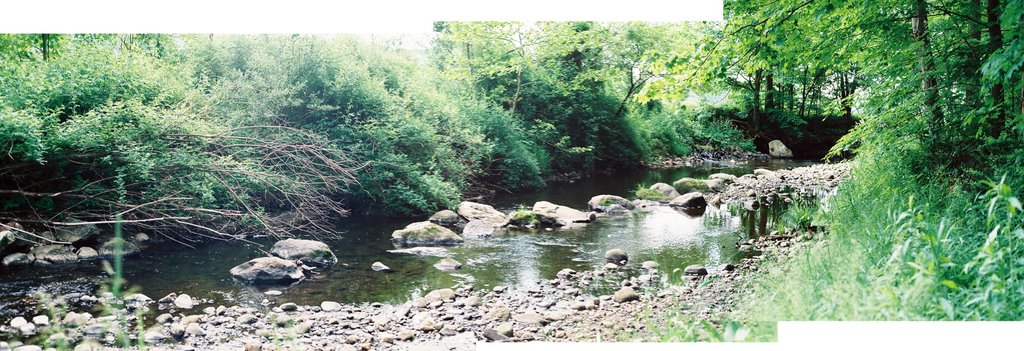
 "Ah to be alive on a mid-September morn fording a stream barefoot, pants rolled up, holding boots, pack on, sunshine, ice in the shallows, northern rockies. Rustle and shimmer of icy creek waters stones turn underfoot, small and hard as toes cold nose dripping singing inside creek music, heart music, smell of sun on gravel. I pledge allegiance I pledge allegiance to the soil of Turtle Island, and to the beings who thereon dwell one ecosystem in diversity under the sun With joyful interpenetration for all."
  from:http://www.rooknet.com/beatpage/writers/snyder.html


A path is something that can be followed, it takes you somewhere. "Linear." What would a path stand against? "No path." Off the path, off the trail. So what's off the path? In a sense everything else is off the path. The relentless complexity of the world is off to the side of the trail. For hunters and herders trails weren't always so useful. For a forager, the path is not where you walk for long. Wild herbs, camas bulbs, quail, dye plants, are away from the path. The whole range of items that fulfill our needs is out there. We must wander through it to learn and memorize the field
--rolling, crinkled, eroded, gullied, ridged (wrinkled like the brain) -- holding the map in mind. This is the economic-visualization-meditation exercise of the Inupiaq and Athapaskans of Alaska of this very day. http://www.albany.edu/~litmag/archives/vol213/map.html 


 "Find your place on the planet, dig in and, take responsibility from there."
Gary Snyder

Friday, September 22, 2006

The Huron

Here's a few bits I've been meaning to post for a while now, taken from:

The Huron; Farmers of the North
(1969)
by
Bruce R. Trigger

"The Huron called themselves the Wendat, a term generally believed to mean "Islanders" or "Dwellers in a Peninsula." This term has been interpreted as referring to the large bodies of water that surround the Huron country on three sides, but it may also reflect the Huron belief that the world was an island supported on the back of a turtle. The term Huron is derived from a French word hure, meaning, literally, a boar, but more generally a ruffian or savage (page 6)."

"Various attempts have been made to determine the meaning of the names of the four Huron tribes ...Aherendarrhonon means "The People of the Rocks"; possibly a toponym since this tribe lived nearer...the Canadian shield (page 14)."

"Charms were highly valued and inherited from one generation to the next...If a hunter found an animal difficult to kill and later found in its entrails something unusual, such as a stone or a snake, he would keep what he found in the hope it would bring him good fortune. Likewise, stones with a curious shape were kept since it was believed that these stones belonged to a spirit that lived in the woods and had lost them there (33)."


"sobriquets" - or nicknames for people of high status include "Ondakhienhai (big stones, elders, and stay at homes)... applied to chiefs in the historic period (38)."

"Certain large rocks were believed to be the homes of spirits. Some were located along the trade routes.. as travelers passed by these rocks they made offerings of tobacco to them.this was done by throwing tobacco into the campfire or the river or else leaving them in clefts in the rock...(91)."

The bold lettering is my emphasis; the writing style and choice of words is Trigger's...

Wednesday, September 20, 2006

Mesingwe, the Hunter Spirit

I can't let a second reference to BigFoot in "Rock Piles" go by without posting an old piece I wrote about ten years ago called
"Mesingw and Bigfoot."

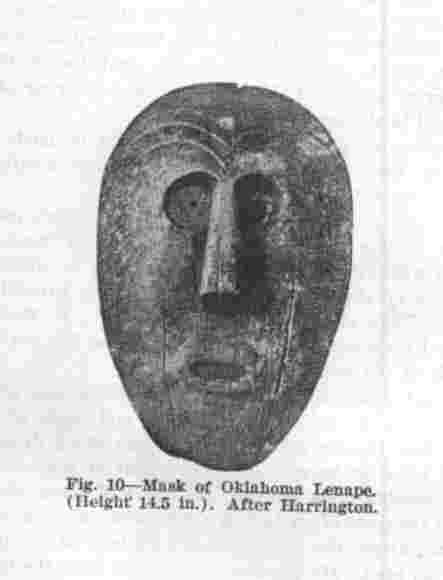
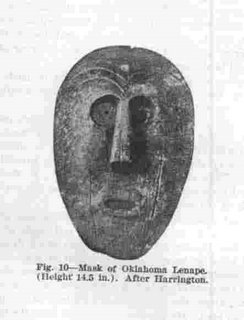
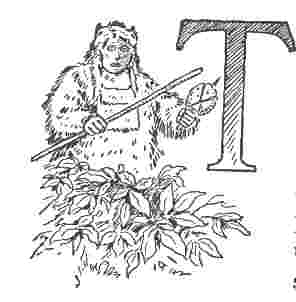
Left: Lenni Lenape ceremonial Mesingw mask.

The Lenni Lenape Homeland is what is now known as New Jersey and Eastern Pennsylvania, from the Delaware River to the Hudson River. Their "brothers" are said to be the Nanticoke, Mahican, Munsee and Iroquois. Their "Grand-Children" are said to be the Shawnee, Potawami, Sauk and Fox, Ioway, Tonkawa, Sioux, Ottawa, Kickapoo, Miami, Peoria, Chippewa, Menomoni, and Winnebego.These People refer to them as Delawares, Wabanaki, Lenape, and "Grandfathers." Descendants of the "Original People" migrated westward away from European settlements and exist as Lenni Lenape in Okalahoma, Wisconsin, and Canada.

"Ku-les-ta! Listen! One time long ago there were three boys about your age who weren't treated very well; in fact their parents did not seem to care whether they lived or died. They were out in the forest one day thinking about their troubles when they saw a strange-looking hairy person with a big face half red and half black. This person said: "I am Mee-sing haw lee kun; I have taken pity on you and I will give you strength so that nothing can ever hurt you again. Come with me and I will show you my country!"
"He took one boy up in the air to the place where he came from; it was a great range of mountains up in the sky reaching from north to south. While he was showing the boy his country, he promised he should become stout and strong and should gain the power to get anything he wished. Then he brought the boy back to earth again.
"Afterwards when the boy grew up and went hunting he used to see Mee-sing-haw-lee-kun riding on a buck, herding the deer together and giving his peculiar call 'Ho-ho-ho.'
Harrington in Dikon Among the Lenape (Indians of New Jersey)
Mee sing, Mesingw, Mee-sing-haw-lee-kun, Misinghalikun, and Wsinkhoalican are all various recorded forms of the Lenni Lenape word translated as meaning "The Mask Being" or "Living Solid Face." This Manitou or Spirit Being, also called "The Game Keeper," lived in the woods, guardian of the deer and all game animals. This concept also appears among the Montagnais-Naskapi of Labrador in the form of Caribou-Man , who in turn is very similar to the antlered Celtic Spirit Cerranos.
The word can also mean Mesingw's human impersonator. In a well researched fictional work called The Indians of New Jersey: Dikon Among the Lenape: Dr. M.R. Harrington (as the captive English boy who narrates the story) writes:
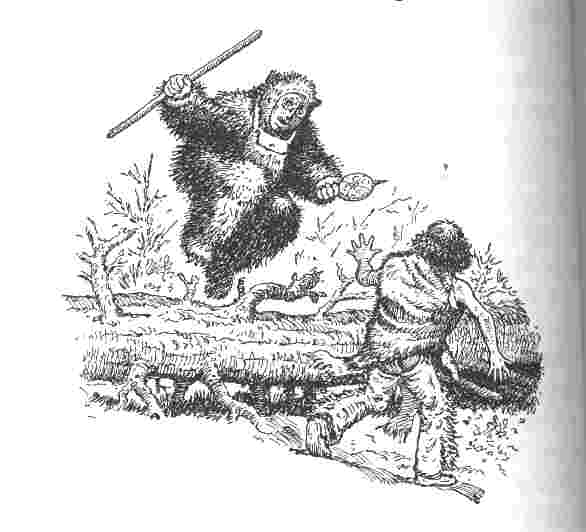
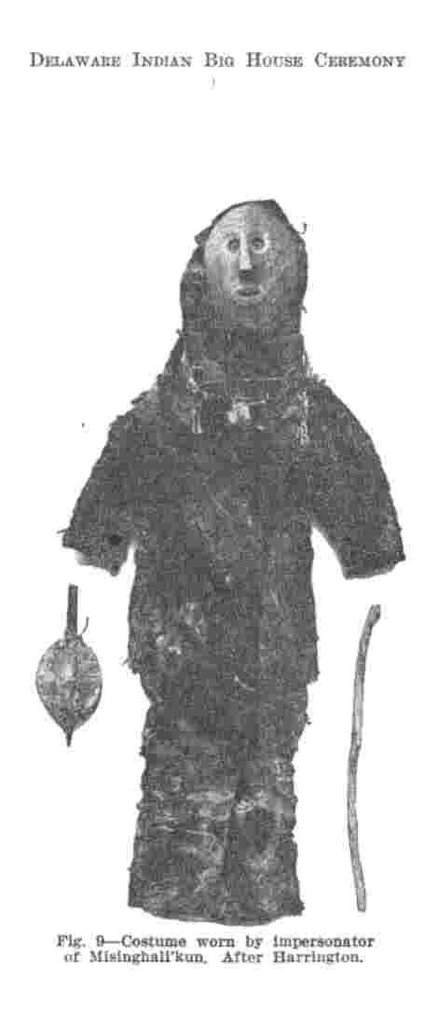
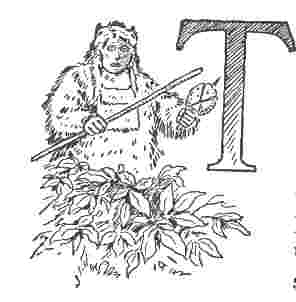
"...I was really enjoying the fun, when I heard a queer noise behind me, a sort of rattling and a sound like a horse neighing. I looked and nearly died from fright. There stood a creature as big as a man, but covered with hair; it had a great moonlike face, half red and half black, and it carried a staff and something that made a rattling noise. It saw me looking and jumped straight up in the air; then it made a dive for me.
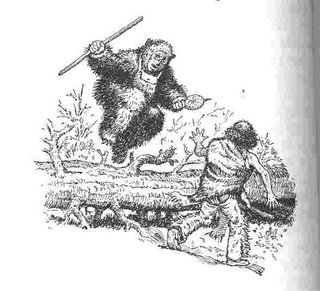

"That terrible creature chased me all over the village, making great leaps and bounds and jumping over everything that came in the way. I escaped only by pushing out into the river in a canoe. Even then I thought for a moment it would follow me there, but it finally turned back toward the Big House, whinnying and rattling. Not until next spring did I learn that it was a man wearing a mask and a bearskin suit. He always appears at the Gamwing, representing a spirit called Mee-sing-haw-lee-kun, supposed to be the guardian of the deer and all other game animals..."
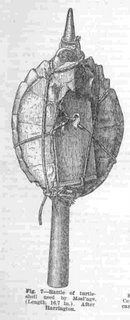
Dr. Harrington began his career as an amateur who amazed the staff of the Museum of Natural History by finding a great number Native artifacts on the outskirts of New York City. He eventually became curator of the Southwest Museum in Los Angeles.
I don't really know if in fact Mesingw and Bigfoot are one and the same, and certainly don't mean to offend anyone. I'm just noting some similarities that occur to me. My recent interest in Bigfoot was sparked when my new neighbor told me that a 'Mumohne' (Monster in Italian?) lives in the woods near the Sacred Waterfall by my house in Connecticut. At the time I was photographing some pecked and polished (possible) "Respectful Hunter's Tobacco-offering Stones Shaped Like Bears and Deer " and knew something of the Lenape Big House and Mesingw, but not much about Sasquatch. Later I typed that S-word into a search engine and soon found that there were various Native names for Bigfoot-like creatures of legend such as "Spirit of the Woods," "Stick Indian,"" Wood Man," and "Wild Man of the Woods" that made me think of Mesingw.
I learned that in some places he even wears a bearskin robe, like Mesingw.
Just the name "Owl Woman Monster" also reminds me of the description of Mesingw's call of "Ho-ho-ho," very much like a Great Horned Owl's call. Other legends from other places also describe an owl-like call. At one point in the Gamwing (also Cantiko, Xingwikaon) or Big House (or in this part of CT, Long Wigwam) Ceremony, deer are hunted for a ritual meal as part of the renewal rites. It's considered good luck to hear (what may or not be) the Great-Horned Owl's call.
Perhaps it's Mesingw herding deer together for respectful hunters.
Dr. Frank G. Speck in The Delaware Big House Ceremony is told by his Okalahoma Delaware informant Witaponxwe (Walks With Daylight):
"And it is said that our grandfather (Mesingw) is believed to walk around early each morning. Now here he goes frightening unruly children. When the "one who is our grandfather begs," the child is taught that he shall pay a plug of tobacco so that he will not scare them.
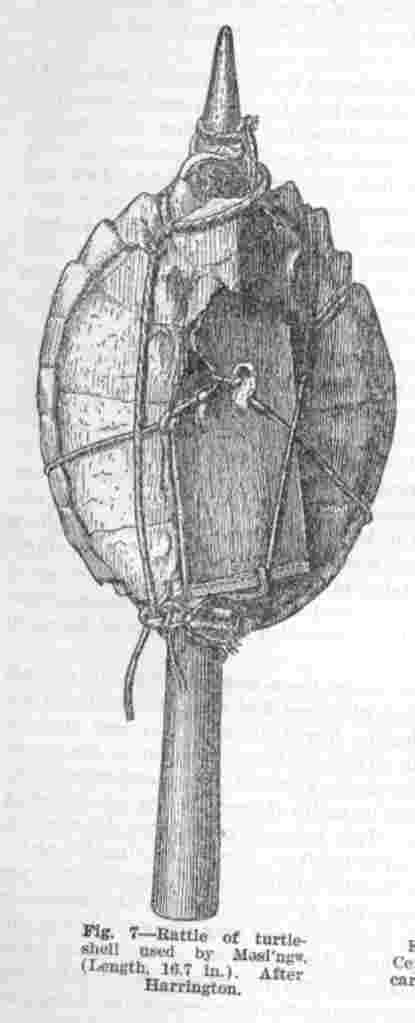
"If the person who assumes the mask is able to see clearly for a long distance it is said that he is a man of power. He carries a (snapping) turtle rattle and a staff of twisted wood ( an 'ala-houn' or walking staff similar to that carried by the Great Spirit). When he makes his utterance it resembles a horse whinnying, and when he makes signals using his turtle-rattle, they give him tobacco. Customarily he kicks at persons. Here in a pouch he carries that tobacco. Every child customarily is taught that he gathers snakes and throws them into that pouch in order that no one may steal our grandfather's tobacco. And it is said that our grandfather keeps guard over all so that none may be overcome by disease. That is also the teaching in reference to the spiritual doctrine of the Mask-Image."
Children were told to behave or they could end up in that snake-filled pouch (or basket), reminiscent of certain Bigfoot legends.
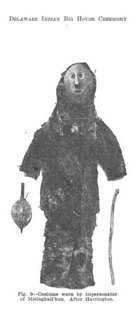
Mesingw briefly appears at the Gamwing as a dancer. The songs that accompanied the dance were not completely known by Witappanoxwe in 1928, although he thought that they mention the fact that he rides on the back of a deer. Sometimes no one volunteers for the part of Mesingw , and the Mask-Spirit dance or 'Mesingkentcke' is omitted.
The prayer to the Mesingw, however, was recorded in Speck's Big House:
"Here now my kindred, we have come to the fourth day since we began, in this place to perform the ceremony. And each and everyone of us knows the ruling of this our form of Prayer-Worship. Now we are using the tobacco our grandfather, while we are pleading earnestly with the Manitou (Great Spirit /Great Mystery). And the Mask-spirit also, when we are giving thanks to him our grandfather fire. This is how it is done by the Bringer-in, "I thank all the Manitouwak (Mysterious Forces) on top of the Earth and all the Manitouwak above. Wherefore we earnestly plead with grandfather when we give to you to eat this red man's tobacco. Have pity on us your grandchildren. They are begging you, oh Mask-Spirit, that we may have success. Give us the wild animals since you control them, all the wild animals because we need that we may be blessed with this meat. And that one our mother the corn, because all of the food given us I thank you Spirit Forces that we are given the blessing of your spirit-power. Now give us all we ask of you Manitou that you are and, our Creator, think of your children."
The Hunters then leave to bring in deer, supplied with tobacco that they continue to offer in the fire.
In Dikon, Mee-sing, as the People of Turtle Town call him, joins the people who stay behind at a meal after the hunters leave. The adopted English hero of the story feeds him sapan, cracked corn meal mush, through the mask.
There is a story of a man named Ben Horse who was overcome by the power of the Mask, "performing the antics of the Mask dancer to the point of dementia," according to Speck, as did an unnamed woman. Both required a Healer to free them from the Mask-Spirit. The Ojibwa Windigo is recorded to have possessed people in the same way.
I've seen photographs and drawings of what I guess is a Healer or Shaman's rattle (according to Harrington who, incidentally, purchased and excavated many a Spirit-mask that became part of many a Museum collection) that is topped with Mesingw's face.
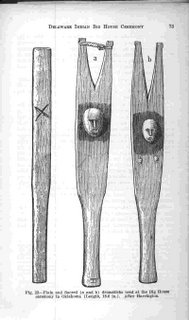


Special forked drumsticks, used only after the ninth night of the ceremony, and the posts of the Big House, a symbol of the Universe, are among other places that the Spirit's face appears. The drumsticks are held so that the drummers or 'cranes' face the carvings which are both grandmothers and grandfathers. The posts support the sky, while the central post represents the walking staff of the Creator which reaches to heaven.
Hunters also made or traded for a small carved wooden Mesingw-face either carried in a medicine bag or worn around the neck for good luck.
During Gamwing, all the Mesingw faces are repainted red and black .It seems that the colors have several meanings: good and evil, joy and sorrow, male and female, and possibly more. Charcoal is used for the black; crushed Bloodroot for the red. It's interesting to note that that Lenape and many other Native Peoples used bloodroot mixed with bear grease as a sunscreen and insect repellent, from which some say the term "Red-Skin" comes.
Perhaps the ritual painting is reminiscent of an ancient friendly gesture toward the Bigfoot-like Mesingw, comparable to lending your Cutter's or Skin-So-Soft to a friend who has none and just snakes, unruly children, and tobacco in his wallet...
References cited
1938 Harrington, M.R. The Indians of New Jersey; Dikon among the Lenape ISBN: 0-835-0425-2 (Illustrations by Clarence Ellsworth)
1931 Speck, Frank G. The Delaware Indian Big House Ceremony PA Historic Commission?
(Scans stolen from the above.)


1991-1996 Personal Communications: the late MoonFace Bear, Paugeesukg Nation, in reference to the local "Long Wigwam Ceremony"; in our last conversation, told me that the Naskapi language is very close to the language that appears in the form of Native place names here in Western CT along the Housatonic and Naugatuck Rivers.
11/11/96 Personal Communication with Barb at the corner store: " You never heard that Big Foot story before? That story's been going around for thirty years or more. Ask some of the old timers."
Tim MacSweeney
Tuesday, September 12, 2006

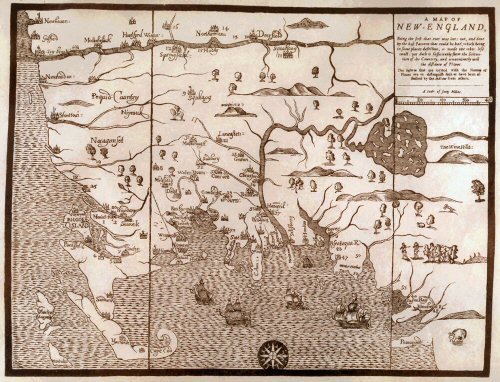
Indian Place Names

An old file I found on a floppy disc has some material from
Indian Place Names of New England by John C. Huden
Publisher: Natl Museum of the Amer Indian (June 1962)
ISBN: 093449018X

There’s a large gap in what I started compiling, but it looks like I started copying anything related to rocks and stone, eels and weirs, sweat lodges and other stuff.
Some of these names survive on maps, especially the old historic ones, and could be useful clues to an “Indians did use stones” sort of person...

A
Abrigada : (Holy Land in Wtby, CT) “hiding place or shelter” (possibly natural caves called ”the catacombs:” part of the “replicated” Holy Land)
ahquanahaganoc: sweatbath (Abnaki)
Aquassik: large boulder (Quassik Falls, Woodbury CT: one big stone creates the falls)
Asawacomuck: plantation or enclosure between two streams
Asnacancomic: (- comet) at the long stone house Nip.
Asnebumsket Hill: “rocks upon rocks,” “ boulder cliff” Nip.
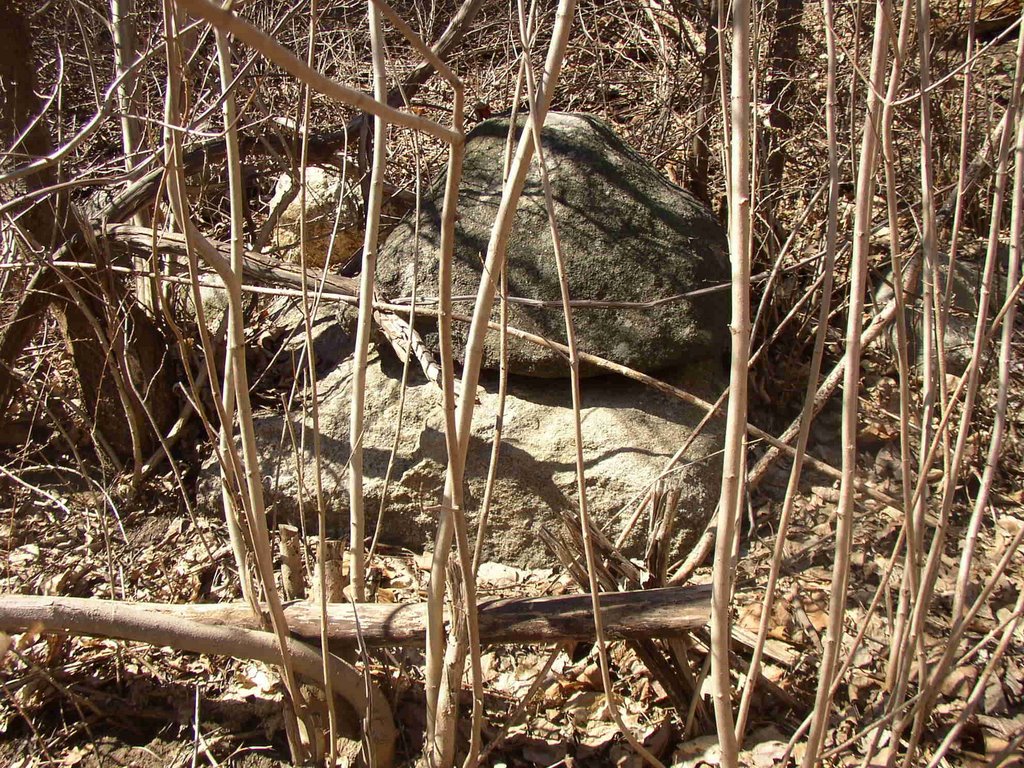
Asnaconick Pond: “at the field enclosed in stones” {stone house} Nip.
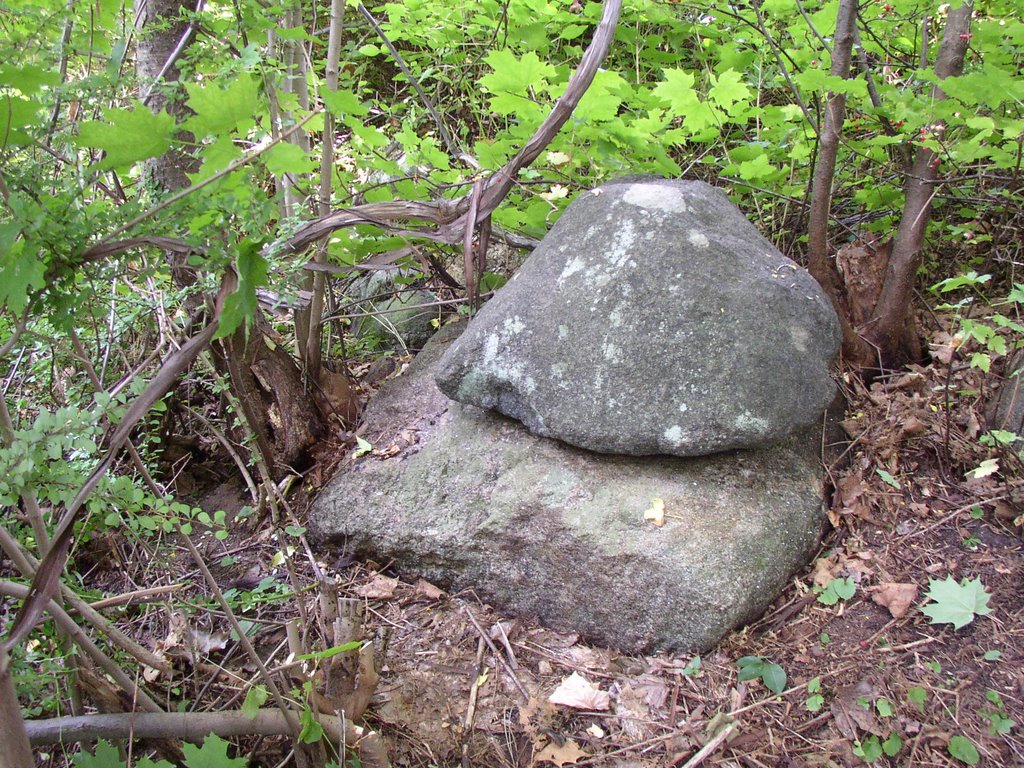
Assameekq: “a cave” or “stone roof” Narra.
Assowompsett: “at place of large rock” or “stone plain place” “trading/barter place” Wamp.
Assinek,Assunoc (hussunek): “Stone place” cave overhang ledges Nip.
Assonet: is Dighton rock, “at the rock” Narra.
autoposit autopscot walled in well or cistern water drawing place / place of wet rocks? Wamp.
B
Babaquamshk: “split rock” Nip.
Bungay “boundary” Quinn. (also in Nip. -gee; Abnaki -y) Photo of Bungbay Rock in Seymour Ct.
C
Canaggogum: “ the fence or boundary” also “highland” Nip..
canapitsit -umet -pache (channel)place of the long fish weir Wamp.
Cassacubque: high rocks
Catacoonamaug: great long fishing place; eels (long fish?)
Chabunnuck kakowak: boundary/agreement place nip.
Chaubongum: boundary Nip
Cheapschaddock: big rocks at boundary Nip

Cheesechankamuck: [branch of Farm. R.] “great enclosed place for fishing” or “big fish weir pool” Tunxis
Chickamug: fish weir ,principal fishing place E Nia.
Chickons: burned so as to be planted, Nip.
Chickons Cattones Akees ; Cottinyakies,Cottinackeesh,Kittikanakish: “small plantation” Natick
Commquessakumkanit: at the rock which stands erect Wamp.
Cuppan augunit: ancient place of refuge n. of Stonington “enclosed hollow place” glacial kettle?

W:
Wabbaquassik(-uk):“place of white stones”?
or rush mats for covering a lodge Nip.
Wabash “white things (stones?)” Nip. “winds” Narra.
Wabbassick At the little white place/ small place eastward Wangunk

Wachocastinook (Creek): “at the place where the walnut trees grow on the hill” “land at stony hill” Mahican
Wakalosen Fort Knox, Waldo Co. Me. “rocks in a circle” enclosure or fort?
Wakoquet “house place” Wamp.
Waktiompsk “rock house” “dwelling among the rocks” “rock cave dwelling” Wangunk
Wallamanumpscook {Worchester Co. MA} “at the rock standing in the red paint place” Nipmuck
Wallempteweekek {S.Twin Lake Piscataquis Co ME} Pl. of deep rnd lake
or, from Natives “coves surrounded by burned land”
Walloomsac “beautiful or paint rocks” Mahican
Wauwonoquassick: “witness rocks boundary place” Mahican/Siwanoy?

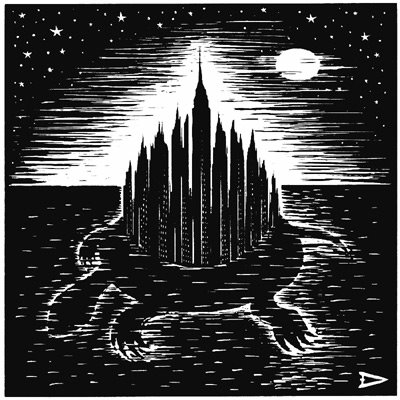
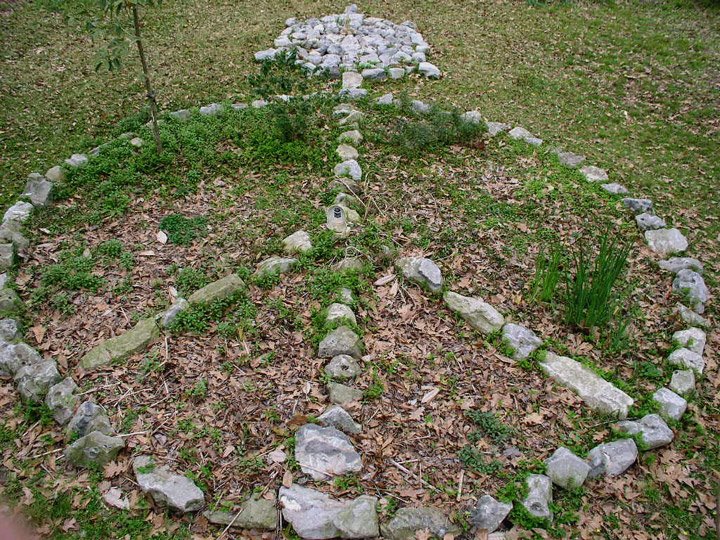
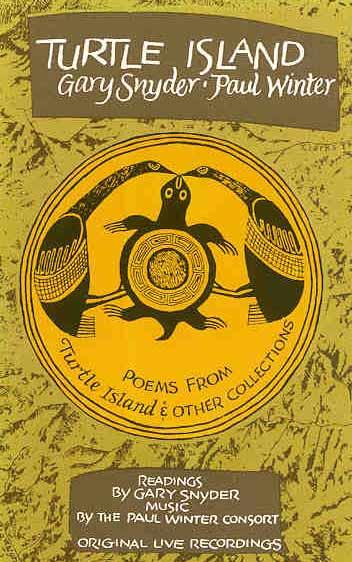
Turtle Island Graphic


From:
http://www.drooker.com/


Yesterday's clear blue skies - and everything else connected to the date-had me thinking about the Island...


Here's another one, also connected:


And one more:


Drucker also created the logo for
Free Speech radio News:
http://fsrn.org/

Wednesday, August 30, 2006

Sacred stones or cottages lots?

The turtle's seven parts — head, body, tail and four legs — symbolize the seven codes of life: bravery, respect, honesty, humility, wisdom, honour and sharing.”

Monday, September 26, 2005
posted by db on Tuesday, September 27th at 3:20 PM
by JULIUS STRAUSS From Tuesday's Globe and Mail Silver Falls, Man. — When Caroline Bruyère was last taken by her family to the site of the sacred turtle on the banks of the Winnipeg River, she was a small girl. Now an elder of the Sagkeeng First Nation and a 62-year-old grandmother, she returned last week for the first time in 50 years. For the occasion, she put on a ceremonial sky-blue dress adorned with brightly coloured ribbons, sweetgrass and other talismans. She pointed out the stones that had been carefully placed by her ancestors around the turtle. "To you they're just rocks," she said. "But to us they are grandfathers." In the coming weeks, this pristine piece of the Canadian Shield is to be parcelled out and turned into lots for cottages...

...(T)he Anishnabe natives consider the turtle one of their most sacred symbols. The stones placed around the animal represent the incarnation of the spirits of the ancestors. The turtle's seven parts — head, body, tail and four legs — symbolize the seven codes of life: bravery, respect, honesty, humility, wisdom, honour and sharing...

...Ms. Bruyère is one of an increasing number of aboriginals attempting to reclaim her culture and the forgotten secrets of thousands of years of spiritual history. It is a journey fraught with frustration and setbacks. Much of the oral history has been lost and few, if any, records remain from the old days when aboriginals could be fined or imprisoned for practising their traditional rituals. "Our ancestors have passed on and they didn't tell us where are spiritual sites were for fear of persecution," Ms. Bruyère said...
...But while she clambered among the rocky outcrops and the small, wet clearings near Silver Falls last week, her eyes glowed with youthful excitement as she became aware of other ancient aboriginal petroforms. There were stones set equidistant in a circle and a sort of a stone ledge — Ms. Bruyère explained it was a spirit chair — surrounded by rocks...
...Non-natives often dismiss the sometimes vague claims that they are violating aboriginal religious grounds. Unlike European settlers, natives didn't typically clear the land and build imposing churches. Instead, their places of worship incorporated and augmented natural geographical features. To a white settler, the sacred turtle probably looked like an unremarkable outcrop of granite...
...Ms. Bruyère believes that only if the natives' ancient spiritual sites are protected can their culture rebound and the people begin to recover from the trauma of the whites' settlement of the land. "When Christianity came to this continent, our spiritual culture was outlawed and we weren't allowed to practise our spirituality. We have become dysfunctional because of that. That's why our people are having such a hard time." Then, before she left the site of the sacred turtle, she turned and, as though to herself, said: "I'm so happy we can find what our ancestors had and rediscover our spirituality. We're very young at doing this."

From:
http://friendsofgrassynarrows.com/item.php?426F
&
http://aol.theglobeandmail.com/servlet/ArticleNews/aolstory/TGAM/20050926/NATIVES26

two hammonassett turtles


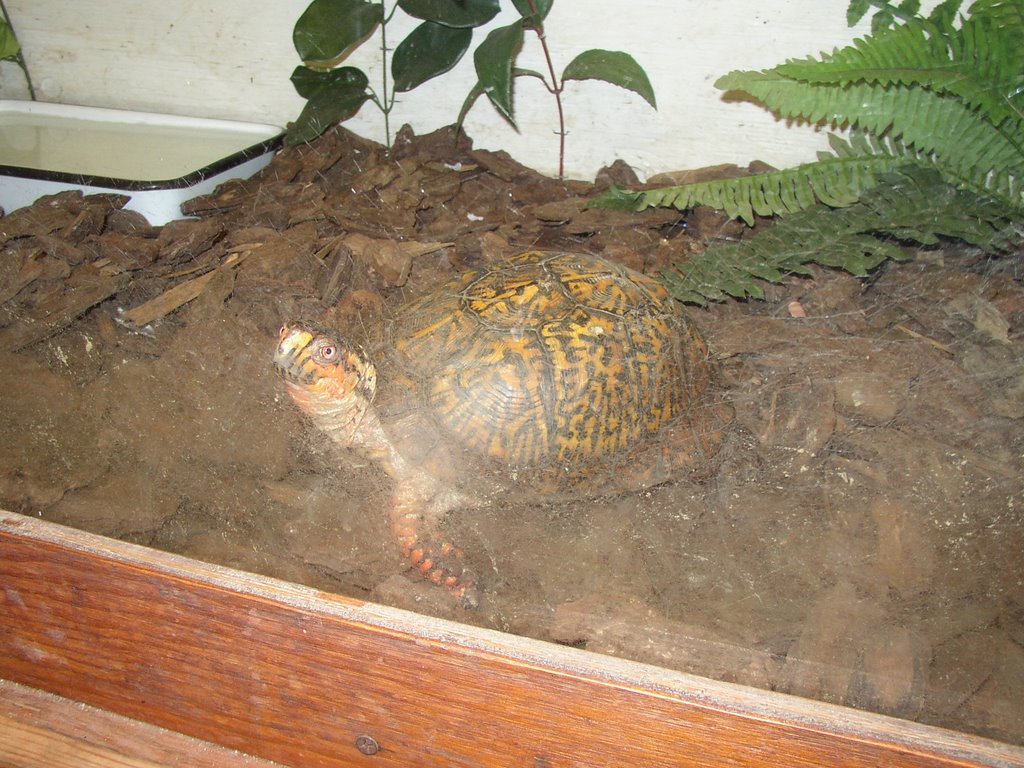
Box Turtle


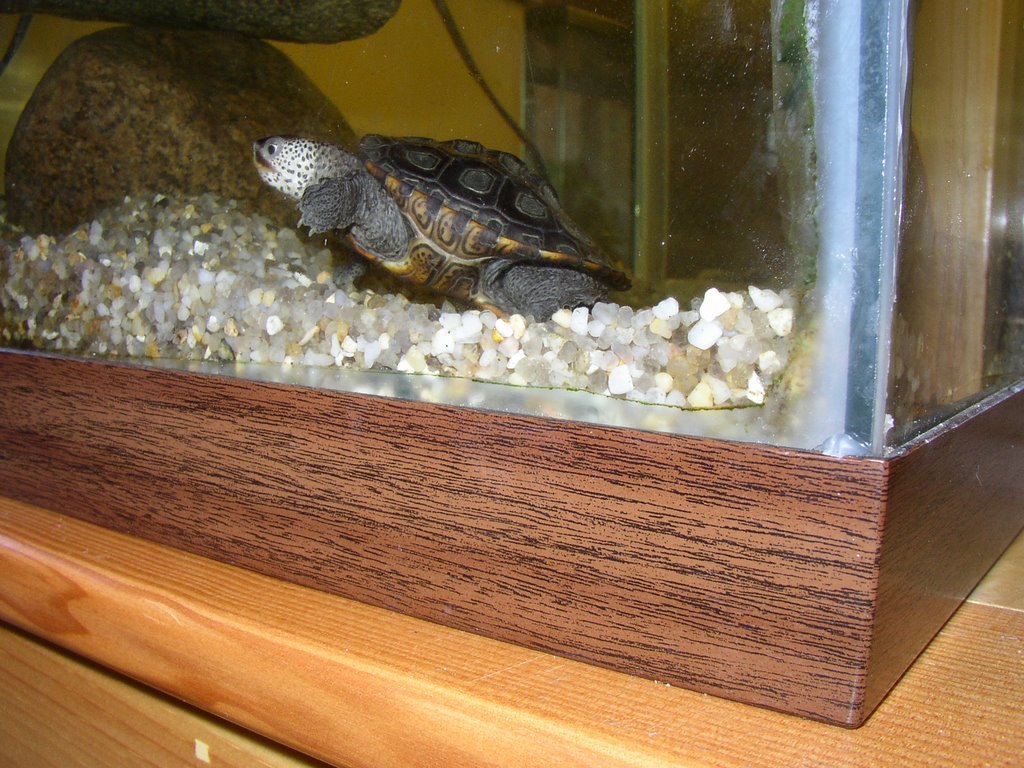
black diamondback terrapin

Friday, August 18, 2006

Constant prayer


It's a (modern) Stone Turtle attached to another symbol in stone that is a constant prayer for Peace.
I don't remember where I found it, but I seem to remember it's the work of Viet Nam veteran...

Link


I keep trying to add this link, as well as copy Peter's links:
http://rockpiles.blogspot.com/
but I just can't seem to do it.


And this one too that has nothing to do with rocks or stones:
http://www.myspace.com/toadandthejugadelics

Wednesday, August 16, 2006

Friday, August 11, 2006

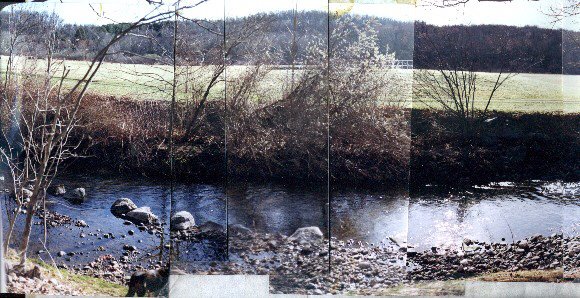
Diagonal Stone Fish Weir

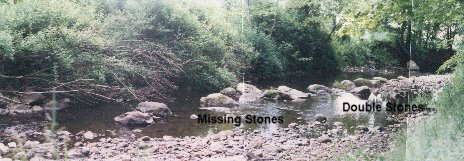
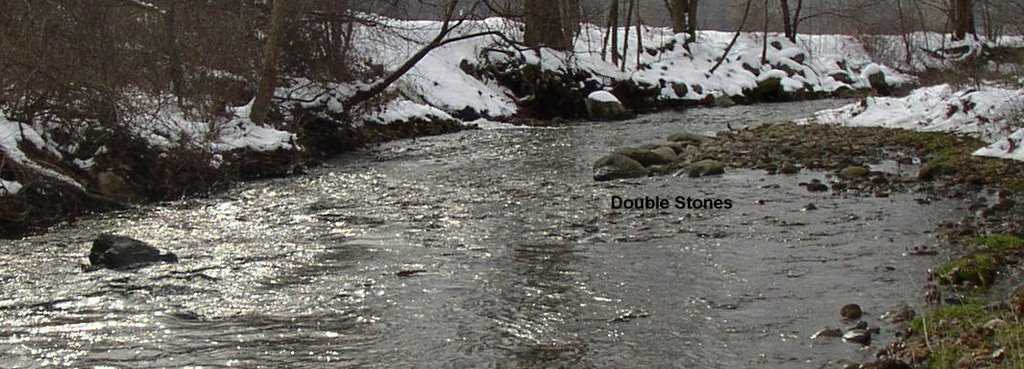
A diagonal stone fish weir...
Summer 1997


Winter 2005...

And a short slide back to the year 1999...


(I took these photos from up in a tree and scotch taped them together...)
And then back to the Fall of 1998...


Close up of the Double Stones...

Thursday, August 10, 2006

Just One Picture

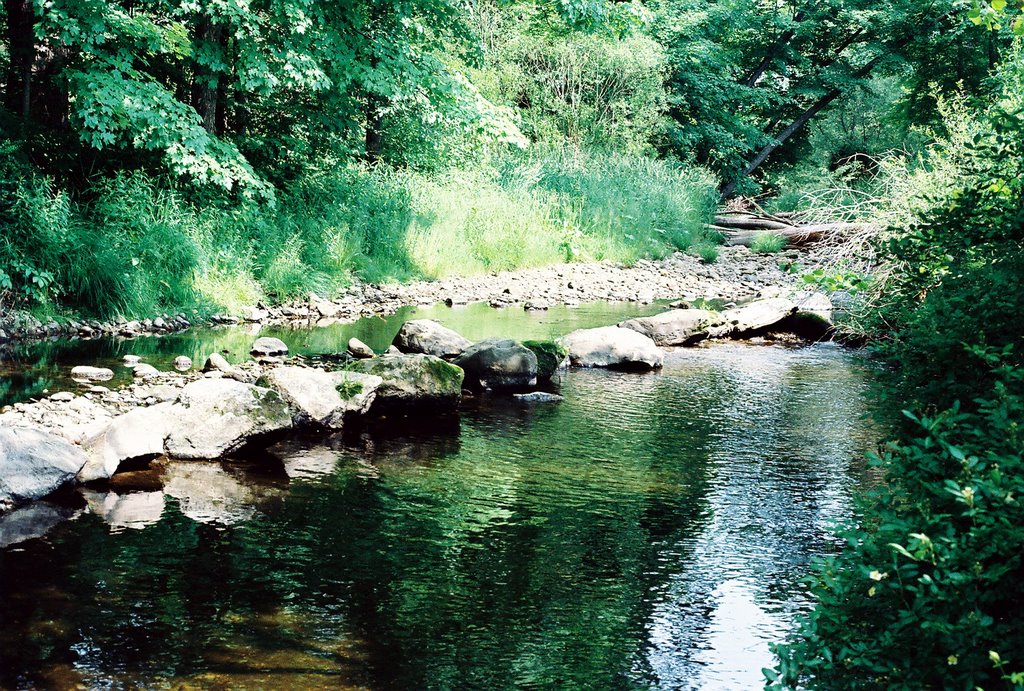
There was lots of rain this year, so the river ran high by what I think is the Stone Fish Weir. I found it hard to even go across the field to look at this structure that gave it's place-name to the area.
I hoped to get the Weir on the National Register, get it recognized, maybe preserve it, ever since 1997 when I realized what it was, this diagonal line of stones that's been here for who knows how long.
I've got tons of photographs that do little more than document its slow dissappearance due to the natural forces of erosion.
I went over the other day, July 29, 2006.
I took one photo and my camera batteries died.
It's the most upstream end of the Weir, where the river is eroding the east bank, a spot most likely to contain artifacts...

Wednesday, August 09, 2006

Water

7-1 CHAPTER 7 NORTHERN CHEYENNE CULTURAL RESOURCES
Pg 7

“Water."
"Springs, rivers, swamps and ground water are living beings with spirits.
According to the 2001 Northern Cheyenne Reservation Survey on Traditional Economy
and Subsistence, over 97% of the people believe that springs have spiritual value.
Furthermore, over 90% recognize that water is very important to their social, economic
and spiritual way of life. “The conceptual meaning of water to us would be the physical
manifestation of the essence of life, of life itself, the fabric of life.” (Little Coyote,
1/8/02). The Sacred Buffalo Hat “came to us out of the waters” [of the Great Lakes
Region]. (Little Coyote, 1/8/02).
The Northern Cheyenne communicate with these spirits. The ongoing traditional
cultural importance of these water locations can be seen in the respect shown to these
locations and in the offerings made at these locations. Routine archaeological survey
on the reservation always takes into account water sources relative to the survey
boundaries. A good contemporary example of this is the current widening of U.S. 212
east of Lame Deer. A survey documented the ongoing use of three springs for
traditional cultural purposes and design changes were made to avoid affecting these
properties/areas.
The Northern Cheyenne Natural Resources Department is conducting a survey
of springs on the reservation. This work will include not only the physical characteristics
of these springs but also their ongoing traditional cultural uses and the medicinal plants
that are often associated with springs (Rollofson, 1/8/02, Appendix F).
Water is also associated with the turtle. The turtle is good to eat and is always
associated with ceremonies. Some of the sweat lodges are patterned after the turtle
and its longevity. These sweats are made for long life (Little Coyote, 1/6/02).
The traditional water drum is still used by the members of the Native American
Church. “When you take those drums apart after ceremonial use, the breath of life
comes out of them.” (Little Coyote, 1/6/02). Water drums must be taken apart after
every ceremony. The water must be disposed of in a ritually specific fashion. (Little
Coyote, 1/6/02).
Swamps are filled with many spirits and may be dangerous due to the
accumulation of power at these localities. The Northern Cheyenne recognize the
spiritual qualities of ground water also. There are special prayers for digging wells.
Ground water represents the quiet nature of the earth. It should not be disturbed...”

http://www.mt.blm.gov/mcfo/cbm/eis/NCheyenneNarrativeReport/Chap7.pdf

Friday, July 28, 2006

Next Two by the Road


So, you may be wondering, "What do the next point stones look like?"

Here's the next one...

Natural forces moved the top stone, as did the guy doing roadside mowing for my town. There was a fresh mark last year, but I can't see it now...


I find I don't see much in it today...


Then there's the one after that...


That was spring time and just today
I needed some tomato stakes, so I cut some from around this point stone...


And since Blogger is actually letting me post photos - unlike the past two days - here's the next most visible one, much further down, past the area disturbed when my septic system was re-done many years ago and the guy put in a little access-way with his back hoe/loader.


There's a gentle rise from the road to the stone row. The ground rises sharply above the zigzag, levels out in the Old Garden area. If I stood on the stone, I'd be just a little bit beloweye level to the Garden...


These might have been tossed from the garden, but I think I see abrader stones, some hammer stones, and maybe in time I'll notice other sorts of tools etc. One of my thoughts about these rows is that it's handy for stone tool storage, especially if arrainged in a turtle-like manner - hammer stones, hand axes, abraders, etc. make good feet...

Wednesday, July 26, 2006

Roadside Zigzag

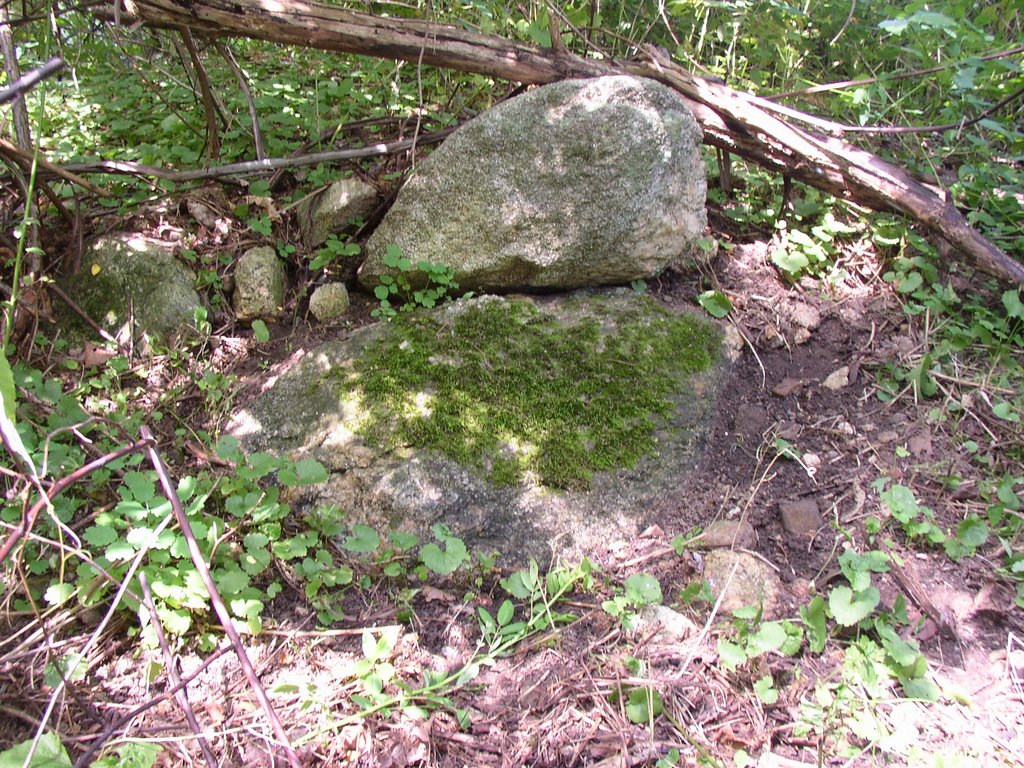
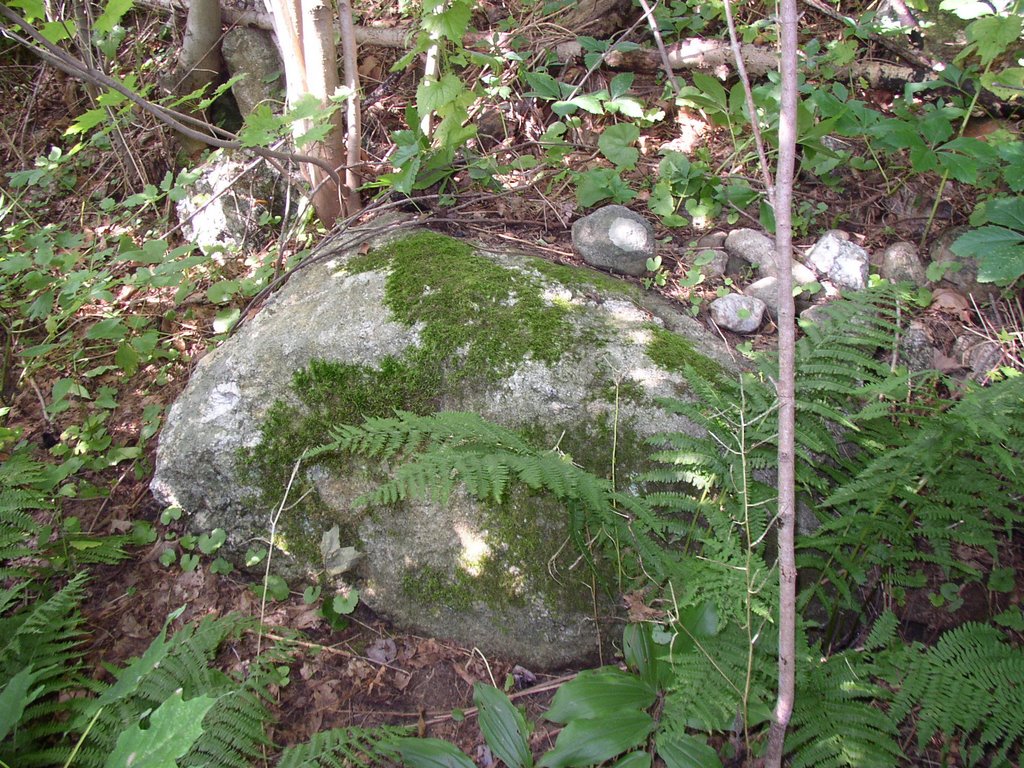
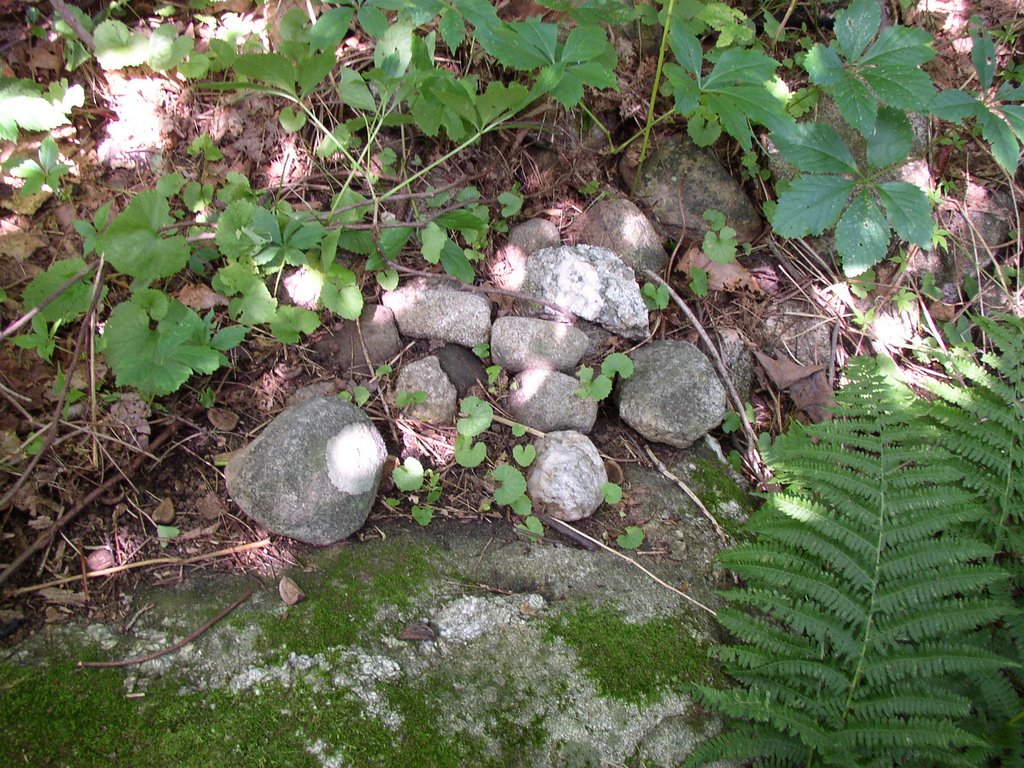
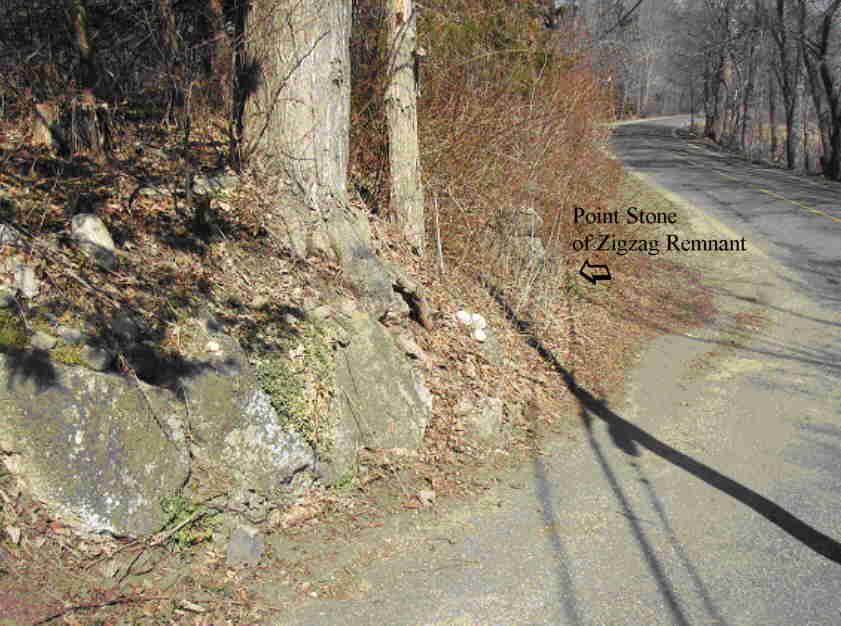
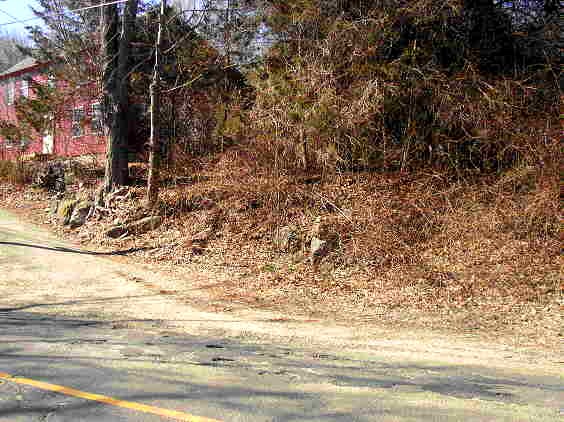
Down by the roadside at the north end of my driveway, newer stonework meets older zigzag stone work.


Note: Looking back  at old posts, I came across this in 2024.
This post has a mind of its own and refuses to be edited,
so I'll simply add this:


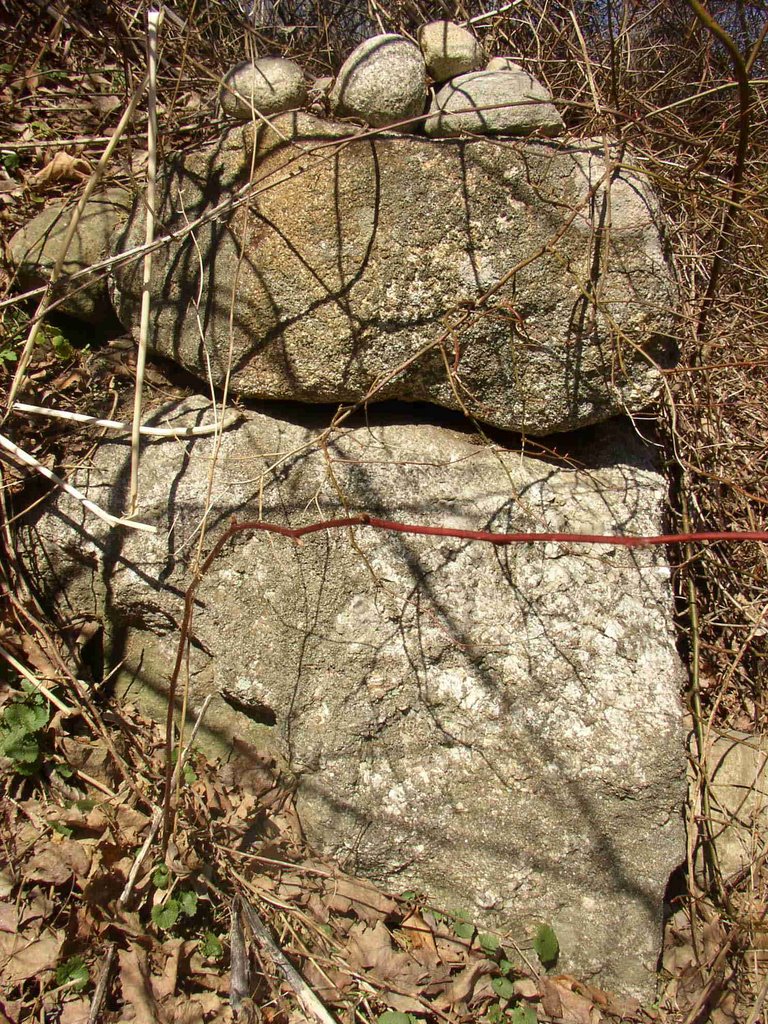
This part is sort of disturbed, I think, but farther along, is a point stone of the ancient zigzag...


Please note that these smaller stones weren't just sitting there on top of these two large stones; they had fallen and migrated into the driveway. I didn't know where else to put them; at least I didn't toss them across the road, which may be what other people who lived here did in the last 300 years...

Notice how nicely these stones seem fitted together...


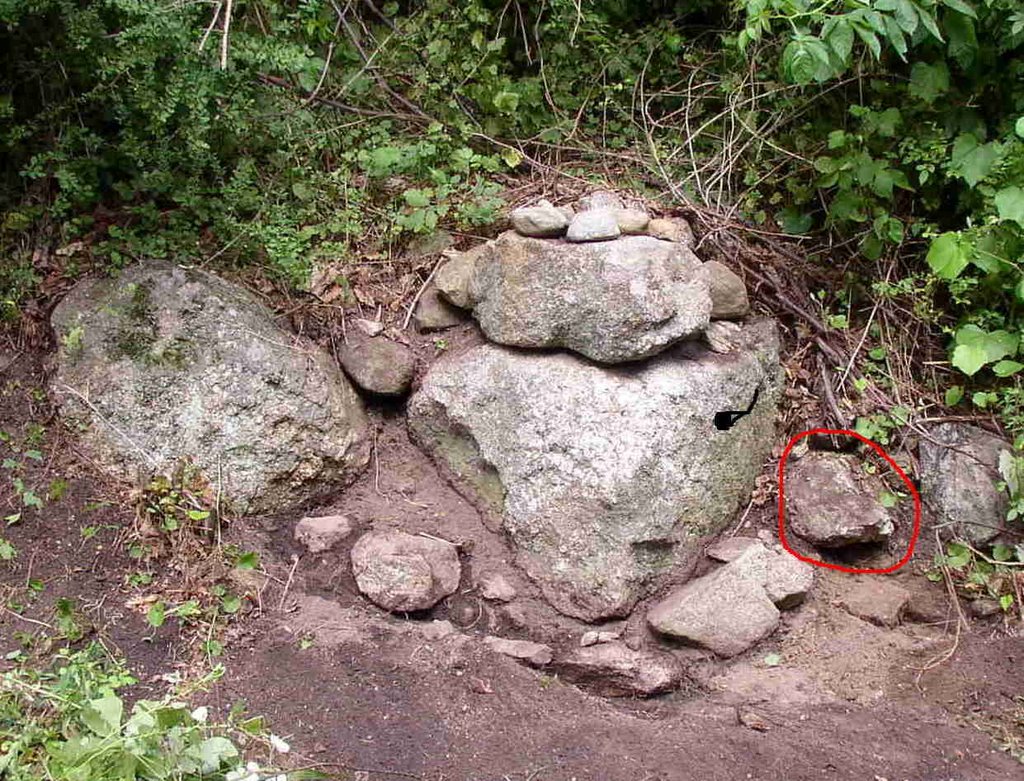
Just lately, thinking about the remnants of rows in my yard, I took a closer look down here, even cleared some brush and debris...


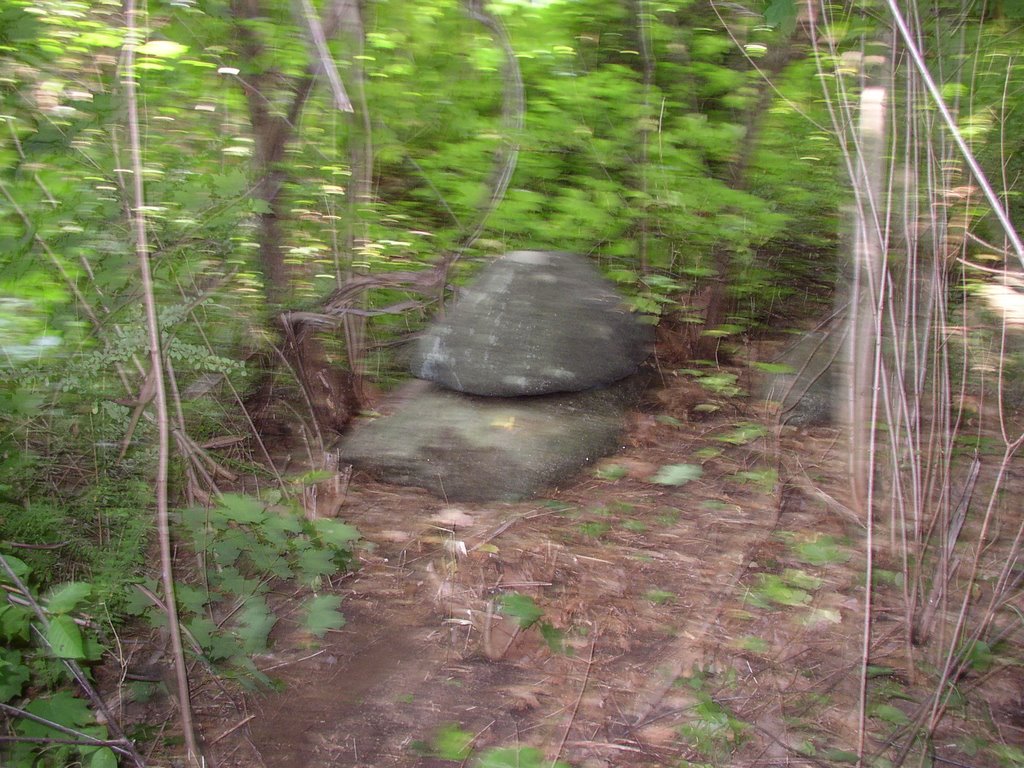
I somehow get the impression that the biggest stone might be a turtle face.
I see the suggestion of eyes and a beak as I look at it.


(Click this one!)


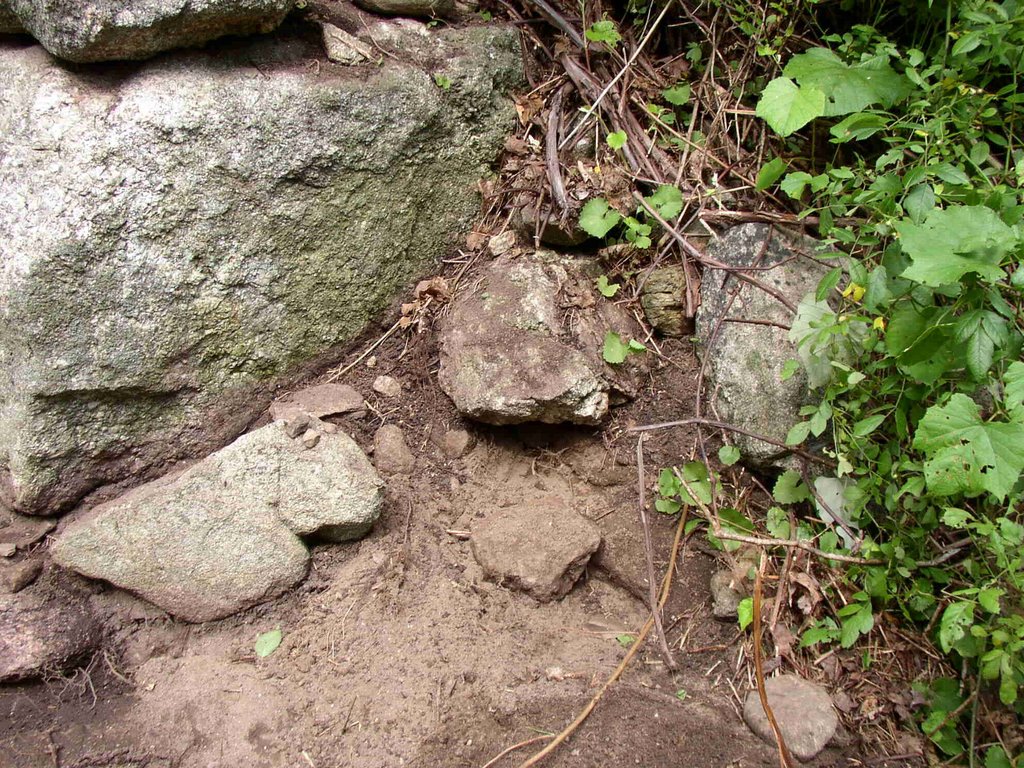
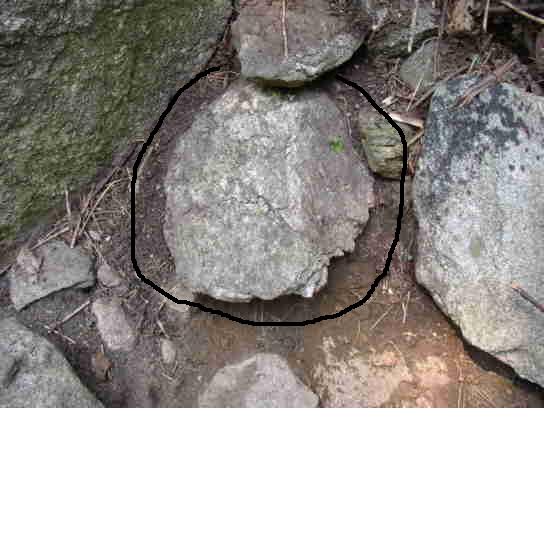
But having just noticed the newest turtle in the chickenyard, and looking for that "low-back" shape, like a mud turtle or painted turtle, a different stone (circled in red and then black in the close-up) caught my attention. It's to the right of the biggest stone...


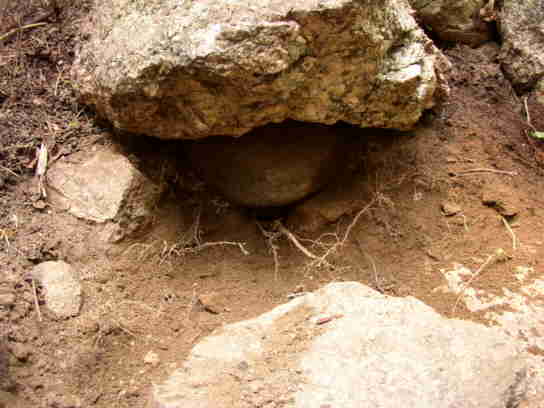
I thought that the stone below it might be the head of a turtle, but brushing away the dirt under the carapace stone (with an actual brush), I now think I'm seeing the plastron stone that's migrated down hill and under the carapace that's also migrated down over the years...


I added some eyes and nostrils to the photo with my paint program...