Tuesday, September 05, 2017

Other End of the Other

And ...
Above: adding snapping turtle eyes. Below: Before adding the snapping turtle eyes. 
I could overlay some turtle eyes on that lighter colored stone,
 but the close up shows there’s no need to: 

The rows no longer connect to the outcrops, the land slopes downward.
  Another zoomorphic stone:

 The slope continues to go downward, gets a little steeper:
Interesting Stone, interesting stacking:
The Row of Stones ends. Down below is the Shepaug River: 
   I took a southeasterly (and upward) route from there – and was at first disappointed at my first sight of this massive set of walls, mostly due to all the assumptions that go into thinking that this is an “Estate Wall,” with capstones even, just as described in your field guide to New England Stone Walls...


But I continued on anyway...

Monday, September 04, 2017

Details along the Other Walls


   & the two previous posts from the same “site.”)

   Not tossed, but placed, and very Deer-like:
    Maybe this is also something, another zoomorphic stone, maybe a deer – or maybe a serpent with a single horn on the top of its head:
And there beside it, a shape that reminds me of a birdstone – not a polished one but sort of a “birdstone in the rough:”
   Here’s a birdstone drawing, lifted from https://www.iaismuseum.org/annual-events/birdstone-2/
   Here’s another example of one – shown standing on its tail, for some reason:


(Doctoring the image:)
From: Making Pictures in Stone: American Indian Rock Art of the Northeast by Edward J. Lenik


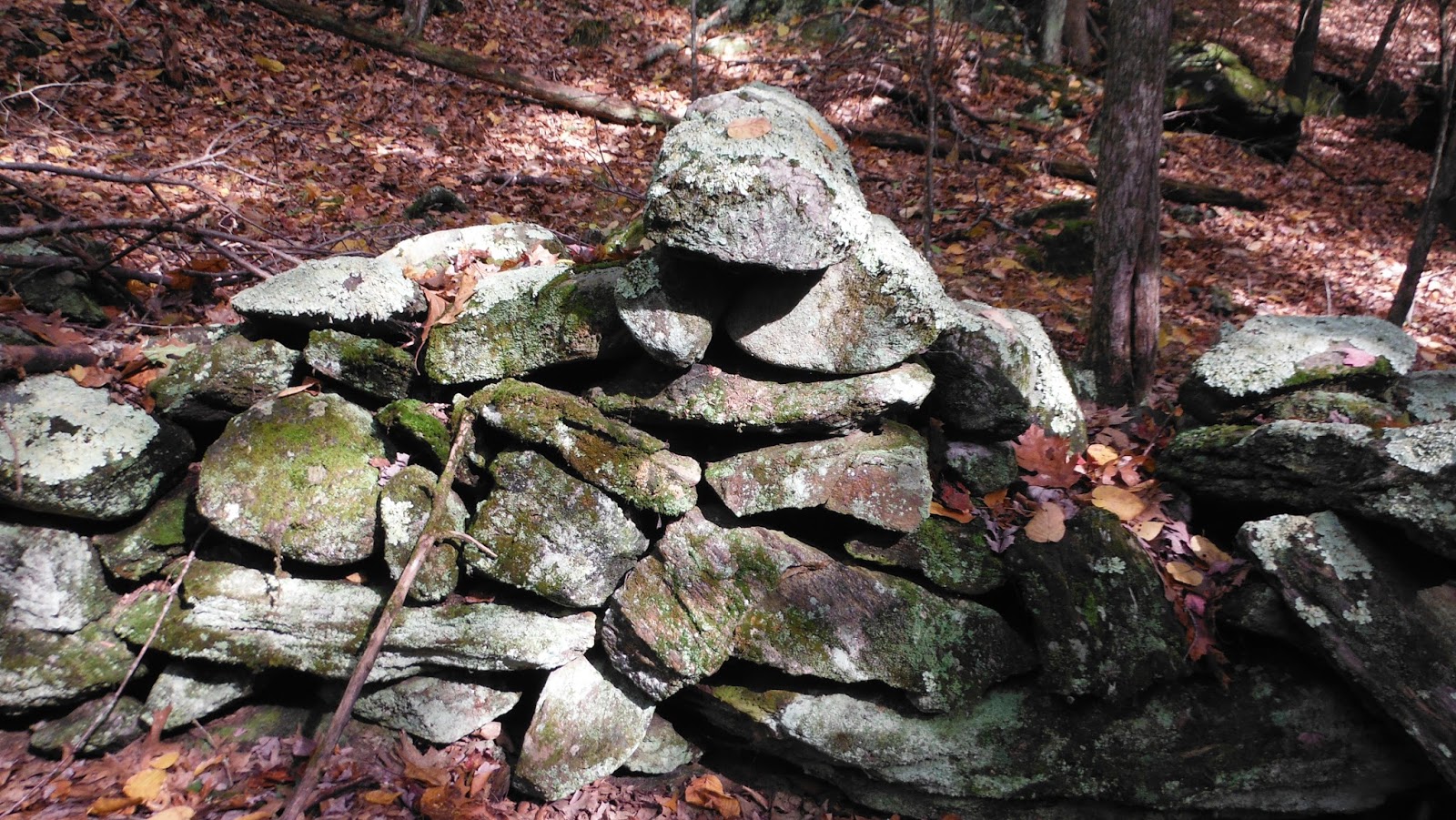
Some interesting stacking of stones:


Sunday, September 03, 2017

The Other Walls


   The first stone walls I started to look at before the last Archaeological Roundtable on Ceremonial Stone Landscapes in 2014 (on the grounds of the “Toot” anyway – I pass miles and miles of walls as I take some back country shortcuts to get to the place) were not so massive as that big enclosure in the last two previous posts. These rows of stone near the entrance to the museum and parking lot (look carefully and you will see the sign and lamppost) are not quite linear in nature and flow with the topography – and could be said to resemble the body of a rattlesnake. 
    I looked at the stones on the side of the road awhile, looking for signs of stones placed so as if to recall animals or human-like heads, found a few:


     Then took a walk “northish,” along the lower western border of the property - which turns out to be a Land Trust property:
    So, there by the lower red arrow, a segment of stones begins. It’s only with hindsight do I suddenly now see that the stacking method could sort of be the imitation of rattlesnake scales (squamation or scalation):

Prompting me to paste an eye onto the image, under a long flat stone that resembles the supraocular scale


Looks like there were two photos I meant to merge, so here you go:
 I’ll be durned if there isn’t a second neglected set – the row of stones that branches off to the west: 
 And a third:
 And a fourth:
     I’ll end this post for now, leaving you with some more from Rolf Cachat-Schilling in A Quantitative Assessment of Stone Relics in a Western Massachusetts Town:

  1. Structures are positioned in an area where their presence is impractical for known post- Contact Euroamerican economic uses and their construction is difficult.
  2. Structures consist of stone types and shapes not evidenced in nearby Euroamerican structures, or in historic-period overseas examples of European stone works (esp. Scotland, Ireland, Brittany, Italy, Portugal).
  3. Structures show labor intensity and extent of labor that is impractical and would be inefficient/wasteful under pragmatic terms.
  4. Number and elaboration of features are obstructive of co-use for grazing, watering stock, etc.
  5. Frequency of structures and similar sites defies practical explanation.
  6. Orientation and nature/types of features do not translate to Euroamerican uses.
  7. Orientation and nature/types of features translate to known Algonquian ritual uses (direction of ritual significance, primary re- source orientations, unique land feature orientation).*
  8. Features fit known ritual practices of the Middle-Late Woodland-to-Contact Period.
  9. Terrain on which features sit lacks evidence of Euroamerican use, documented or by visible artifact (including vegetation types, tracks, debris, relics).*
  10. Neighboring terrain is unsuited to Euroamerican uses.*
  11. Site lacks evidence of Euroamerican structures.*
  12. Site is consistent with recorded Algonquian CSL sites in terms of location and content.*
  13. Structure lacks evidence of recent tampering.
  14. Structure is consistent with other structures on site.
  15. Structure is consistent with structures in other sites in town.
  16. Structure is consistent with known structures outside of town, but in the Eastern Algonquian region.*
  17. Structure is consistent with a documented written description, drawing, painting, or photo of an Eastern Algonquian structure.*
  18. Structure is consistent with a known structure that has received Federal or State recognition as a Native American historic feature.
  19. Structure is consistent with tribally recognized features.


https://vc.bridgew.edu/cgi/viewcontent.cgi?article=1202&context=bmas


Friday, September 01, 2017

Note on Some Turtle Shell Revelations

Or “Adding the eyes sometimes makes the rock art come alive." - J.L.


     At first you might not ‘get it,” but that stone wall (or that pile of stones) might contain some realistic imagery of Cultural Icons, dependent of course on the creator’s artistic ability.

     Unhappy with a couple of images of the gateway in the previous post to this one, I wandered back up to that big old “wall” (or qusukqaniyutôk) in order to get a better capture. Along the way I kept a look out for capstones that could be turtles or Tûnuppusuonk - turtle effigies. Yesterday I happily looked through that file and quickly stole an image and pasted some box turtle eyes onto a bit of crop and paste work before and after.
    This morning I look at it and say to myself “That’s not the dome-like carapace of a box turtle, now is it?” So off to pirate an image of a snapping turtle leads me to Wikipedia to lift this one:
      So, correcting myself, here’s the newer image (until I find a snapping turtle who will pose just like that photo on top of that stone wall for me):
    Close by, a little further north, is another interesting sort of turtle that might be a grinding slick of sorts (maybe to roughly shred some soft material?). Thinking “You might not get it” shows how the trick is to view the turtle effigy or Tûnuppusuonk, I’ll show the “hurried on a freezing cold day” capture:
   And then the older one where the viewing angle helps you “get it:”
So I’ll overlay the photo with the correct eyes, toss in another lifted image of a snapper:
Here’s another:
    As a friend once said, “Adding the eyes sometimes makes it (the rock art) come alive.”
(Is it a lower jaw - made of a similar stone/split stone?)

Sometimes there’s a protruding spike sort of thing on a turtle shell, just as in the image above. This has nagged my thoughts for years (at times, I mean – not in every waking moment, although it sometimes occurs in dreams). Maybe it’s not the nuchal notch, but a portrayal of the spike on that first vertebral (along the backbone) scute that fits into it perhaps (and yes I know it’s a box turtle in the photo, but it’s the one that triggered the thought yesterday when I was pasting box turtle eyes on what I should have seen as anything but a box turtle):
How about side by side snapping turtles, Mr. and Mrs. Common Snapping Turtle made of stones?
Single stone "carapace and head" variation:

    I guess I’ll add some of these Snapping Turtle Overlays to the Flickr Album with the whole collection: