Or Indigenous Qusukqaniyutôkanash
1

Qusukqaniyutôk: (‘stone row, enclosure’ Harris and Robinson, 2015:140, ‘fence that crosses back’ viz. qussuk, ‘stone,’ Nipmuc or quski, quskaca, ‘returning, crosses over,’ qaqi, ‘runs,’ pumiyotôk, ‘fence, wall,’ Mohegan, Mohegan Nation 2004:145, 95, 129) wall (outdoor), fence, NI – pumiyotôk plural pumiyotôkansh.) - Nohham Rolf Cachat-Schilling
Bulletin of the Massachusetts Archaeological Society, Vol. 77, No. 2 Fall 2016
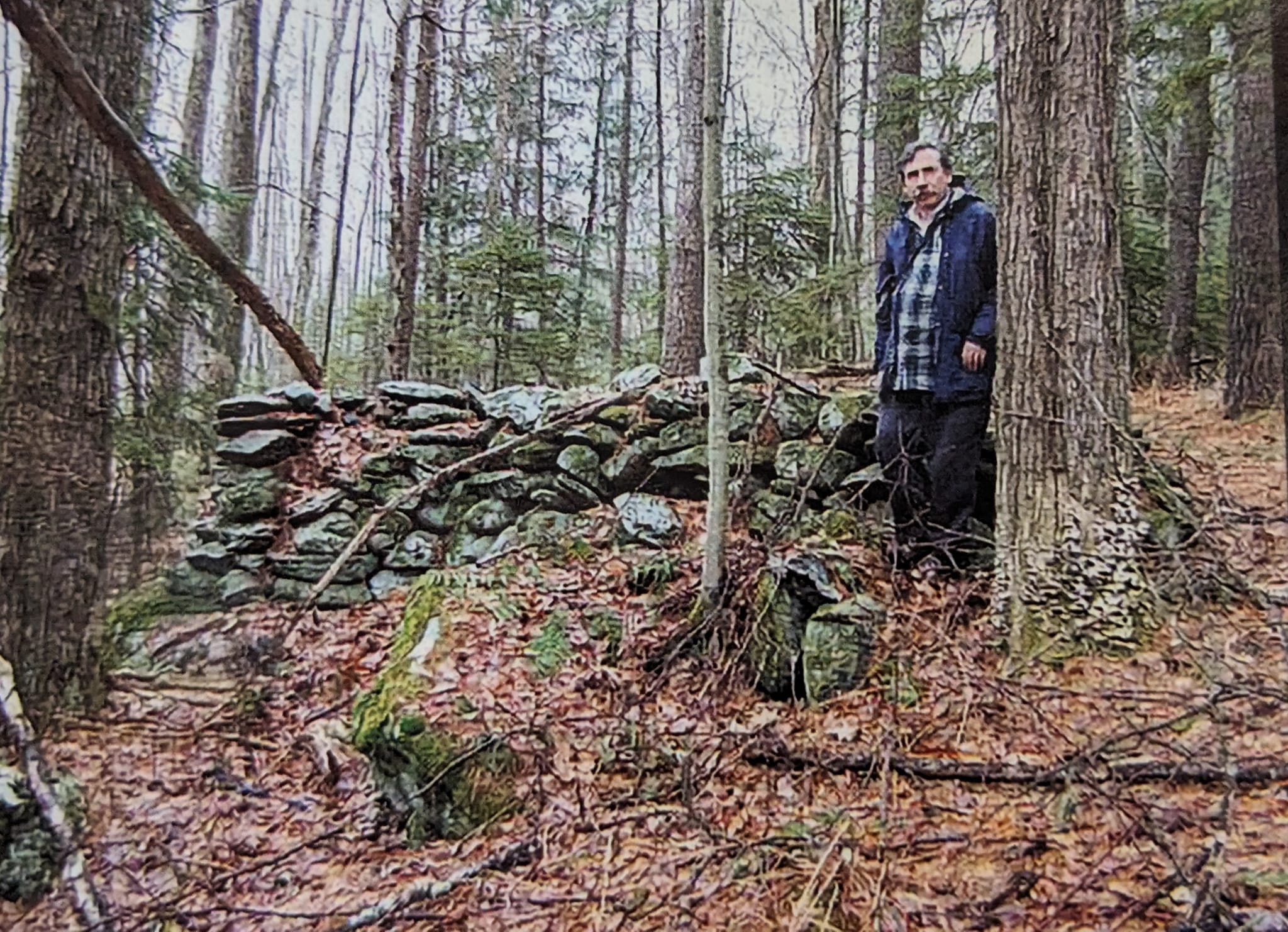
Qusukqaniyutôkansh (pl): Rows of Stacked Stones, colloquially “stone walls” or “stone fences,” often assumed to be post contact constructions related to property ownership and agriculture.
This isn't the exact image I was looking for, but all too often, the older constructions are rebuilt in the following manners, without a second thought, because of the long standing bias that "Indians didn't build in stone until taught to by the English, in New England."
Some "Proper" English Stone Fences aka "Dry Stone Walls:"
“Some of the more remarkable rows (of
stones),” Curtiss Hoffman writes in Stone Prayers: Native American
Constructions of the Eastern Seaboard (2018), “have what appear to be serpent
heads at their ends. These and the more sinuous walls have been reclassified
within the effigies category." - Page 61
A single boulder head is perhaps the easiest to identify:
Not only at the "beginnings" or "openings" of the assumed "stone sheep fences," can the "single boulder snake head" variation of Indigenous Stonework be observed, the "Serpent Stacking" can also be found in segments of what we often refer to as "stone walls." This can be observed in a detail taken from the first image in this post, an assumed Yankee Stone Wall in my hometown in CT:
The same distinguishing characteristics can also sometimes be observed in what are often assumed to be zig zag "stone walls" of accidental construction, alleged accumulated field clearing stones tossed against the rails of early settler colonists first fences composed of wooden rails - just as the more linear "walls" are assumed to be tossed under early cross and rail fences...
Those wooden rails raised the height of the fence up to a legal standard of property ownership by reason of "improvement" - under early colonial laws...


Qusukqaniyutôk (2023): “A row of stones artistically stacked
or laid using elements of Indigenous Iconography, sometimes obviously resembling
a Great Snake, often composed of smaller snake effigies as well as other effigies
both zoomorphic and anthropomorphic, sometimes appearing to shapeshift into
another effigy, possibly related to control of water or fire (sometimes both) on
Sacred Cultural Landscapes that are beginning to be recognized as Indigenous Ceremonial
Stone Landscapes.”
From a perspective of distance, the largest of the Stone Snake
Qusukqaniyutôk snake across the
landscape, crossing over others, sometimes connecting great boulders or bedrock
outcrops, sometimes along streams – and sometimes stacked over and hiding a
stream, a Musical Row of Stones - the sound of water is the Great Snake
contentedly “purring.”
Inside some enclosures, there were “gardens,” plant
resources perhaps tended by fire, perhaps protected from fire, something living
kept in balance, kept in production by someone offering tobacco to a serpent
guardian before entering, someone singing while stacking stones, picking up and
replacing her grandmothers’ and grandfathers’ stones that have fallen.
Zigzag, linear rows of stones, snaking across
the landscape, both sides of an Indian Path or Native American Trail or an
Indigenous Road that’s possibly ten or twelve thousand years old…
See also: