Tuesday, November 03, 2020

Qusukqaniyutôk 2020


Qusukqaniyutôk: a (‘stone row, enclosure’ Harris and Robinson, 2015:140, ‘fence that crosses back’ viz. qussuk, ‘stone,’ Nipmuc or quski, quskaca, ‘returning, crosses over,’ qaqi, ‘runs,’ pumiyotôk, ‘fence, wall,’ Mohegan, Mohegan Nation 2004:145, 95, 129) wall (outdoor), fence, NI – pumiyotôk plural pumiyotôkansh.)  - Nohham Rolf Cachat-Schilling

 Bulletin of the Massachusetts Archaeological Society, Vol. 77, No. 2 - Fall 2016

https://vc.bridgew.edu/cgi/viewcontent.cgi?article=1202&context=bmas


    “A row of stones artistically stacked using elements of Indigenous Iconography, sometimes resembling a Great Snake, often composed of smaller snake effigies as well as other effigies both zoomorphic and anthropomorphic, sometimes appearing to shape shift into another effigy. These rows of stones are often possibly related to control of water or fire and perhaps more on Sacred Cultural Landscapes that are becoming to be recognized as Indigenous Ceremonial Stone Landscapes.”


     From a perspective of distance, the largest of the Stone Snake Qusukqaniyutôk snake across the landscape, crossing over others, sometimes connecting great boulders or bedrock outcrops, sometimes along streams – and sometimes even over a stream, the sound of the Great Snake contentedly “purring,” sometimes also known by many as a "Musical Row of Stones:" 

https://wakinguponturtleisland.blogspot.com/2015/03/musical-row-of-stones.html

Added 7/22/2022:

     Inside certain enclosures, perhaps there was a garden, perhaps tended by fire, perhaps protected from fire, something kept in balance, kept in production by someone offering tobacco to a serpent guardian before entering, someone singing while stacking stones, picking up and replacing her grandmothers’ and grandfathers’ stones that have fallen.

   Zigzag, linear rows of stones, snaking across the landscape, both sides of an Indian Path or Native American Trail or an Indigenous Road that’s possibly one or ten or twelve thousand years old…


Wednesday, October 28, 2020

Protective Great Stone Snakes (Bethlehem CT)

 Guardian Uktena-like qusuqaniyutôk  “a stone wall”

    Another photo from November 2012, a roadside Great Snake Effigy - a Serpent Segment of Zig Zag "Stone Wall" just above the Nonnewaug River and Floodplain. From above (and from 1934):
Only some of these 1934 floodplain cornfields are still cornfields. The "Indian Footpath" is now a paved road, widened in the 1980s or 1990s, obliterating some of the rows of stones whose age is unknown:


Around 1740, when the People who were living at the Nonnewaug Wigwams "moved on," wooden rails were probably added to this Indigenous Stone Construction to establish an "improvement," a legal fence four and a half feet high, that established property rights in what became the Town of Woodbury CT, split wooden rails placed so that it is "qusuqaniyutôkanuk" or “on the stone wall” 


Friday, October 23, 2020

Protective Spirits, Guardian Snakes (Nonnewaug)

    Great Serpents can be Protective Spirits, Guardian Snakes having control over weather and water – and against the fires caused by lightning shot from the eyes of the Thunder Beings (Thunder Birds) as well as the controlled burning Indigenous Peoples used to maintain Balance and create Abundance. I refer to the sideways looking gateway Serpents I observe in the field as Uktena, recalling the Cherokee stories about “the Strong Looker,” as the name translates to, a Spirit who sees your thoughts and knows your intentions as you enter a certain space.
In some Indigenous stories, a tobacco offering pleases the Great Horned Guardians...
2021edit:
This "backbone" row of stones, this snake effigy, shown in red below,
 could be said to emerge from a cliff face,
a "door" to the Underworld home of the Great Serpents: 
(Stupid Sheet lifted from Rock Piles)

The cliff face spot where I've watched the Winter Solstice sun set,
a little warm spot with a snow free place to sit:

Western terminus of the row of stones/effigy:


Just below that, a Serpent Gateway
where three rows of stones meet:


Serpent heads at some of the "points" of the ten foot segments of zigzag stones:


The (enhanced) white dot above is the grinning, shape shifting serpent's head, in an aerial photo from 1934. The linear segment behind (north) of the head becomes a zigzag row of stacked stones, "regular and even" ten foot segments...


Thursday, October 15, 2020

Medawlinno Footprints (and more)


Sherry L. Gould writes:

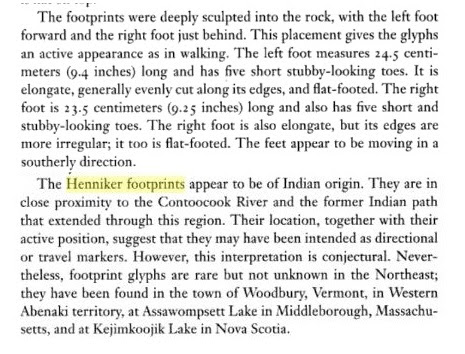
These footprints are in Henniker NH where the Abenaki believe foot prints were left here by Medawlinno. People with extremely powerful medicine, like Passaconaway, could press their feet into solid earth.

    There is no oral tradition of what person may have left these prints in the rocks in Henniker that we have found yet. Just our traditions of what kind of person was able to do it, and traditions of Passaconaway's abilities.


 “We had a great hike to the footprints today. With input from Bob Goodby and Nancy Jo Chabot, the outcome is undetermined origin. Dr. Goodby feels the oval indents could be a natural occurrence, but all agree the defined toes are not likely a natural occurrence. We need to do more research for Dr. Holton's original files on the prints, and search for oral history in the area for significance.


  The rainy pictures are from today's hike, pictures by Vicki Blanchard. The sunny pictures are from Saturday's hike with Polly and Angela Fleming (the photographer). I slipped my shoes and stepped in the prints, they are surely a size 7 and the feel was very smooth and fitting…”

https://www.facebook.com/Abenaki-Trails-Project-130903648704620


  “Passaconaway (Child of the Bear) - He was known as a peacemaker. He had a vision that the newcomers, who arrived in ships from the east with white sails, were coming on clouds and that they would dominate the land with their coming…”

https://www.cabinet.com/news/merrimack-news/2019/04/19/native-americans-of-merrimack-their-chief-passaconaway/


Medawlinnoak, “medicine people”

“The convergence of spirit, the elements, and resurgent prolific life – epitomized by over-arching sky, shaped and shelving bedrock, sunlight and reflection, deep and strong currents – create a place of exchange. Spirit is able to move between worlds more readily here; the edges between the underworld of earth and water, existence on the surficial plane, and the above world of sky, blur and cross over. Things are in a state of flux, moving and mixing, intersecting. The constant change of creation is present here, closer and better accessible. This is one reason that messages of acknowledgement in the form of petroglyphs are often found at these places. These ancient representations, placed by medawlinnoak, medicine people, as they worked to seek balance with and through the presence of spirit concentrated there, continue to speak their opportune truths into the present. We see and hear them even now, carrying through the dysphoria and disturbance of the modern milieu…”  Rich Holsuch - March 31, 2019

https://sokokisojourn.wordpress.com/tag/medawlinno/


Wednesday, September 23, 2020

Thursday, September 10, 2020

"Unfind It!"

 Trump vs the National Historic Preservation Act (4 years or so ago):

    "You might wonder what a lowly archaeologist might have to do with the likes of one of the current Republican Party frontrunners.  Several years ago, one of my coworkers had the dubious honor of performing an archaeological survey on some of Trump’s land.

      In many places, in accordance with various laws and statutes an archaeological and environmental survey has to be performed before land can be developed - this is to protect historical and cultural resources, endangered species, and water and air quality.  To a lot of people (Trump included) it seems like a big waste of time, but this is how many thousands of people earn a living (myself included).

     “Several years ago, one of my coworkers had the dubious honor of performing an archaeological survey on some of Trump’s land...One day, while my coworker was leaving the field, a limo pulled up and a window rolled down.  A hand from inside the vehicle waved him over.  There was the Donald himself, wanting to know the progress of the excavation.
    “Find anything?” he asked.
     “Oh!  Yes-” Trump’s question is one you only want to ask an archaeologist if you have time to kill. We love to talk about the stuff we find, and my coworker made the mistake of thinking Trump actually cared because a few minutes later (Trump stated):
 “Unfind it.”
     No matter how many grumpy landowners and construction managers we deal with, a statement like this always comes as something of a shock, and in my coworker’s telling of the story, it took a moment to process. 
 “What?”
  “I said, Unfind it.”
      That was about the moment where he realized what exactly it was that Trump wanted him to do.  Not gonna lie, going through an attempted strong-arming from the man himself would be a little surreal, and my friend handled it better than I would have: “Oh!  Sir, we will ensure you are in compliance with all relevant laws and statutes.”
     “That’s not what I said-”
      “We’re here to ensure you are in compliance with all relevant laws and statutes, and that’s what we’ll do.”

      At this point, Trump must have told his driver to drive off in a huff, because the window rolled up and the limo pulled away...”
  
Condensed from:


Thursday, September 03, 2020

Snakes and Rockalopes


       It took me a while to figure out just what someone meant when she said, “(It’s) A Turtle. Not a snake or a Rockalope. ”

      See: I often enhance photos of Indigenous Stone Effigies with an "overlay” of eyes and horns or antlers to “bring the image alive,” as Doc. Johnnie Rock Lobster puts it or “to hit you over the head with the fact that you are looking at a Ceremonial Stone Landscape feature such as Turtle or Snake Effigy.” 

Or as I once put it to Doug Harris when I was worried that I might be disrespectful doing so, when my intent was to illustrate a form of Rock Art in hopes that these features can be recognized, studied and protected, as is done in Civilized countries around the world. I was relieved when Doug told me he didn’t view the practice as disrespectful, so I continue to “hit people over the head” with these images of Turtles and Great Horned Snakes (or Serpents), the latter often with antelope or more often deer horns superimposed on photos – like a two dimensional taxidermist creating a “Jackalope,” but only sort of…

     Wikipedia tells us: “The jackalope is a mythical animal of North American folklore (a fearsome critter) described as a jackrabbit with antelope horns. The word jackalope is a portmanteau of jackrabbit and antelope. Many jackalope taxidermy mounts, including the original, are made with deer antlers…Folklorists see the jackalope as one of a group of fabled creatures common to American culture since Colonial days. These appear in tall tales about hodags, giant turtles, Bigfoot, and many other mysterious beasts and in novels like Moby-Dick. The tales lend themselves to comic hoaxing by entrepreneurs who seek attention for their products, their persons, or their towns.

{ https://en.wikipedia.org/wiki/Jackalope }

       The same source tells us that “The Horned Serpent appears in the mythologies of many Native Americans.[1] Details vary among tribes, with many of the stories associating the mystical figure with water, rain, lightning and thunder. ..Horned serpents appear in the oral history of numerous Native American cultures, especially in the Southeastern Woodlands and Great Lakes.

{ https://en.wikipedia.org/wiki/Horned_Serpent }

   I’m showing you a mythical being, but I’m not trying to fool you about these seeming Rockalopes.


  I’m showing you a unique artistic creation that is commonly dismissed as “a linear line of refuse,” supposed field clearing piles and “accidental” stone walls like zig zag stone walls as well as  all the fancier stacked “sheep walls” attributed to Post Contact Settler Colonists.  There’s an older Indigenous Cultural Landscape others may be erasing from the present day landscape by a reluctance to recognize, study and preserve something ancient and irreplaceable, a National Treasure.