Wednesday, December 28, 2016


Tuesday, December 27, 2016


Monday, December 26, 2016


Sunday, December 25, 2016
Crowning Jewel (So to Speak)
I can’t believe that
my grandkids aren’t awake yet, Christmas morning, calm and bright.
So I pour some coffee and open up a file
of photos called “around 3-12-2011” and I find a Serpentine row of stones:

There’s interesting stonework all along this “terrace” above
the floodplain...
But then as I walked north along all these interesting
stones, just below the state highway, I stopped to take a photo of a steep spot
where a spring emerges from the ground:

There is a lot going
on here to say the least, but do you see it, the Crowning Jewel, so to speak?
Saturday, December 24, 2016


Friday, December 23, 2016
Something Serpentine
I was looking
for more Mound Swamp 2006 photos, and while I was doing that, I came across this one from the same year, taken a mile or more away, standing in my driveway:

House of
Undocumented Age (Circa 1700?), detail of the stone retaining wall and NE entry
to yard.
Sometimes the
light hits the stone just right, so that you can see the marks made by whatever
tools were used as field stones were dressed to fit this wall together.
Sometimes the
imaginative investigator can observe Something Serpentine about those marks:


Thursday, December 22, 2016
Uktena at the Bald

Above: You step up from the present day path that interrupts this zigzag row of stones, up by the northwest corner of what I think of as the "Mound Swamp." You step up and you feel it with your feet, the big flat dome or "bald" of bedrock just below the leaves and debris of fallen branches.
I imagine that back when the Pootatuck were maintaining their Homeland landscape with fire that this was kept clean - firewood gathered and afterwards a low ground fire was set to keep it free of leaves and unwanted brush, yet encouraging the "wild" low bush blueberries (that are still present) to grow and actually boost the yield of the plants. Below: The Yellow "You Are Here" dot shows about where the photo was taken, the black and grey line at 10 o'clock of that dot is the zigzag row of stones - and if it's been windy enough, that rough oval of contour lines is exposed bedrock:


For well over 25 years now, I've occasionally visited this spot, sometimes just looking, sometimes observing and sometimes even both. For about 10 years I've been posting images, drawings and conjecture here or at Rock Piles - and on a Sunday after a NEARA meeting in Danbury CT just before the turn of the century, I visited the site with Peter Waxman and Norman Muller.
And I suppose you could say in those last 25 years I've been unlearning everything I'd been taught about New England Stone Walls in the first 25 (or 30) years of my life, especially the serpentine and zigzag ones. Recently, I've been looking at identifying characteristics of the actual rattlesnake most authorities say is the model for the Great Horned Serpent/Snake, the Eastern Diamondback Rattlesnake (even learning some of the scientific names of certain scales) and comparing those diagnostics of rattler identification to the stacking method, Serpent Stacking, that I think I see/observe in suspected Indigenous stonework.
Sixteen or seventeen years ago, I didn't imagine that I'd come to be pretty certain that some (maybe most) of these New England Stone Walls should be considered to be the Great Serpent Petroforms of Turtle Island. When I took that photo above, I still wasn't as positive about that snake business - or that these larger effigies were composed of the other smaller effigies I seemed to be observing. These Great Serpents are composed of other serpents and all sorts of other "beings" of all sorts, often represented in other forms of Indigenous artwork, the Native American Iconography, these large artifacts that are sometimes taken for granted...
And I guess "represent" is the wrong way to say it.
Just like saying "decorative" about a "design" on Indigenous Pottery.
These "walls" are The Great Serpent, just like zigzag quillwork on a deerskin bag is the power of lightening and water and, well, the Great Serpent...
These Great Serpents are made of other smaller Serpents, stacked on other Serpents, mixed with turtles, bears and deer, birds and and human or maybe spirit faces, stacked in a way to resemble scales or sometimes markings, and even some that seem both markings and scales...
So looking at the 2006 photo above, at the stone in the center that just caught my attention, observe: the carefully made (rather than a "tossed or dumped" collection of stones where a Snake Rail Fence stood on a small low dome of bedrock below a thin cover of duff) zigzag or serpentine row of stones at the trail's edge.
Observe: the "largerish" triangular flat topped "large cobble" or "small boulder," where existing trail meets the existing row and making me pause as I write this to wonder how old that well worn trail or path is at this where, to the best of my recollection, there's crumbling soil just below those lower-most stones at the edge of the truck and tractor tire tracks - human and deer tracks too.
Observe: the symmetrical placement of the stone, at a high spot on the ten foot segment, pointed end forward so that does accurately resemble a rattlesnake head...
Observe: the little protruding ridge of stone over a depression on the sides of the stone, much like a rattlesnake has a superocular/supraocular scale above the oval eye. Has this stone been shaped so that it may have been someones intention to make it more accurately resemble a rattlesnake head... ..
Observe: does it seem as if the stone behind the suspected head stone be used to hold a set of antlers?

Observe as I am writing this: the lower stone is tilted at that slight angle, The Uktena "Strong Looker" Style, who knows your intentions when you walk by on the higher side of this stone row...

Wednesday, December 21, 2016
Solstice Serpent Eye

“This stone chamber
in Kent (NY) is aligned with the sunrise on the winter solstice. In this photo
taken a few years ago, the sun shines directly through the opening on to the
rear wall. This year's winter solstice will occur on Wednesday, December 21st, (2016)
at 5:44 am EST.” ~ Highlands Historic Preservation - https://www.facebook.com/highlandshistory/photos/a.477694434198.257919.357070209198/10155693421034199/?type=3 { See http://www.highlandspreservation.org/ for more - and note the link to: http://www.cellarwalls.com/}
I think about
Indigenous Sweat Lodges when I see stone chambers – and now, lately, the Great
Serpent who was modeled after a rattlesnake. I’m starting to think that at
least some of these “Mysterious Chambers” are not Colonial root cellars or
pigpens, although many were appropriated and reused as such, doubt some Celtic monks
(or the Celtic equivalent of monks) built them without leaving any forensic
evidence at any of the hundreds of similar structures, and I am just about
certain they aren’t connected to extra-terrestrials.
(I was happy to find this on the Highlands site:
And yes, the
Upton Cave or Upton Chamber, shown below, has been dated to sometime between
1200 and 1600:


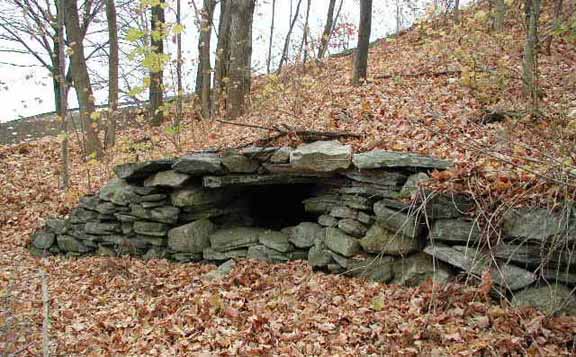
Note the long “lintel
stone” above the door-like entrance in both photos. Also note the larger stones
used on the left, the smaller on the right in both. Not all chambers are made
this way, but here’s a third chamber in Littleton MA that is:

Dan Boudillion Photo: http://www.boudillion.com/glossary/littleton01.jpg
from http://www.boudillion.com/glossary/glossary.htm
That last one is
the “kicker,” so to speak, while the first photo from Kent “sheds light” on the
subject, so to speak. The stacking method is an Indigenous style of stacking,
based on the scales and markings of a Rattlesnake (and is composed sometimes of
other effigies including smaller snakes and, of course, turtles). That lintel
may double as the scale above the eye of a rattlesnake, the superocular or
supraocular, other scales represented in stones of similar shapes and relative
sizes:

Look at this
fine image I lifted and compare the scales to stones, stones to scales:

(In the comments of the above at Flickr, someone even says, “The
scales look like stones.”)
Back up to The Solstice photo, and consider this: When the
Winter Solstice Sunrise lights up this snake's eye, the days begin getting
longer. I wonder if when you walk directly east is there anything suggesting
where it may have been viewed from at a distance. I’m guessing there may (or
may not) be a “long view” that might add to the overall snake impression – the Great
Serpent slowly opening its eye for a few days around the Solar Stand Still as
the event is sometimes called. Is there any other event that lines up with the
Equinoxes, a stone or a distant hill or something?

Stone Chamber, Kent NY Winter Solstice
Sunrise 2010 http://www.panoramio.com/photo/66095070

Stone Chamber, Kent NY Winter Solstice
Sunrise 2010 http://www.panoramio.com/photo/66095061
Upton again, with
an “eye overlay:”

Here's another image of a "chamber" that exhibits some of the same choice of stones and stacking, the “Old Pigpen,” in N. Madison
CT (or just over the town line of Killingworth), courtesy of Andrew Pighills, a
stone mason who does “not necessarily agree with any comments therein (this
post),” and who creates some beautiful stonework, mostly in the English style (http://www.englishgardensandlandscaping.com/stonework.html).

A long view of this one shows a sort of connection to stone walls (or are they the body of this particular Great Serpent?):

So, there’s my
Solstice 2016 offering, a suggestion that some chambers are really snake heads,
and some, maybe even the one you watched the sunrise at this morning, mark the
return of the light, the beginning of longer days, shorter nights...
Subscribe to:
Posts (Atom)