Friday, September 29, 2023

Snake Effigies in Modern Pottery


"Lorraine Gala Lewis (Laguna Pueblo, Taos Pueblo, Hopi-Tewa) recreates ancient pottery forms. And her process involves studying history. “My research has opened doors with ties to our past,” explains Lewis, who often collaborates with museums and private collectors.
“I don't consider the ancestral pottery as objects, artifacts or relics,” advocates Lewis. “These creations are alive, and each carries its own spirit.” 


Monday, September 25, 2023

The Wonders


Sites in Ohio may be as vital to human history as the pyramids. Why have they been ignored for so long?

BY DAN KOIS (SEPT 24, 2023):

“Among the most curious submissions was the United States’ proposal: a group of eight sites in southern Ohio featuring earthen mounds and walls, collectively called the Hopewell Ceremonial Earthworks. For nearly two decades, a mostly volunteer group of dedicated archaeologists, historians, and Native American tribal officials has been patiently making the case that these mysterious, not particularly photogenic piles of dirt are as culturally and historically significant as Stonehenge or the Colosseum. They’ve battled local opposition and national obscurity, and in some ways, the sites themselves, which are sprawling, sometimes heavily forested, and at several locations, plowed over by centuries of farmers. One is across the street from a federal prison. Another has been turned into a golf course…


   Glenna Wallace was a professor and college administrator when she was elected chief of the Eastern Shawnee Tribe of Oklahoma in 2006…A year after Wallace’s election, she visited Ohio State University to hear a talk by the author of a book on the Shawnee warrior and resister (sic) Tecumseh. The next day, she drove about 45 minutes east of Columbus, with the author and others, for a scheduled visit to Native American earthworks in the town of Newark, Ohio. To her surprise—she’d never heard of the Newark Earthworks—they were enormous. To her dismay, a substantial part of the ancient structures was located on a golf course owned by a local country club.


  “There was a golf tournament happening that Saturday,” Wallace told me (Kois). As her group made its way toward the small observation platform that overlooks the course and earthworks, they got into an altercation with a group of golfers on carts. 

   “They said, ‘You need to step back, you need to come back another day,’ ” Wallace recalled. 

        “They actually said, ‘You don’t belong here.’ ”


When she made it onto the wooden platform, she said, she was overwhelmed with admiration for the ancestors who had made these monumental geometric shapes. She watched as golfers teed off from atop  ancient mounds and drove their carts over the earthen walls. She told me, “The longer I stood there, the sadder I became, because of how they were being used—abused. There was no knowledge. No reverence.”


https://slate.com/human-interest/2023/09/hopeton-earthworks-ohio-unesco-world-heritage-history.html


Saturday, August 12, 2023

Identifying Indian "Stone Walls"

Or Indigenous Qusukqaniyutôkanash 

1
Qusukqaniyutôk: (‘stone row, enclosure’ Harris and Robinson, 2015:140, ‘fence that crosses back’ viz. qussuk, ‘stone,’ Nipmuc or quski, quskaca, ‘returning, crosses over,’ qaqi, ‘runs,’ pumiyotôk, ‘fence, wall,’ Mohegan, Mohegan Nation 2004:145, 95, 129) wall (outdoor), fence, NI – pumiyotôk plural pumiyotôkansh.) - Nohham Rolf Cachat-Schilling

Bulletin of the Massachusetts Archaeological Society, Vol. 77, No. 2 Fall 2016

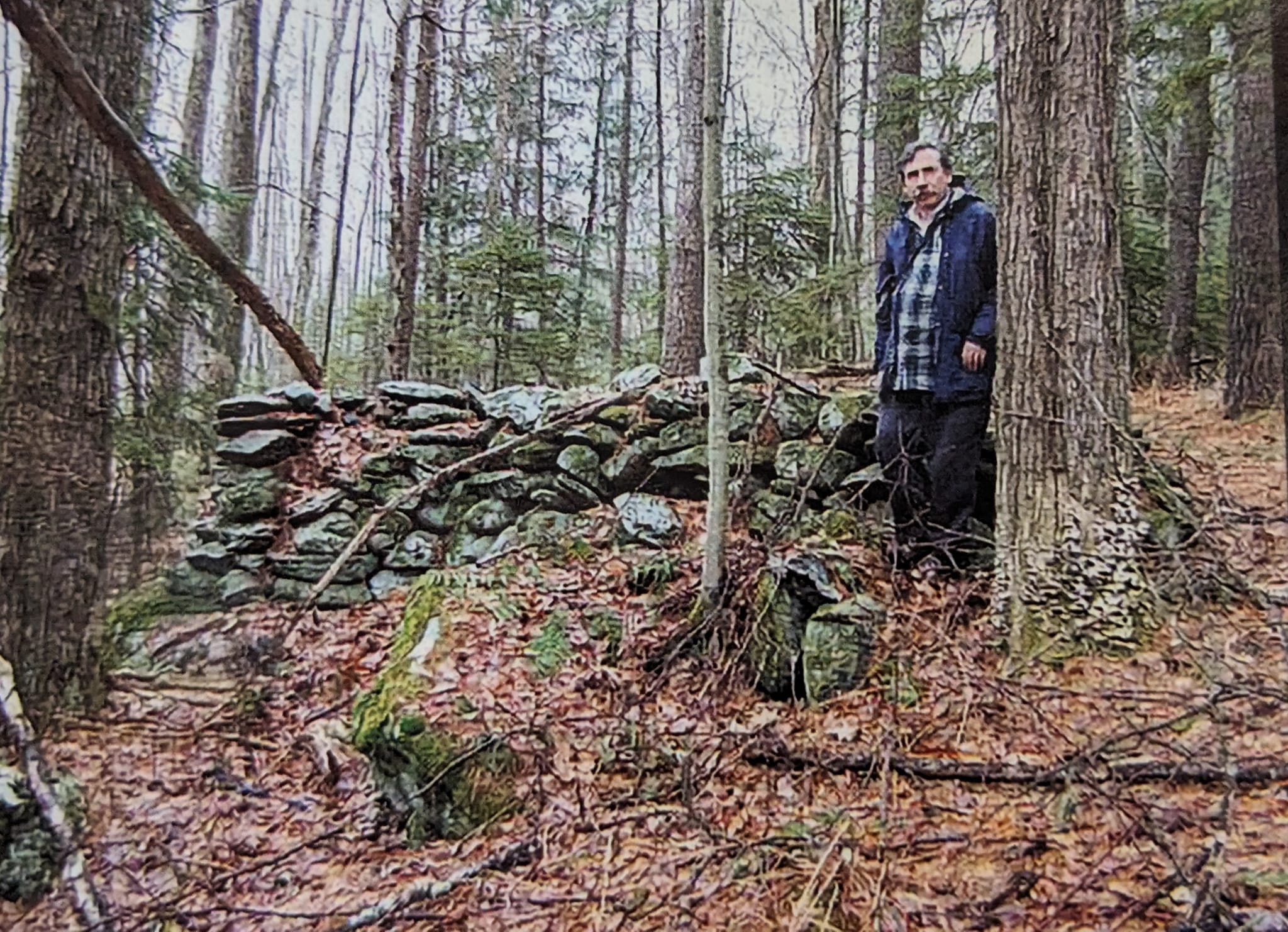
Qusukqaniyutôkansh (pl): Rows of Stacked Stones, colloquially “stone walls” or “stone fences,” often assumed to be post contact constructions related to property ownership and agriculture.

This isn't the exact image I was looking for, but all too often, the older constructions are rebuilt in the following manners, without a second thought, because of the long standing bias that "Indians didn't build in stone until taught to by the English, in New England."

Some "Proper" English Stone Fences aka "Dry Stone Walls:"


“Some of the more remarkable rows (of stones),” Curtiss Hoffman writes in Stone Prayers: Native American Constructions of the Eastern Seaboard (2018), “have what appear to be serpent heads at their ends. These and the more sinuous walls have been reclassified within the effigies category." - Page 61

A single boulder head is perhaps the easiest to identify:  


Not only at the "beginnings" or "openings" of the assumed "stone sheep fences," can  the "single boulder snake head" variation of Indigenous Stonework be observed, the "Serpent Stacking" can also be found in segments of what we often refer to as "stone walls." This can be observed in a detail taken from the first image in this post, an assumed Yankee Stone Wall in my hometown in CT:


The same distinguishing characteristics can also sometimes be observed in what are often assumed to be zig zag "stone walls" of accidental construction, alleged accumulated field clearing stones tossed against the rails of early settler colonists first fences composed of wooden rails - just as the more linear "walls" are assumed to be  tossed under early cross and rail fences...


Those wooden rails raised the height of the fence up to a legal standard of property ownership by reason of "improvement" - under early colonial laws...


Qusukqaniyutôk (2023): “A row of stones artistically stacked or laid using elements of Indigenous Iconography, sometimes obviously resembling a Great Snake, often composed of smaller snake effigies as well as other effigies both zoomorphic and anthropomorphic, sometimes appearing to shapeshift into another effigy, possibly related to control of water or fire (sometimes both) on Sacred Cultural Landscapes that are beginning to be recognized as Indigenous Ceremonial Stone Landscapes.”

From a perspective of distance, the largest of the Stone Snake Qusukqaniyutôk snake across the landscape, crossing over others, sometimes connecting great boulders or bedrock outcrops, sometimes along streams – and sometimes stacked over and hiding a stream, a Musical Row of Stones - the sound of water is the Great Snake contentedly “purring.”

Inside some enclosures, there were “gardens,” plant resources perhaps tended by fire, perhaps protected from fire, something living kept in balance, kept in production by someone offering tobacco to a serpent guardian before entering, someone singing while stacking stones, picking up and replacing her grandmothers’ and grandfathers’ stones that have fallen.

Zigzag, linear rows of stones, snaking across the landscape, both sides of an Indian Path or Native American Trail or an Indigenous Road that’s possibly ten or twelve thousand years old…

See also:

Friday, August 11, 2023

A Stubborn Theory Indeed

I just happened to re-read this old article:

  I doubt the authors (Ellsworth and Ives) realize the stubborn “theory” may well be the colonial origin of certain stone features on a landscape used by humans for thousands and thousands of years.

     “Evaluations of máunumúetash* by parties who do not test their hypotheses against Northeast Algonquian cosmology and rituals are doing, at best, only half an investigation," writes Nohham.

  “Evaluations of qusuqaniyutôkansh (“stone walls”) by parties who do not test their hypotheses against Northeast Algonquian cosmology, Traditional Ecological Knowledge, and Rituals of Renewal on Ceremonial Stone Landscapes are doing, at best, only 3% of an investigation,” remarked Sherlock Stones to his associate, famed Rocket Surgeon John Possum. "The late Dr. Brian Jones, the Connecticut State Archaeologist spoke and wrote about that "Other 97% of the Human History," the Indigenous Peoples' History, that most people are almost entirely unaware of - or are greatly misinformed about."


  I’m just a guy with a blog, inspired to overlay “Serpent Imagery” on photos to kind of “make the structures come alive” by adding horns and eyes, and perhaps even point to a similar structure or a variation, illustrating the repeated existing patterns of Indigenous Iconography, the Artwork, in the stacking of these Stone Prayers, these "Stones of Intention:"  


Below: a photo lifted from Greater Rhode Island Roaming


One Snake Head 

      At the Beginning (Not the End) of a “Stone Wall” is Nothing

Two Snake Heads at Two Stone Walls may be a Coincidence

While Three Snake Heads at Three Stone Walls is a Conspiracy, as the old archaeologist joke goes,

                      But Four Snake Heads at the Beginning (Not the End) of Four “Stone Walls”

               May be more than:

 “a juggernaut of wishful thinking masquerading as science”

“a shakedown culture complete with lawyers, fake science, and internal schisms (that) makes Timothy Ives’ book both a microcosm and a warning about the direction of our country"

“farming relics” and  “pseudoscience that goes into determining that the stone piles are related to Native American rituals.”

Snake Head Variations


*Máunumúet(ash) - place(s) of ceremonial gathering (ehenda mawewink, Lënapeuw, mawighunk, Mahhekanneuw). Themes of connectedness, reciprocity, prayerfulness and continuity are expressed through máunumúetash.

Nohham Rolf Cachat-Shilling

Bulletin of Society for Connecticut Archaeology (2018)

https://www.academia.edu/40876479/SCASubmission


Friday, July 07, 2023

Snapping Turtle (Nonnewaug CT)

 Káhtôquwukanuk  “in the pile” 

Above: 7/6/2023
Below: circa 1997

Tûnuppasuonk Kodtonquag

 - turtle effigy in (stacked) stone(s)? 

(Nipmeuw).


Above and below: Winter 2008