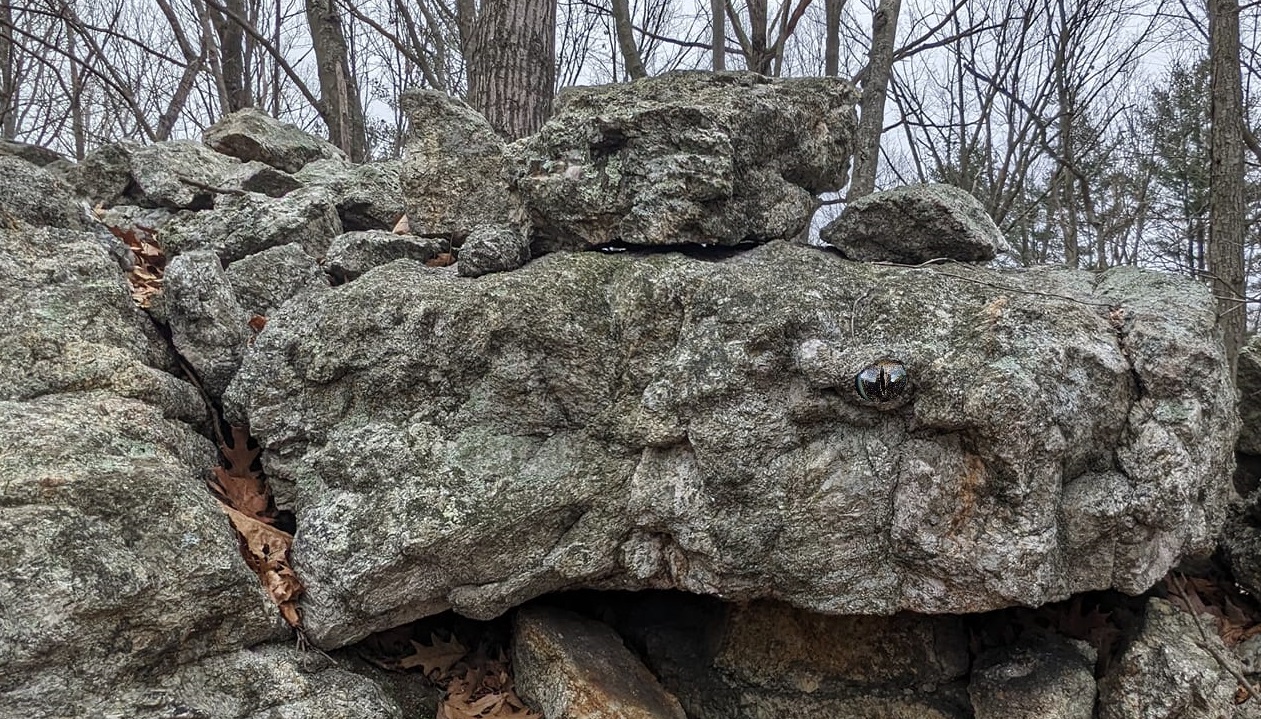
I seem to have jumped ahead in my story telling narrative, so I shall jump back a few days, and bring you to the town line between Watertown and Bethlehem CT, and some interesting stonework. As I made my way home that day, I found myself passing by some stonework that I'd stopped to take a look at once before, I found myself looking at an outcrop of bedrock that has what most of us call a "stone wall" crossing through part of it. That "stone" in the bottom left corner is bedrock:
The bedrock outcrop on the other side of this "stone wall," the Watertown side, you could say:
Just like Ed Lenik says of other forms of Rock Art, the two most often depicted animals are Snakes and Turtles. As a long time observer of Indigenous Stonework, most often I am looking for stones or combinations of stones, that suggest those same two animals.
Looking at this stonework...
Becomes this:
Looking at the largest of stones at the bedrock outcrop, this large block of stone suggests, to me, that it has been placed "just so" in order to recall the spiritual being known as the Great Serpent.
If you are wondering "Why a Great Serpent?" then I will link you up to these stories about the "Horned Serpent:"
If you actually clicked on it and looked at the link, you may have noted that "in Native American myths and legends, horned serpents are usually very supernatural in character -- possessing magical abilities such as shape-shifting, invisibility, or hypnotic powers; bestowing powerful medicine upon humans who defeat them or help them; controlling storms and weather, and so on -- and were venerated as gods or spirit beings in some tribes..."
I'll also add that the Horned Serpents (from the Underwater or Underworld below the surface of this world that "we walk on" and "eat from") are the enemies of the Thunder Beings or Thunder Birds of the Upper or Sky World, who can start forest fires by shooting lightning out of their eyes. The Great Serpents would show up to put out the fires, making a battle cry that sounds like thunder, in response to the flames started by the Thunder Beings, bringing the forest fire under control. I'll add that many of the numerous "stone walls" that resemble these great horned snakes could have functioned as fuel breaks (and probably still could) during that "burning of the landscape" that many of the earliest European visitors to the hemisphere noted in the little bits of writing that survives to today. I suggest that many of these Snake Rows of Stones (as Doug Harris puts it) were intended to function as such, perhaps becoming widespread during that "Hunter Gatherer Fluorescence" of the Late Archaic Period (6000 to 3800 Radio Carbon Years Before the Present) that my friend Dr. Lucianne Lavin writes about in "Connecticut's Indigenous Peoples," when the archaeological record shows more frequent fires, an increase in animal and human populations, and increasing concepts of territoriality.

The photos:
"On It's Head:"