Friday, June 29, 2012

"Pair of Eyes or Pareidolia?"

"It is not that the stone paleoart does not exist, it is that we have not known what to look for."
Ken Johnston


"There seems to be a limiting fear among archaeologists of being accused of pareidolia, the psychological phenomenon of inferring meaning from random sensory data, to the extent they will infer no meaning on objects or deny its possibility.
Examples of visual pareidolia are seeing
 a dog in the clouds,
 a human face on the surface of Mars,
 a virgin mother on a grilled-cheese sandwich,
or

a lion head on a twelve pound block of flint with two eye sockets, ear, nose, mouth, two drilled holes, “whisker holes” on snout, stands upright in correct viewing orientation on its flat base, and was found in context with other zoomorphic sculptures and which admittedly “looks just like a lion” according to a lithics analyst at a prominent U.S. lab. I mention the “lion head,” my real-life example, tongue-in-cheek, because it seems archaeology needs to (figuratively) come to understand the difference between the clouds, Mars, a sandwich and a possible artifact. Such interpretation is precisely the job, and the duty, of the archaeological investigator." ~ Ken Johnston, avocational archaeologist (publisher)


http://portablerockart.blogspot.com/p/pair-of-eyes-or-pareidolia.html


Monday, June 18, 2012

Plants and Stones Blog

Plants and Stones Blog


“This is the the newest stone pile along our property line. Lack of covering vegetation easily shows the relative youth of this pile. The last farmer left this ground 24 years ago. This stone pile must be older that that. The height of this pile suggests that it was dumped from a tractor bucket. The stones in this pile are also smaller than the stones in the wall. Every year the frost sends a new crop of stone to the surface. The new crop contains smaller but more numerous stones. There is never a crop failure with the stone…”


"Pioneer settlers had to clear their land as a first order of business. Hauling stone to what would become field's edge preceded planting. Stones were likely heaved in a pile since there was no time to build walls. Years later stone walls could have served as pasture fences. A wall occupied less land than a stone heap and having the livestock walk on solid cleared ground was safer than having them slipping on slanted stone. Here at field's edge traces of an old wall can be found among the rubble..."


http://stonewallgarden.blogspot.com/2012/02/where-is-winter.html

"Yesterday's sunshine found Becky sitting on a stone wall under the huge cherry tree.  She saw this stone nearly buried in the litter close to the edge of the wall recently built by us. Not the usual stone, this one deserved closer inspection.  Some of the edges of this stone are as sharp as a knife edge.  Other surfaces are soft and porous.  We believe that the hard gray area of this stone is flint.  We would like to know how the stone was formed.
There is evidence that Native Americans lived on land very close to our present home. We can almost see the vee shaped stone structure that still spans the river and was thought to concentrate the migrating fish, eels, shad or salmon, making harvest of this natural food source easier. A flint factory appears to have existed a short distance downstream of the eel weir. I have spoken to a man that grew up on this farm. He describes finding primitive stone points here in great quantities. Our land overlooks the river and is largely glacial gravel deposits. The fertile part of the farm lies below us along the riverside. Native Americans left no signs of their presence on the land where we live..."


http://stonewallgarden.blogspot.com/2012/03/beckys-found-flint.html


Thursday, June 14, 2012

Stonewalling

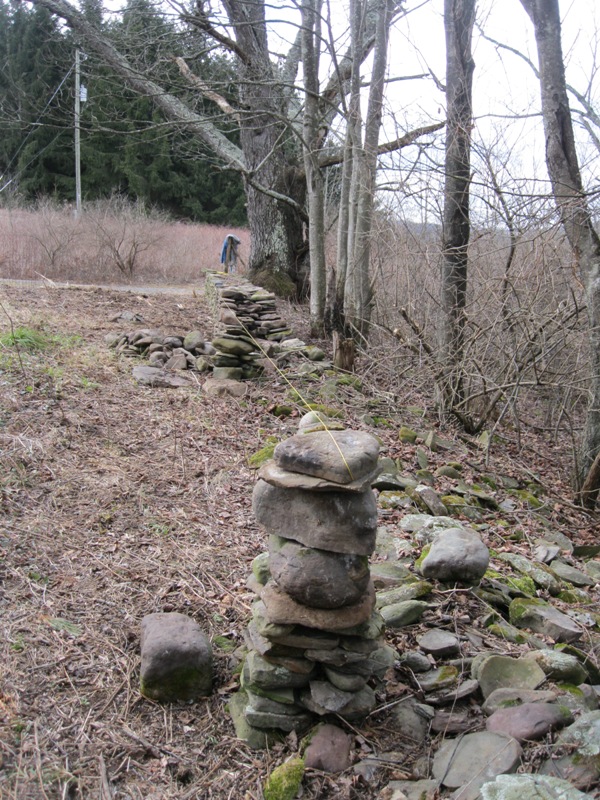
The above image popped up late last night in an image search for "weird stone walls fences."
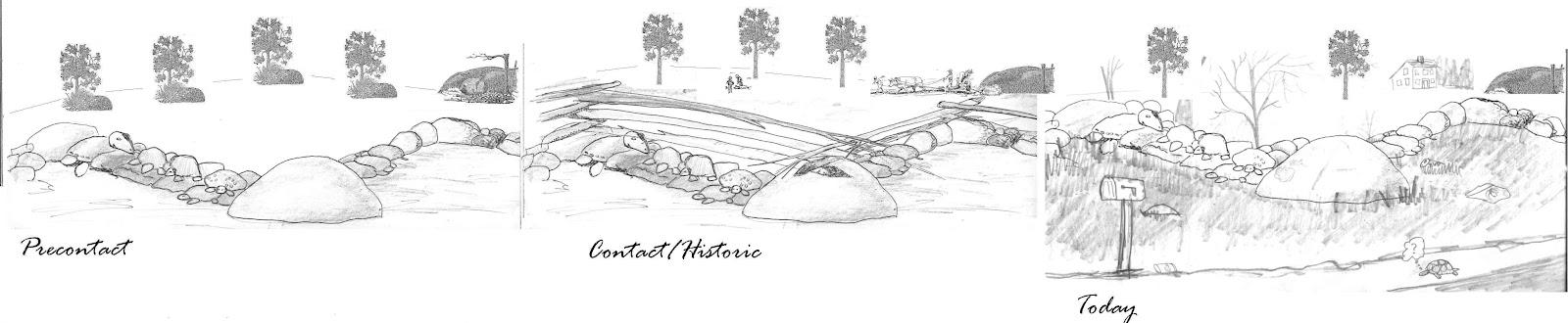
Maybe it was "unusual stone walls fences," I forget, but I found a "Stonewalling" post on "yankee whisky papa's" blog that included a drawing by Eric Sloane that I hadn't lifted yet that illustrates a bit of "Stone Wall Myths" that even included that old Stone Manure Pile Myth.
Yankeewhiskypapa writes: "If you enjoy a stroll through the woods in New England, you will likely find stone walls. A very short moment in each year is the harvest. Mechanized now, the harvest was once a near-panicked and frantic race for many seasons. Making hay is even a risky venture with New England weather. I occasionally bird hunt in up-state New York amongst the cleanly-shorn fields where some of the migratory birds glean the errant grains from the ground."
Just what papa is talking about - stonewalling or making hay - is a little mysterious. The stolen drawings are credited to Sloane and it's possible these are Sloanes words typed into the post:
"The labor is poured out, elbows and backs wear down... some will never be the same. Toes and fingers are crushed, and shoulders on men both young and old pinch during a pre-dawn stretch. In April, it's still cool enough for hard work, and there won't be too many biting insects. Burning stumps and brush tend to smoke the clothing, and at the end of the day, the clothes are better kept by the door instead of in the bedroom... it goes back on the next morning. They smell, but it's the arms and joints that complain the loudest..."

No hay wagon appears but a stone boat does show up - weren't we just talking about that sometime or other, looking for images?
There's more Sloane images, more yankeewhiskypapa rambling here:
(It occurs to me now, pouring myself another coffee, that the blog may make more sense if one is actually drinking whisky while reading it...)
Another image that popped up seems to come from Massachusetts, the Minute Man National Park.
In my own personal theory on stone rows/stone fences, I contend that the majority of stone rows on the New England Landscape - that still haven't been stolen or rebuilt - are actually Native American in origin, the whole wooden fences and "thrown up" stones a reverse chicken and egg situation.

(Below: It's really a "cross and rail fence," more likely built over already existing stone rows that are evidence of the earlier Native American Cultural Landscape, easily converting Indian Land into private property by an early Massachusetts Fence Law, Puritan and Biblical in origin.)


(Turns out, these Minute Man National Park split rail and stone fences aren't all that old, "restored" or "rebuilt" for the creation of the National Park. Imagine my embarrassment for being fooled!)

The author of the blog [ http://www.lincolnroadsides.org/index.htm ]says this: "There is the mistaken impression that stone walls are primarily a colonial phenomenon. They are not. Although walls were being built from the time of the first settlement to the end of the pioneering stage, most were built in the half century between the end of the American Revolution and the construction of the first railroads.
Settlers felled forests and cleared land of rocks and stone. The first walls were mere dumps along a field’s periphery. Later people built more sophisticated walls.
Stone was not their first choice of fencing material: Widespread use of it began only when other alternatives – stumps and split rails – grew scarce because of overclearing.
Thousands of fence lines became magnets for the stone refuse that would otherwise have ended up in piles. The large boulders were rolled into position; smaller stones were tossed above and between them. As the stone accumulated, primitive “tossed” walls began to rise up out of the weeds, replacing the lower tiers of wooden fences."
Looks to me like that was some pretty fancy and skillful "tossing" under those rails, accidently creating what look like some rather testudinate effigies.
Turns out the blog might be a sort of advertisement for a stone builder, including this drawing, captioned with the Olde Yankee Advise on what makes a Good Stone Wall/Fence:

I added this drawing below to my American Fences file after jumping into a Minute Man National Park image search, a more fanciful rather than accurate painting:

The actual stone rows look more like these stolen images from

Added on 12/31/2020:
Pre-existing Indigenous Snake Effigy Fence??


And this one was in there, making a person like me wonder what happens when you follow those stone rows. Would there be more of this on the grounds of the Park?
Minute Man Boulder
Then there was this refreshing thought I found clicking on an image out of a bunch of some nice polished stone hand tools: "Minute Man National Historical Park is perhaps best known for its role in the American Revolution. Visitors to this park are greeted by colonial homes, the capture site of Paul Revere, and the site of the famous “shot heard round the world.” But what about the people who lived in Concord before the arrival of the British settlers?"

Tuesday, June 12, 2012

Serpent Surprise

I just happened to be dropping off my grandson's back pack, travelling up a road named for a Native American man who lived on this hill in the early days of the Historic Period, as they say. I passed by what turns out to be the tail end of something I assumed was a stone row, a row I've been driving by for years but had never looked at closely.  As I drove back down Scuppo Road, I guess you could say, "Nature was calling me," to put it politely, so I finally stopped by the stone row...

I could see the faint trace of the sometimes zigzag, sometimes serpentine, sometimes linear, stone row that remains along the edges of this dirt road - and along some of the paved roads in the area too - just as you can see in that well executed computer drawing above the photo of the smaller stones of the tail of what turned out to be a Serpent Row that is perhaps 50 feet long or so...
The stones got a bit bigger, boulders rather than cobbles, blocky and placed sort of "upright," if you know what I mean. There might be some outcrop under the duff of leaves and branches, but as the outcrop began to show, the placement of stones got pretty interesting...
And I was surprised to see, looking north, that the row ended rather quickly:

So I was drawn toward the end of the row so I could be surprised by the "end stone:"

(Looking South)

And looking East:
It's not the most "dramatic" of serpent heads, but it's longer than wider, triangular like an actual snake's head - maybe Scuppo, who I know nothing else about other than the fact that he was "an Indian" who lived here on this hill somewhere, might have constructed this Serpent and never got around to finishing the head stone, but that's just a fanicful guess...
               (More Serpents and Snakes: http://rockpiles.blogspot.com/search?q=serpent  &  http://wakinguponturtleisland.blogspot.com/search?q=serpent )

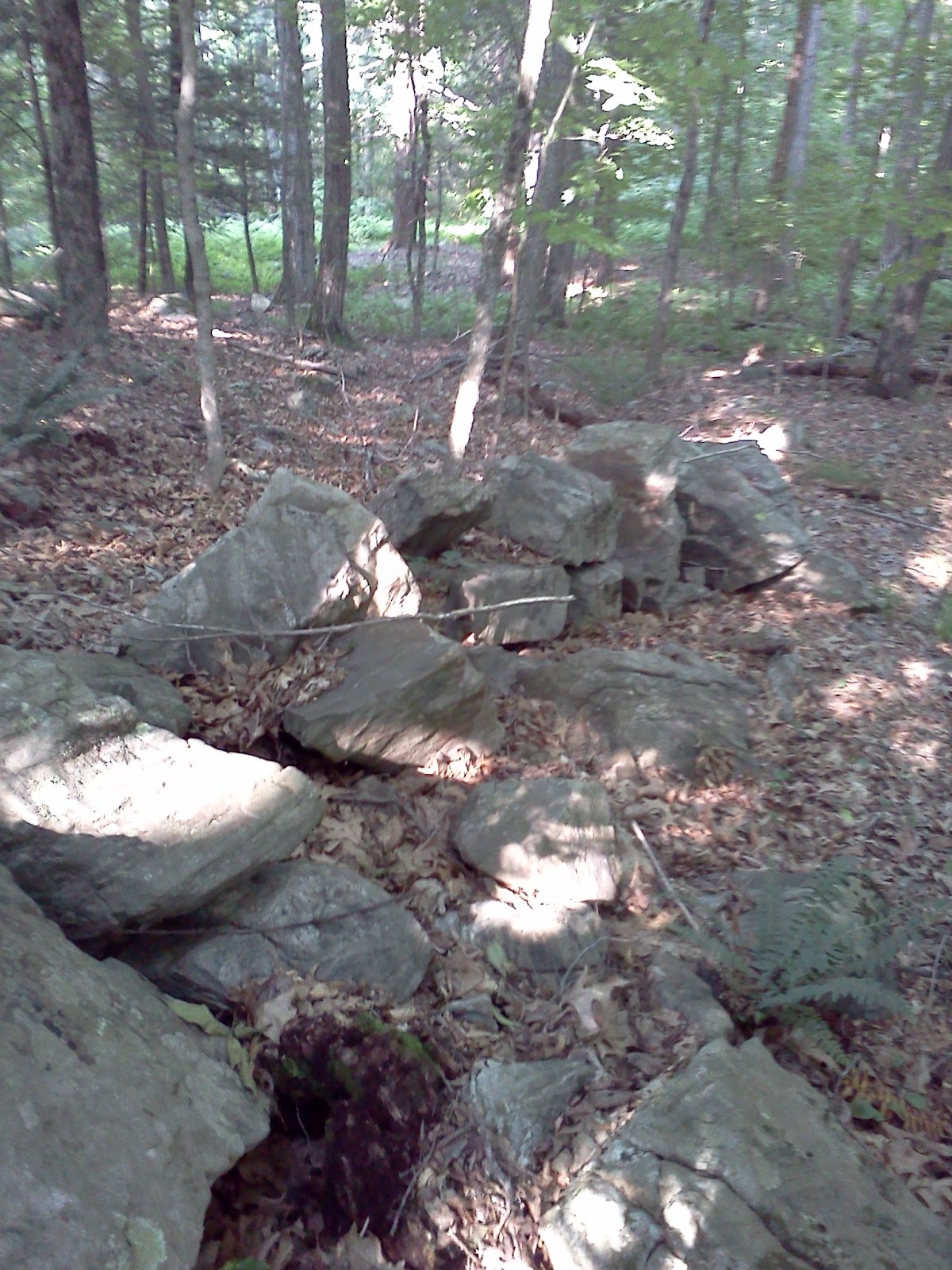
 It's about a hundred feet north to where a linear stone row has a little gap in it, ten feet wide at the most, but with end stones on both sides of the gap. This is the one I photographed with the cell phone camera:
Another a few feet east:


Walking back to the road, there were a couple more boulders that were interesting:

Thursday, May 31, 2012

NAGPRA (Thirty Days)

"I used to search for reservations and native lands

before I realized everywhere I stand

there have been tribal feet running wild as fire…”


Stones gathered, stones placed just so

In a heap, in a row,

Over a period of time so long ago

That no one truly knows

How long they’ve been there;

And the Old Ones shrug their shoulders

And say “They’ve been there Forever.”


Native Graves Protection Act, you say?

What it boils down to is,

You got so many days

To move your granny

To do your study

Before we bulldoze it away.

Dontcha know?

There’s money to be made!

Your “rocks” are in the way.


And that’s the real bottom line

They’ll give you just so much time

To move your Ancestors off of OUR LAND!


"If the discovery occurred in connection with an activity, including (but not limited to) construction, mining, logging, and agriculture, the person shall cease the activity in the area of the discovery, make a reasonable effort to protect the items discovered before resuming such activity, and provide notice under this subsection. Following the notification under this subsection, and upon certification by the Secretary of the department or the head of any agency or instrumentality of the United States or the appropriate Indian tribe or Native Hawaiian organization that notification has been received, the
activity may resume after 30 days of such certification."

Sunday, May 20, 2012

An Ancient Zig Zag Rock Wall


They seem to have different names depending on where you go on Turtle Island - stone fences/stone walls, rock walls/rock lines and probably more, sort of like "pop" and "soda," "Dr. Pepper" and "Mr. Phib." Some places they put your groceries in a bag, other places they put them in a sack.

"Hikers"  is a more universal term (as if "universal" is the right word - I see relatively few photos from people hiking on other planets, like I never understood why there weren't Extra-Terrestrial Contestants in the Miss Universe Pagent) and some of them are bloggers who share through digital images the hikes they take to places I'll never go.
So thanks, Todd Lochmoeller/Traveler, for posting this image above of An Ancient Zig Zag Rock Wall and all those other images I'm about to dive on into (watching for the rocks of course) at:

Friday, May 18, 2012

Recollecting Nemasket


"Before I left Lakeville, I visited the old Indian burying-ground; but it is now difficult to recognize it as such, since all the stones have suffered mutilation at vandal hands. Even the Indians graves are not respected, and she who remains is but a solitary figure amidst the rush of invasion, the only type of a race which has now almost vanished from New England." Source: Walter Gilman Page, New England Magazine, “A Descendant of Massasoit”. January 1891, 642-644.


http://nemasket.blogspot.com/2011/01/visit-to-zerviah-gould-mitchell-1891.html
 
Wootonekanuske and Teweeleema,
 more familiarly known as Charlotte and Melinda Mitchell,
 were the last descendants of Massasoit and lived at Betty's Neck in Lakeville.


AN HEIR TO KING PHILIP: http://nemasket.blogspot.com/2009/09/heir-to-king-philip.html
 
 "a rock on a high hill a little to the eastward of the old stone fishing weir, where there is the print of a person's hand in said rock". [Massachusetts Historical Collections Vol. 3d 1810]
"Lenik himself suggests that "the handprint is that of a shaman who has marked the area as a sacred site. The boulder, standing alone on the hilltop, may have been seen as a source of spiritual power. The carving of the handprint may have been a shaman's attempt to derive power from the site."Hand Rock: http://nemasket.blogspot.com/2009/05/hand-rock.html

Monday, May 14, 2012

Chinese Walls (in California)

My friend Dave C. often sends me Google Earth images, like the one above, that show interesting details that stand out on satellite photos - from all around the world as well as Turtle Island.

Well, the image sent me on a little "Google Journey" - one showing me the documented Chinese rock walls near the place marked spot. This sounds like someone working for my Grandpa Tim: "Morgan Quick agreed to pay a Chinese contractor $1.75 for each rod (sixteen and a half linear feet) of stone wall. He also provided pork and rice for the workers. The contractor, who sat under an umbrella tracking construction progress with an abacus, paid his workers 25 cents per day IF they completed a rod and a half (twenty four feet and nine inches). The daily wage was lost if workers failed to meet the quota."


But the result that "got me" was the Department of the Interior's Bureau of Land Management website (http://www.blm.gov/id/st/en/prog/cultural/lower_salmon_river/historic_mining.html ) with the above picture of the obvious prayer seat/tsektsel, accompanied by this text:.
" The Chinese along the Lower Salmon River: Some of the places where past residents lived are still visible. These habitations were typically rock structures. The structure foundations average about 3 feet high, 6 feet wide, and 10 feet long. A wooden framework was constructed over the top of the rock walls. A variety of roofing materials were used. Most roofs were probably of canvas attached to a framework of milled lumber or driftwood. The wood was undoubtedly scavenged when the structure was abandoned.
Many of these structures had a fireplace. Generally, structures built by Euro-Americans had the fireplace in the wall opposite the entrance. Some rock structures built by the Chinese have the fireplace adjacent to the entrance. This architectural feature is unique to some structures built by the Chinese. The only other known standing structures with this unique architectural style are Chinese structures in some of the old mining areas located in New Zealand."

After seeing the Grey Feather Gallery of photos at Ancient Paths of Shastina (that I 'lifted' to illustrate this post http://wakinguponturtleisland.blogspot.com/2012/05/classic-example-of-prayer-seat.html), I (and probably Norman too) wonder what "the Chinese fire place/foundation" faces and what other features might occur around it that just might be similar to those Grey Feather photos at:
(Main site: http://www.ancientpathsofshastina.com/)

A photo I couldn't easily steal of a CA Chinese rock house can be found at:


Saturday, May 12, 2012

Classic example of a prayer seat

A conversation with Alyssa Alexandria RunsWithWolves

Photo: Alyssa  Alexandria


What does the Tsektsel face?
Another Tsektsel or prayer seat:
Photo: Alyssa  Alexandria

The view, focal point from inside the second prayer seat:


Photo: Alyssa  Alexandria

Are any of the prayer seats integrated with the walls? Yes, they are. The walls do trail down to nothing once they reach them, however. Sometimes just a single row of cobbles.


The walls are robust at ground level, then meander up into nothing but a single row of stones going up the outcroppings to the prayer seat area; then (they) just stop and you're within the "spots."

They are all tied to walls. I took a series of photos with smoke holes, medicine boulders, some other wild perch type seats-- it's a little ceremonial area on top of a high outcropping. Lots of donation stones (red ones).

Added on 3/26/2022:
  

Prayer seat

níswonki - an enclosure, "three bends" (Nipmeuw, Narragansett). https://www.academia.edu/40876479/Assessing_Stone_Relics_in_Western_Massachusetts_Part_II_Patterns_of_Site_Distribution

świhwákuwi (viz. świk+wāgawi, ‘it grows around,’ Unami Lenapeuw, Zeisberger 1995:151, 173; świ, ‘three’ for 3-sided - Mohegan Nation 2004:98) form open ellipses that the author considers roughly equivalent to the “nave” of a Christian church…” https://www.academia.edu/40876478/Quantitative_Assessment_of_Stone_Relics_in_a_Western_Massachusetts_Town


Tsektsel or prayer seat (Yurok)

http://wakinguponturtleisland.blogspot.com/2012/05/classic-example-of-prayer-seat.html


https://www.latimes.com/archives/la-xpm-1985-08-25-mn-24849-story.html

https://escholarship.org/content/qt71d2g30s/qt71d2g30s_noSplash_0005b610d8eb3ffac3aaad128f8c8aff.pdf


Thursday, May 10, 2012

Multiple Choice


How would you caption this?


a.) "Turtle effigy in a Native American Stone Row"

b.) Made by a "crazy colonist"

c.) An accidental random occurence (One of 999,999) during field clearing (in a field already cleared by Native Americans sometime before 1659) while building a "stone wall" in Woodbury CT"


Monday, May 07, 2012

Ancient Paths of Shastina


"Ancient Paths of Shastina" is primarily geared towards those who wish to connect with the earth energies found within our megalithic power spots. But, whether you're on a spiritual journey, looking for photographic opportunites, a Dowser, Nature Lover or just wanting to experience the ancient petroforms and walls in a professionally guided atmosphere...

Monday, April 30, 2012

Lichen It (or Not)

I certainly would not be the first person who said, "Lichen growth is an unreliable indicator of time."
Walk down my driveway with me and I'll show you what I mean...
That big stone on the flower bed was pushed out of place by some lilac roots from on top of the upper retaining wall (probably built in 1850 from the recycled stones from the original central chimney of my possibly circa 1700-10 "at least begun to be built" home, the chimney replaced by a brick one when the house was modernized by Samuel Atwood, a descendant of Woodbury's first doctor, Jonathon Atwood). Keep in mind that this retaining wall soon blends into a zigzag stone row on this side of the Indian Trail, still known as Nonnewaug, with another zigzag stone row bordering the other side of the road (which shows quite well in aerial photography taken in 1934 and is now only a remnant of its former self, much like me).
   Update: the retaining wall does show stone tool marks, but by the spring of 2016 many elements of Native American Iconography were identified in this and other stonework I had long assumed were Euro-American in origin. Dr. Curt Hoffman added them to a database he continues to compile and filed a site report, adding this wall and others to his list of (I think he said) 7,000 sites. (5/17/2016)

I placed these cobbles on the fallen boulder and none of them had any remarkable amount of lichen growth on them when I did, unlike the boulder whose lichen growing career probably started in earnest around 1850. I'm going to make a guess that I placed the stone all the way to the left in the photo on the boulder in around 1997 - or a little after - because that's when I saw my first "without a doubt" Native American made Tobacco Offering Bear Effigy. The others were placed there, one at a time over the years, picked up somewhere close by or dug out of the flower bed - or fallen into the driveway from the second retaining wall made for  this flower bed...


It looks like it has about the same amount of lichen growth (see how it almost blends into the boulder in the second view of the top of the stone), and a person could be tempted to say that this might prove that the stones were placed there at the same time, but they weren't. A bunch of dry summers (one really dry summer comes to mind) slowed the growth, while I also recall a really wet summer when all sorts of mold and fungi began growing everywhere, especially the Black Rust I think people were calling it, on my tomatoe plants. Originally it looked much like the underside when first placed there...

It's much the same story with the other stones I later placed there...

There were a figurative ton of interesting crystals in the on this cobble (same stone above and below).

This one below is a possible Nutting Stone, used to crack nuts (or acorns), found nearby, about two or three hundred feet from the probable mast forest resource zone to the western hilltop, where early roads and cart paths lead down to the early 1700's mill on the river...

These two, which have almost no lichen on them, I put where I did because the type of rock/stone matched up well, especially with that high degree of probability that these stones were "borrowed" from the nearby Testudinate Stone Mounds up by my old Chicken Coop because it was an Easy Thing To Do, a factor you should always take into consideration when dealing with Human Behavior. These two fit the pattern of a headstone and a left foreleg. The headstone also has another repeated feature, a depression that easily accepts a clam shell for a tobacco offering...


People seem to enjoy driving into this flower bed wall along my driveway and I pick up what falls and put them on top of the former chimney stones, fine examples of colonial stoneworkfrom circa 1700, hammer marks from when they were quarried and drilled holes, possibly for the keeping room fire place, those old "kitchen fireplaces" where colonial moms (or servants) were cooking stuff on spits or in those metal pots that they hung from hooks and all, just like you see in paintings and houses turned museum.
Will these stones placed on the quarried chimney stones get covered with lichen as well?
Will I ever be able to put all the turtles together again, with no King's Horses or King's Men to help me put them back together again after the Egg was Scrambled?
 

Maybe I'll use the Grandfather Trick and say to my Grandkids, "I'll bet you can't make some turtles out of these stones - a dark one, a light one, a red one, maybe one with a light brown head and green feet..."