Friday, February 23, 2007

Article in a Newsletter


Just one link:
http://www.pomperaug.org/pdf/pgs3-4.PDF

Nothing ever happened.
Yet.


Above: the weir remains as of Jan. '05...

Thursday, February 22, 2007

A Friend of Mine

I just got back into contact with a long time friend, Roger Makepeace.

Walking anywhere with him was like having a living fieldguide to the plant kingdom.
Knowing my interest in stone rows, he sent me this photo, writing "Found miles of lace walls in the Andes" when he went to Peru and Bolivia last winter.

He's got a website at http://llareta.com/ and a blog at http://ecohomewnc.tripod.com/peru/ where he's got photos that always come to my mind about the bigoted statement you hear about "Indians weren't intelligent enough to build with stone," especially when I think about corn and other veggies traveling along trade routes.


There's lots more fine photos of more stonework at Machu Pichu and else where at his site


I owe thanks to his sister Anne Makepeace (http://www.makepeaceproductions.com/ )
who is currently working on a project for PBS:


"From the award-winning PBS series American Experience comes "We Shall Remain," the most ambitious primetime television series and media project on Native history ever produced."
http://www.pbs.org/wgbh/amex/weshallremain/index.html

Friday, February 09, 2007

Nova Scotia Link

Because I saw the link at RockPiles, http://greatmuin-rockpiles.blogspot.com/ ,
I'm posting these for "greatmuin."
(And the others who read these rants too.)
I saw greatmuin's photos, asked some questions and promised a post.

Sorry about the quality of the images...

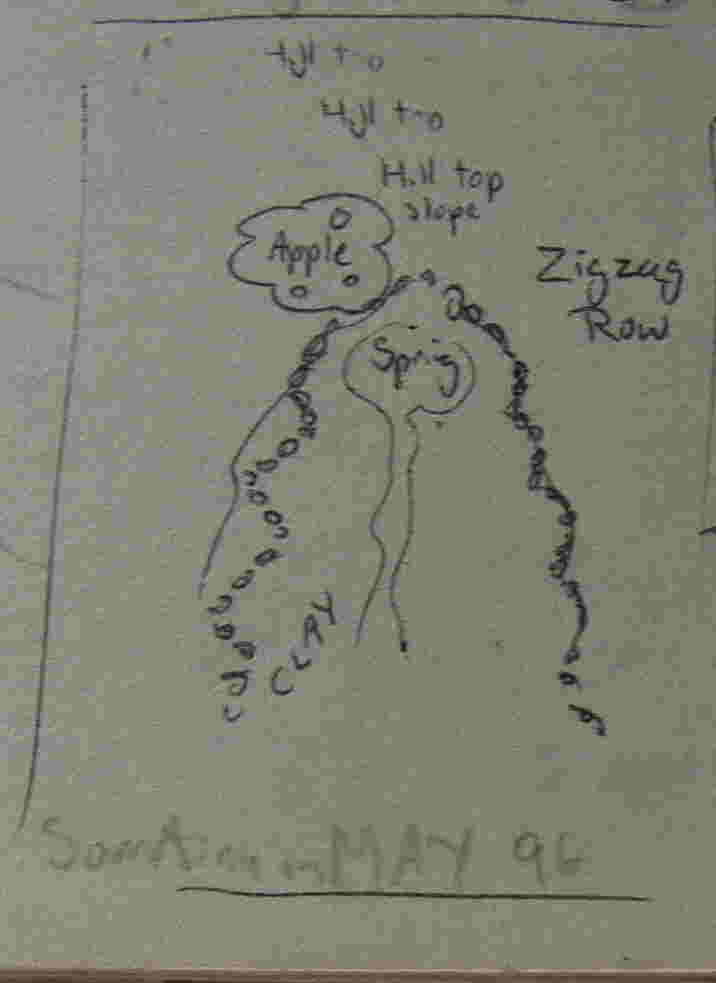
I found an old history that talked about a burial grounds; spotting the oldest of trees near where it might have been, I was intrigued by a serpentine row of stones I first noticed by a large Hemlock.


I drew this in 1994 maybe:


This later but looks like I was too lazy (or busy, maybe) to make them look as serpentine as they really are:


Detail of the terrible photo:


The row turns to zigzag as you follow it south - and connects to other rows. It's hard to capture in photos...


I threw this in as an after thought, a musing about the landscape as a turtle.
We are Waking Up On Turtle Island after all...


Some featuresof the many rows, often repeated elsewhere...


Wednesday, February 07, 2007

Mark's Poem

Sunny Afternoon
By Mark Barabasz

Sun shines brightly as my daughter lies in the grass
quiet afternoon in suburban Seattle
her hair shiny, her skin smooth, fingers small
easy lift of her chest as she naps in the yard
I cover her with a parasol; her skin might burn,
I will do anything to protect her

Sun shines brightly as my daughter lies in the grass
the sound is deafening in suburban Baghdad
her hair matted with blood, skin torn, fingers ripped
her chest heaves as she struggles to stay alive
I cover her with a blanket, her skin burned
I could not protect her…

taken from: http://poetsagainstthewar.org/displaypoem.asp?AuthorID=29183#453085648

"Lace Walls"

In SUSAN ALLPORT’s “Sermons in Stone; The Stone Walls of New England and New York,” the author writes, “In 1871 there were 252,539 miles of stone walls in New England and New York—enough to circle the earth ten times.”
Out of those quarter-million or so miles of “fence,” you’ll find many a “stone wall” that turns “lacey” (Allport's book includes a study of Lace Walls on Martha's Vineyard on pages 120-30).
My friend PW writes at Rock Piles: “It seems to be a classic pattern that a stone wall becomes suddenly higher as it passes over the high point of a knoll. While passing over this high point, the wall also becomes lacey: with one or several holes that you can see through.”


(The row should be higher than I've drawn - or drew a long time ago - so that a person could stand behind it - and resemble the place in CT that I showed Peter and Norman a few years back, where a 3 foot high row makes a "wave" 5 or 6 feet high. I've seen similar in Rhode Island also too.)


People come up with lots of suggestions as to why these lace walls occur – wind spirits pass through them easily, lack of stones to build a tall row of stones as sheep fences, and more. I have a simple explaination: you might be waiting at a kill site and a really high spot would allow you to stand up (to ease your aching back) and keep watch, assuming you believe a lot of stone rows were Native American made and functioned as hunting devices, sort of like a fish weir for deer or other game.
A not so high spot might allow you to squat or sit on a stone, as shown in this recreation made by stealing an image off of Google to add to my friend’s Rock Piles image…
And he's got an animal skin on his head, ears and all, sort of like the effigies on my drawing above, athough he seems otherwise under-dressed for the weather.

Thursday, February 01, 2007

Wamsutta's brother Metacom (also called Philip)

This was news to me: "So the story goes, Punxsutawney Phil was named after King Phillip. Prior to being called Phil, he was called Br'er Groundhog."

from: http://www.groundhog.org/faq/, the official site of Punxsutawney Phil.
It doesn't say why a groundhog was named after him.

"King Philip’s War was one of the bloodiest and most costly in the history of America. One in ten soldiers on both sides was injured or killed. It took many years for Plymouth and the other colonies to recover from damage to property.
The outcome of King Philip’s War was devastating to the traditional way of life for Native People in New England. Hundreds of Natives who fought with Philip were sold into slavery abroad. Others, especially women and children, were forced to become servants locally. As the traditional base of existence changed due to the Colonists’ victory, the Wampanoag and other local Native communities had to adapt certain aspects of their culture in order to survive."


"The war is named after the main leader of the Indian side, Metacomet, Metacom, or Pometacom, known to the English as "King Philip"."


Wednesday, January 31, 2007

Turtles in my Logo


Some of the turtles I neglected to photograph do appear in drawings. There are many "Turtle Specific" specimens in (an imaginary) stone circle in this drawing.
At 2 O'Clock is the spotted turtle, at 4 a snapper or a stinkpot or something, etc...

THE TORTOISE AS A SYMBOL.

Taken from
Frank G. Speck’s "Delaware Big House Ceremony (1931)”


“Outlined in particularly high relief is the tortoise. In the latter creature we have the symbol of life, of perseverance, longevity and steadfastness. As the Delaware patriarch says, "The tortoise is the earth; is life." In the procession of time and among the elemental nature forces the direction of movement is from east to west, according to Delaware belief. So moves the tortoise with measured pace across the earth and through the Big House, carrying out the mythical allegory. At the end of his journey at the "western door," meaning where the sun sets at the edge of the earth, night will come to an end as does the ceremony after the twelveth night. Thus the tortoise "brings the ceremony." His shell in the form of the rattle is carried by the participants who take the part of leaders in the recitations and dances and move in the proper westward direction in the Big House. The saying is, as the ceremony is opened, and after the intervals of pause, "The tortoise is bringing us the worship and we are now ready to touch it again."
The tortoise, moreover, is "he who carries our mother's body" - the latter being a metaphor for the earth. The tortoise being a "grandfather" thus becomes more ancient than the earth. The prominence of this mysterious creature in Delaware religious belief has long been noted by writers dealing with the tribe.
As early as 1670 the Delawares are recorded as declaring that all things came from the tortoise, that it brought forth the world, that from it's back a tree had sprung upon whose branches men had grown, that it had a power and a nature to produce all thing such as earth, and the like; that it brought forth what the supreme divinity wished through it to produce.
Zeisberger mentions the world-flood myth in which it is related that some human survivors took refuge on the back of a turtle whose age was so great that his shell was mossy. And the turtle represents the earth. His rounded back is to the Delawares the earth dome.
Another indication of a belief in the latent potency of the magical powers of this remarkable creature is met with in the esteem paid to the yellow color-pattern on the upper shell of the animal. Face paint patterns of a dignity appropriate to the men taking part in the Big House Ceremony are copied from these markings. The men wearing these patterns are adopting the symbol of the creature who "carries our mother's body."
The creature that typifies the earth bearer designated as taxko/ xkc (fused together) in Delaware, and whose symbol exists in the form of the shell rattle, is the Box Turtle (Cistudo Carolina). This reptile is by the rulings of precise taxonomy not a tortoise but a connecting link between the aquatic turtles, or terrapins, and the terrestrial forms, the true tortoises. For the Box Turtles, of the genus Cistudo, deriving their name from the well known structure of the hinged plastron which permits the animal to withdraw the soft parts of it's body completely within the protective cover of the shell, have partially webbed feet, which places them nearer to the Turtles than the Tortoises. Yet to distinguish the reptile of Delaware tradition from the semi-aquatic American turtles, I have adhered to the designation of tortoise in the text and discussion.
Perhaps certain remarks offered by the informant will, in conclusion, add something to our idea of another side of the character of this knowing and potent reptile, so important to the religious sense of the Delaware.


"The turtle is in its way an evil thing, yet not so evil as a snake which is controlled by the Evil Spirit and also has human face-paint patterns. The Turtle can hurt human beings. Once a boy caught a water-turtle and turned him on his back. The Turtle got mad; raised himself on his legs stiffly. The Turtle raised himself, and launched himself through the air and struck the boy on his head and nearly killed him. The Turtle has a weapon in the sharp frontal plates." (Pgs.44-47)
He also adds:
SYMBOL OF THE TWELVE:
The Delaware also point out the occurrence of thirteen plates in the carapace and twelve in the plastron of all members of the American tortoises and turtles, bordered by the twelve marginal plates on each side. Another evidence in native thought of the tortoise as being a living symbol of the Universe. (Pg. 62)"

Frank Speck in "Delaware Big House Ceremony" 1931

Tuesday, January 30, 2007


Peter left a comment about the last post so I had to look at those two photos again.


I want to identify this one as a box turtle on a big stone sticking out of the ground.

See the high dome of the plastron and the ridges on either side of where the turtles head should be?


It looks like this "grandfather" that I think is beyond a doubt a box turtle, with what other people call "the sunbursts" and I refer to as beaver prints. The Estabrook Turtle is more antomically correct, the "serrated marginal scutes" look just like photos of actual box turtles...


Dan's photo shows a "closer to the ground stone" below and a smoother shaped "low dome" stone carapace that makes me think "terrapin" or "snapper."


Or a "slider," which by coincidence is my nickname at this pizza joint my band plays at because I play slide guitar.


Some stone work might be considered crude, but often there is high degree of detail in lots of it. I'm thinking of those photos of mounds where I think I see long necks and legs that make me think "snapping turtle."


I know of a couple of stone turtles that have definate spots all over them, cyrstals of quartz and even garnet. I wonder what kind of turtle those could be...


Getting Turtle Specific, I googled “turtle identification” this morning, got a bunch of results, and include them here, with the thought in mind that stone effigies of turtles would most likely have similar characteristics.
What Kind of Turtle Do I Have?
Copyright by Valerie Haecky (who writes:) "This document may be freely distributed for non-profit use, provided this notice is included."
...www.turtlecare.net/what.htm
"People often ask, what species of turtle they have, or even, whetherthey have a water or box turtle. The following guide is a quick way fordetermining some common types of turtles. It is essential for you tofind out what kind of turtle you have, since each type of turtle hasdifferent requirements. The following are two books that I use myself: "The Audubon Society Field Guide to North American Reptiles and Amphibians" by Bebler and King. ISBN 0-394-50824-6 "Turtles of the World" by C. H. Ernst and R. W. Barbour. ISBN 1-56098-212-8...


5. If your land turtle has a high, domed shell, it is probably a box turtle.

6. If your turtle has a flat, unkeeled carapace with yellow, black, and possibly orange or red markings, it is a Chrysemys species. This includes cooters, sliders, and painted turtles.

7. If your turtle is yellow/black with red or orange markings on its cheeks, it is a red-eared slider turtle. If there are red crescents on the marginal scutes, and red and yellow stripes on the legs, it is a painted turtle.

8. If your turtle has a brown or black carapace with 3 ridges, and the skin is olive or black, you might have a Reeves turtle.

9. If your turtle has lots of yellow spots on the carapace, it is a spotted turtle...

11. If your turtle has the following properties, it is one of several types of snapping turtle:

* Clawed front feet/webbed back feet

* Small plastron, it looks like the turtle is wearing a shell that is too little for it when looked at from below

* Large head, long tail, and long neck for the size of the shell

* Usually dark/black carapace

* Hooked jaws..."


At http://www.torontozoo.com/adoptapond/Turtles.asp I added a few new words to my turtle vocabulary:
1. Scutes
2. Longitudinal keel
3. Serrated marginal scute
(as marked on the above image I'm pasting in from their website).

And here’s a long list of names with links to all sorts of stuff from CNAH – the Center for North American Hereptology: http://www.naherpetology.org/nameslist.asp?id=7

Thursday, January 25, 2007

Nice To Be Mentioned

It's nice to be mentioned in Rock Piles now and again.


Like in the recent "Group Walk in Estabrook Woods:"


"... when I first explored Estabrook woods, I photo'd a large propped rock on a support boulder which looked like a turtle's carapace. Tim MacSweeney had some fun with that photo. "


I did have fun with that photo, afflicted as I am with Turtle Vision, possibly a form of mental illness - or perhaps not.


Here's what that was all about, the stone and the fun...


And Dan Boudillion had a photo of a very similar looking stone that at first glance I thought was the same stone!


These photos (and more rantings and ravings) were originally published at the NEARA website, under the title "Turtle Vision," as a "guest perspective."


"What you see is an illusion of what you see, until you learn to see what you're seeing."

There is a difference between a hallucination and an illusion...

Thursday, January 18, 2007

A Wall of No Great Importance


I guess these road realignment plans aren't going to happen, but I'll post this up anyway.


I don't think their preservation had much to do with me trying to get them recognised as to what they could possibly be - "rows that functioned as firebreaks for controlled burning, were perhaps hunting devices, and had a spiritual purpose as well..."

"A letter from the CT State Historic Preservation Office...stated that the wall is considered to be of no great importance, but I strongly disagree with that. The possibility exists that this row of stones may not be of Colonial or Historic origin but could rather be prehistoric in origin, built by Native Americans as part of a land management scheme that depicts a higher degree of civilization than is accepted by most archaeologists and anthropologists.
There are actually two adjoining stone rows in question. One is a linear row that joins a zigzag stone row, a row atypical of the incidental construction of zigzag row that results from stones being thrown up against a wooden “snake fence” that has long since deteriorated, as in described in books about stone walls by Eric Sloane and others..."
These are the sections of zigzag stone rows that might have been buried - or removed and sold- without a serious study; they aren't the greatest of photographs, but I think I captured a little of the zigzag nature of them, as well as some testudinate forms that lead me to believe they are Native American constructions...


Tuesday, January 16, 2007

Oldddd Stufffff


"A Zigzag on a Bison Skull May be North America's Oldest Art"

"What looks like a rather nondescript, zigzag line on the skull of an extinct bison turns out to be an exciting bit of artwork: It apparently is the oldest painted object ever recovered in North America.

The forehead of the skull was decorated with a jagged, reddish line sometime between 10,200 and 10,900 years ago, reports archaeologist Leland Bement of the Oklahoma Archeological Survey.


The unique specimen was recovered from a bone bed at the site of a Folsom-culture buffalo kill in northwestern Oklahoma. Bement said the painted skull was placed near the entrance of the kill site, perhaps to ensure the success of future hunts. The paint, made of a locally available iron mineral, was preserved for 10 millennia because the skull was quickly covered by the carcasses of bison killed during a subsequent hunt. The good-luck charm apparently worked."

M DK

Current Research in the Pleistocene 14:6-9 (1997)
A Painted Skull from the Cooper Site: A Folsom Bison Kill in NW Oklahoma

Leland C. Bement, Marian Hyman, Michael E. Zolensky, and Brian J. Carter

"An extensively trampled bison skull from the contact between two of the three bone beds at the Folsom-age Cooper site in NW Oklahoma has a red zigzag line 5cm long and 4mm wide painted on its frontal (Figure 1). The line traverses the frontal suture, and paint is deposited on the open suture walls. A second area of paint lies 1.5 cm anterior of the first. Its extent is unknown due to damage from trampling. Taphonomic and site formation analyses suggest the skull was painted just prior to the second kill, after natural decay had cleaned and bleached the skull's surface (Bement 1994). The success of the second kill is amply indicated by the bison skeletons overlying the painted skull and extensive damage by trampling."
"Circular and zigzag pictographs are very common in Fern Cave (See Photo 6).This could be due to some American Indians' belief that powerful shamans could pass through rocks marked with circles and zigzags. The circular elements might be tunnels into other dimensions or worlds, as in shamanic trances of transformation, and the zigzags may refer to the Milky Way, which some Native American groups considered to be the path of dead souls (Lee 1988:139). Natural cracks in the stone were often enhanced with these patterns and represented passages into the rocks. These openings allowed the shaman access to the power in the stone, and provided passageways to the spirit world."

http://members.tripod.com/~fclark/creative_corner/fern_cave.html
A Narration of the Captivity and Adventures of John Tanner
Dr. Edwin James (1830)

“It must have been early spring when we arrived at Saugenong, for I can remember that the leaves were small and the Indians were planting their corn. They made me help in their labors. After the planting they all left the village and went out to hunt meat and dry it, and they took me with them.
When they came to their hunting grounds, they chose a place where there were many deer. Here they built a long screen, like a fence, of green boughs and small trees. The Indians were to shoot the deer from one side of it, and they showed me how to remove the leaves and dry brush from that side. I sometimes had the help of the squaws and children in this work, but at other times I did it alone.”

The Occasional Chestnut Rail


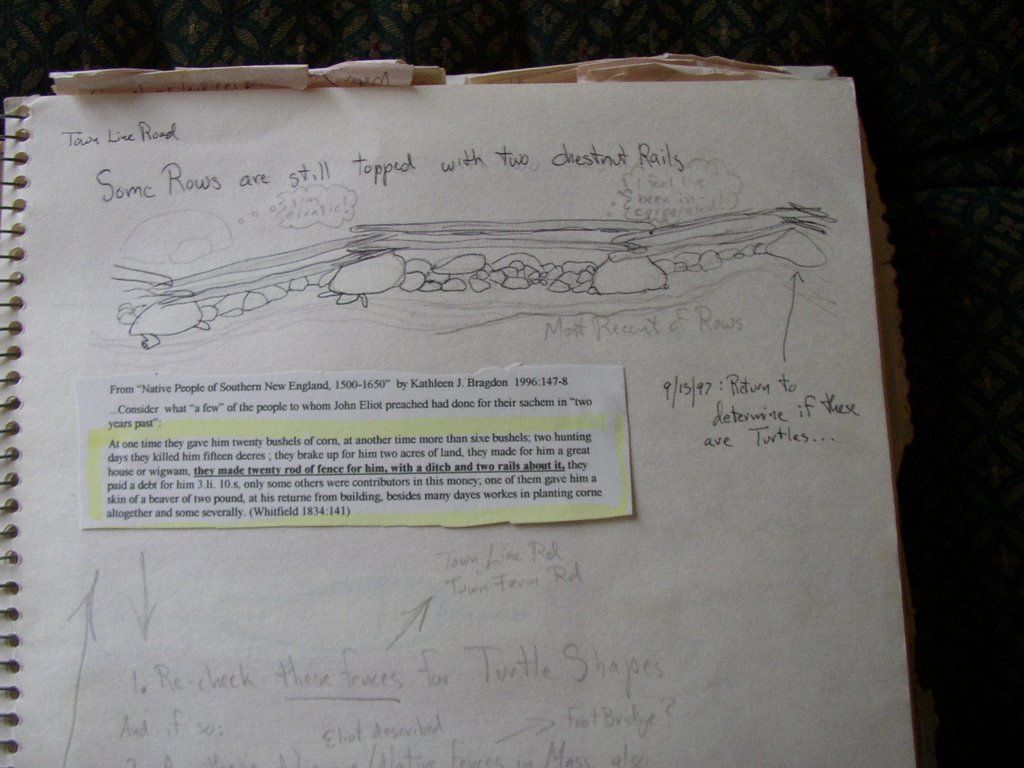
Every once in a while I find a wooden rail or two on top of a stone row. I assume they are chestnut rails because they lasted so long, but they could be any of the more popular commonly used and easy to split woods but they just look so much like chestnut to me, an old antique restorer-guy who was always being asked to identify wood.


I posted up a “soon come” photo – a photo of a notebook page – and wrote that I wrote down the wrong name of the road in the sketchbook. Well, I didn’t; there is another of the multiple “town line roads” surrounding me in four or five different places (including even an “old town line” road or two) that have some zigzag stone rows with rails on top of them.
And the stones are testudinate – shapes reminiscent of turtles – and I’m sure it was easier to leave the stones in place and then turn a trail into a road that used to go to an artist’s colony way back in history and then turn back into a wood road that eventually reverts to a tractor road that eventually turns into a trail that now opened back up as an ATV and dirt-bike race track (they never drive slowly, do they?) that eventually someone will get seriously hurt or killed on.
And there’s hammer stones and shaft abraders and those stones with the depressions worked into them to crack nuts just sitting there on the rows, along with old bottles, cans, tail pipes, tires, snuff and kerosene cans as well as spent shot gun shells etc.

One of the other places with rails on zigzags is across the road from my cousin’s former house – before she moved to the house where, out by the entrance of her driveway, there used to be Pomperaug’s Memory Pile - that I think I posted a woodcut of, either here or at Rock Piles.

This particular zigzag row remnant, like the zigzag row remnant that is along the road by my house, is disturbed at its southern end by the old poor house or work farm of the late 1700’s, where all kinds of linear and rectangular and definitely colonial sorts of stone work abound.


There's a swamp back there now, so I'm guessing the stone row protected that resource zone from burning (and vice versa, if you wanted to burn over the swamp).


Or it was a colonial "animal containment fence" for some really short legged creatures like cows or sheep from getting into the swamp - or perhaps for keeping frogs inside the swamp - because we all know Indians lacked the ability to use stone.

Sometimes the "difficult to capture (in photos) zigzag rows" aren't difficult to capture under certain conditions and here's one that didn't get away...


Some details:


4/9/2020 Edit - adding Eye and Horns to the Snake Head Stone:


Resting on the big point stone is a (possible) smaller, hand-sized, 
  hammer
stone-like 
cobble 
with a distinct depression on the bottom that suggests a "nutting stone" theme happening here...

Friday, January 12, 2007

Bad Scanner day

My scanner acts up every once in a while.
It's frustrating.
So how about this:


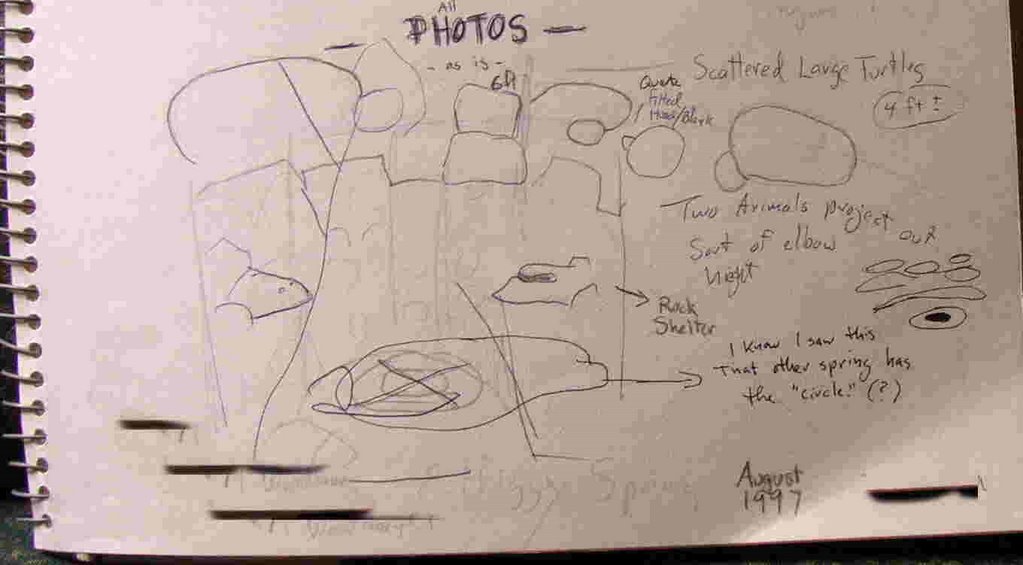
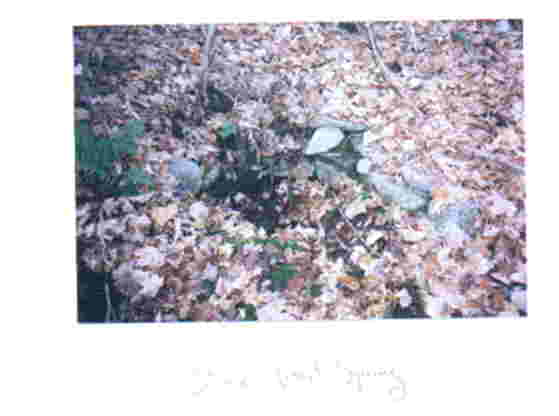
Here's some stone worked spring things:


I did actually date the Spring dicovery as sometime in August 1997...

... the hillside above this spring is all terraces with stone rows on top of them, springs and outcrops linked by mostly linear - as opposed to zigzag- stone rows, which I mention because the Rock Piles post of yesterday asks, "Where else are similar rows (Etc)."


Here's a much more simple spring near "The Wigwams."


I think I once sent Norman or Peter (or both) a copy of this photo because he had photographed a similar one. Maybe I didn't because the scanner was acting up...


Here's a "Soon Come" future post I'll put up. Seems I wrote myself a note in Sept. 1997 to go back and check out a place (that I wrote down the wrong name of the road). Almost 10 years later I took some photos...